
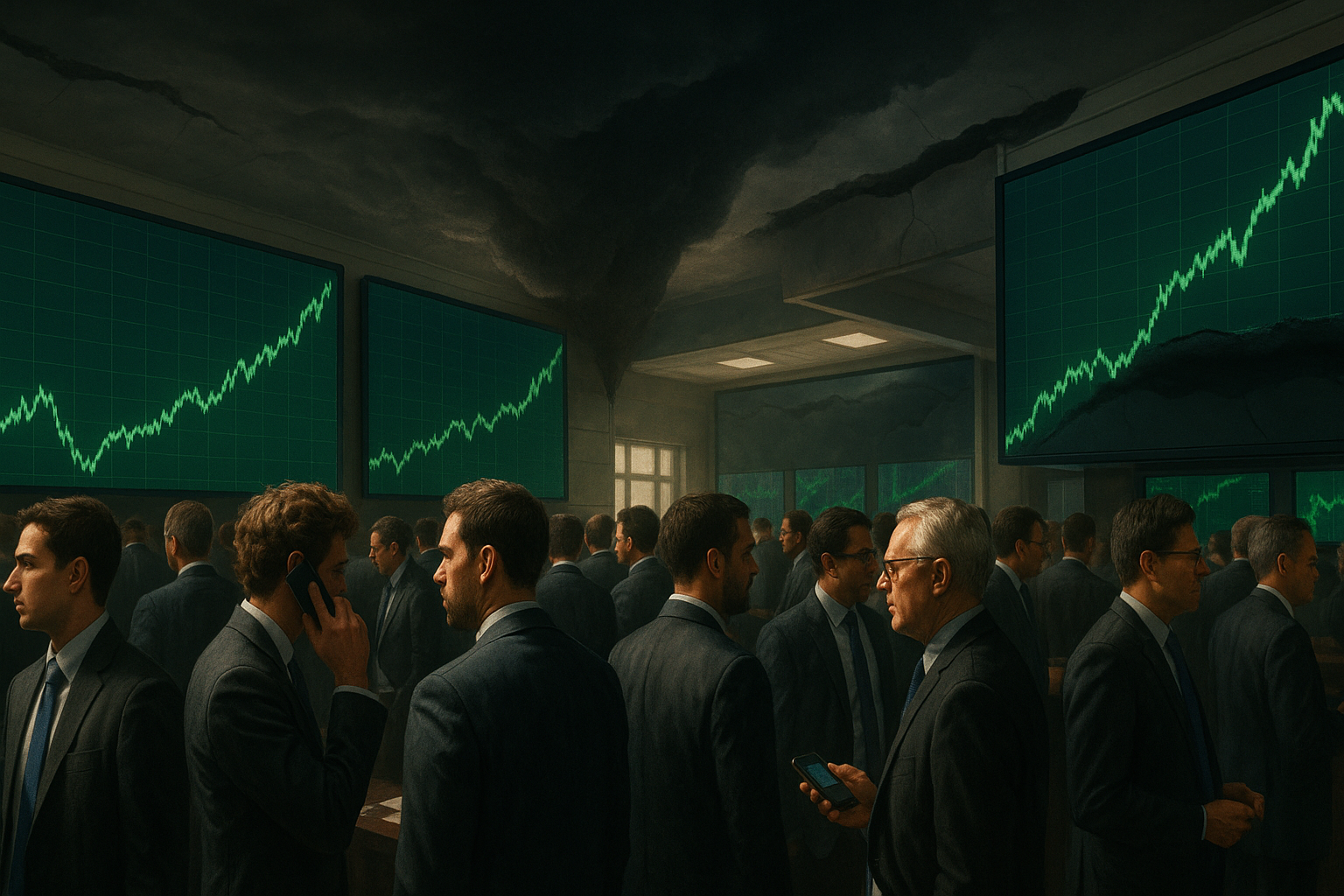
The S&P 500 hit another record high yesterday, while JPMorgan's latest market outlook describes investor sentiment as "cautiously optimistic." Meanwhile, the Fed is signaling rate cuts on the horizon, and the financial press is full of reassurances that the next recession has been indefinitely postponed. Everyone's feeling pretty good, which is precisely when I start to worry.
I've spent more than my share of time on trading floors—enough to develop both respect and skepticism for the financial industry's predictive powers. The collective brainpower of Wall Street is undeniably impressive. Some genuinely brilliant minds work there. Yet somehow, as an industry, they've managed to miss every significant market crash with remarkable consistency. Not just occasionally missing the mark—I'm talking about a perfect record of failure.
Remember 1987? The dot-com implosion? How about 2008 or the pandemic plunge? Each arrived to collective shock and surprise from the very people paid millions to see these things coming.
This isn't simply about hindsight making us all geniuses. There's something more fundamental at work—a structural blind spot that's hardwired into the financial system itself.
Why Smart People Miss Big Crashes
Having covered market cycles for years, I've identified at least four interlocking reasons why Wall Street consistently fails to spot major disasters before they happen:
First, follow the money. If you're an analyst at Goldman or Morgan Stanley, you're not compensated for being the lonely voice warning that everything might collapse. Your bonus depends on finding opportunities within whatever paradigm currently rules. The perennial bull collects fat checks for years; the cautious bear gets shown the door long before vindication arrives.
Second—and this is crucial—there's career risk. Imagine yourself as a fund manager back in 2006. You suspect housing is a house of cards (sorry, couldn't resist). What happens if you act on that conviction too early? You underperform for quarters or even years. Clients flee. Your boss questions your judgment. As Keynes noted, "The market can remain irrational longer than you can remain solvent." Or employed.
Look at Michael Burry. Right about 2008, made a fortune... then spent years underperforming while warning about various impending disasters that refused to materialize on schedule. Being early feels exactly like being wrong—until suddenly it doesn't.
Third, there's what economists call a collective action problem. Even if you see disaster looming, what exactly can you do about it? One bank can't single-handedly deleverage the entire financial system. If CitiGroup starts selling off risky assets while everyone else keeps partying, Citi just loses market share and executive jobs. Nobody wants to be the first to leave the dance floor.
Finally, there's normality bias. Despite all their mathematical sophistication, finance professionals struggle to imagine genuine breaks from established patterns. Their stress tests reflect what's happened before, not what might happen next. When a risk officer says they've prepared for a "once-in-a-century" event, they mean they've modeled something like 2008—not whatever fresh hell awaits us.
The Market Efficiency Trap
Here's the real kicker—these blindspots aren't glitches in the system. They're features.
The more efficiently markets process information, the more they create conditions for their own eventual collapse. How? In truly efficient markets, small advantages get arbitraged away instantly. This leaves only two paths to outperformance: take on more leverage or venture into obscure, complex instruments where risk hides beneath layers of mathematical abstraction.
This naturally pushes the entire system toward greater complexity and higher leverage over time... which happens to be the perfect recipe for catastrophic failure.
There's a psychological dimension too. Markets aren't mathematical abstractions—they're made of people (yes, even algorithms are written by humans with human biases). And we humans have limited imagination. We're wired to extrapolate from recent experience, not anticipate phase transitions.
When was the last time you saw a Wall Street forecast that wasn't essentially "next year will be like this year, plus or minus a few percent"? Almost never, right?
The uncomfortable truth is that financial crashes aren't just bigger versions of normal down days. They represent fundamental changes in how the system operates—phase transitions where yesterday's rules suddenly don't apply. It's like trying to predict an earthquake by measuring normal ground movement. The metrics look fine until they catastrophically don't.
Regulators: Always Fighting Yesterday's War
You might think regulators would save us from ourselves, but... not so much. I've sat through enough regulatory meetings to know they face their own version of the same problem.
Regulators are perpetually fighting the last war, crafting rules to prevent whatever caused the previous crisis while risk silently migrates to wherever the new blind spots are. Remember how Dodd-Frank was supposed to end "too big to fail"? Today's banks are even bigger than before 2008.
There's also enormous pressure on regulators not to "disrupt markets" or "create uncertainty." The result? A tendency toward regulatory forbearance—looking the other way when problems first appear, hoping they'll magically resolve themselves. By the time the problem becomes undeniable, it's usually too late for gentle solutions.
I witnessed this firsthand during my stint covering banking regulation. Those closed-door sessions were something else—everyone in the room would acknowledge growing imbalances in certain markets, but addressing them meant painful adjustments nobody wanted to initiate. So we'd all nod soberly about "monitoring the situation" and "enhanced reporting requirements"—bureaucratic speak for kicking that can straight down Pennsylvania Avenue.
So What's Next?
Does all this doom-saying mean another crash is imminent? Not necessarily. Bubbles can persist for years, sometimes decades. The timing of crashes is essentially unpredictable—that's kind of my whole point.
What it does mean is that we should be profoundly skeptical whenever the financial industry collectively assures us that major risks are contained. The system is designed—intentionally or not—to miss the big ones until they're already happening.
For individual investors, this suggests maintaining healthy skepticism about market forecasts (including mine!) and building some resilience into your financial planning. The next crisis won't look like the last one, and it will almost certainly arrive when most of Wall Street is confidently assuring you that everything's just fine.
The most dangerous words in finance aren't "this time it's different." They're "everything seems under control."


