
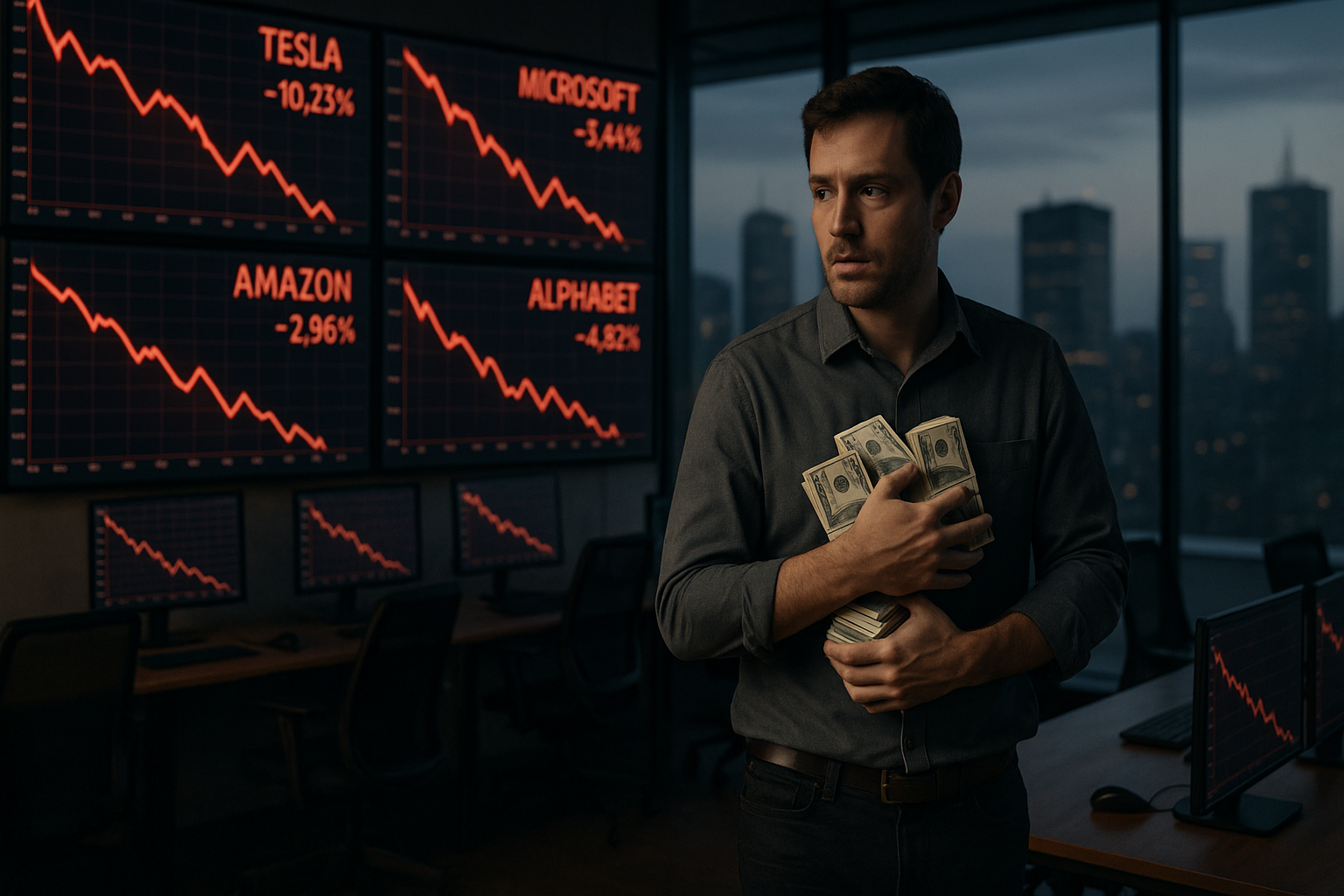
The financial markets have always operated on a peculiar blend of data and emotion. Just yesterday, I noticed a post from a retail investor who completely liquidated their tech portfolio amid what many are calling the early stages of a "Santa Rally."
This type of capitulation is fascinating because it highlights the eternal tension between FOMO and fear—that psychological tug-of-war that probably existed since the first Mesopotamian grain futures were traded by torchlight.
Look, there's something intellectually honest about this investor's position. While professional asset managers are busy crafting elaborate year-end narratives to justify their allocations (and their fees, let's be honest), here's someone essentially saying: "This doesn't smell right, and I'm out."
The parallels they draw to the dot-com bubble aren't entirely misplaced. Today's market has similar characteristics—tech dominance, speculative valuations, and a strangely detached relationship with traditional fundamentals.
I've covered market psychology for nearly a decade, and I keep seeing the same patterns. The investor mentions AI capex spending with "zero ROI besides some chatbots," which is precisely the kind of observation that would have seemed heretical during the Web 1.0 boom when any company with a ".com" suffix was apparently worth its weight in gold-plated servers.
A model I often use when thinking about market psychology is what I call the "Music Chair Economy." Most sophisticated investors know they're participating in something resembling a game of musical chairs. The music will eventually stop, but the returns while it plays? Too compelling to ignore.
The trick becomes positioning yourself close enough to a chair that when JPow finally takes away the punch bowl (and he will, folks), you're not left standing with your portfolio pants down.
Our retail friend has decided to grab a metaphorical chair early.
The interesting question isn't whether they're right or wrong—nobody rings a bell at market tops—but what percentage of sophisticated investors secretly harbor the same concerns while publicly maintaining bullish postures? I've had drinks with enough fund managers to know the private conversation often contradicts the public newsletter.
There's something else worth noting here: the reference to not wanting to "hold the bag at all time highs." This reflects an increasing awareness among retail investors about institutional dynamics. The sophisticated players have always understood that markets often represent a complex game of hot potato, where the goal isn't just to make money but to avoid being the last one holding the asset when sentiment shifts.
Wait—I'm getting sidetracked. Let me get back to timing.
The timing component is particularly interesting. Our investor mentions 2026 as the potential pop date, which suggests they're thinking in terms of presidential cycles—another framework that's traditionally been the domain of institutional investors but has increasingly filtered into retail consciousness. Democracy and markets, always tangled up.
Is our retail friend making a brilliant move or committing the cardinal sin of market timing? The truth is that successful investing often has less to do with being precisely right and more to do with managing your own psychological comfort. If sitting in cash helps this person sleep at night during a period of market exuberance, that has real value—regardless of whether the S&P climbs another 5% or drops 15%.
The most sophisticated investors I know aren't necessarily the ones who maximize every basis point of return; they're the ones who understand their own psychological limitations and invest accordingly. Sometimes the most profitable move is the one that keeps you in the game for the long term.
Anyway, I'm not sure if our retail investor will be vindicated or kicking themselves in six months. But I do know that markets have a peculiar habit of making both bulls and bears look foolish in the short term, while eventually proving both partially right in the long term... which is why the financial markets remain the greatest psychological experiment ever conducted—with real money as the stakes.


