
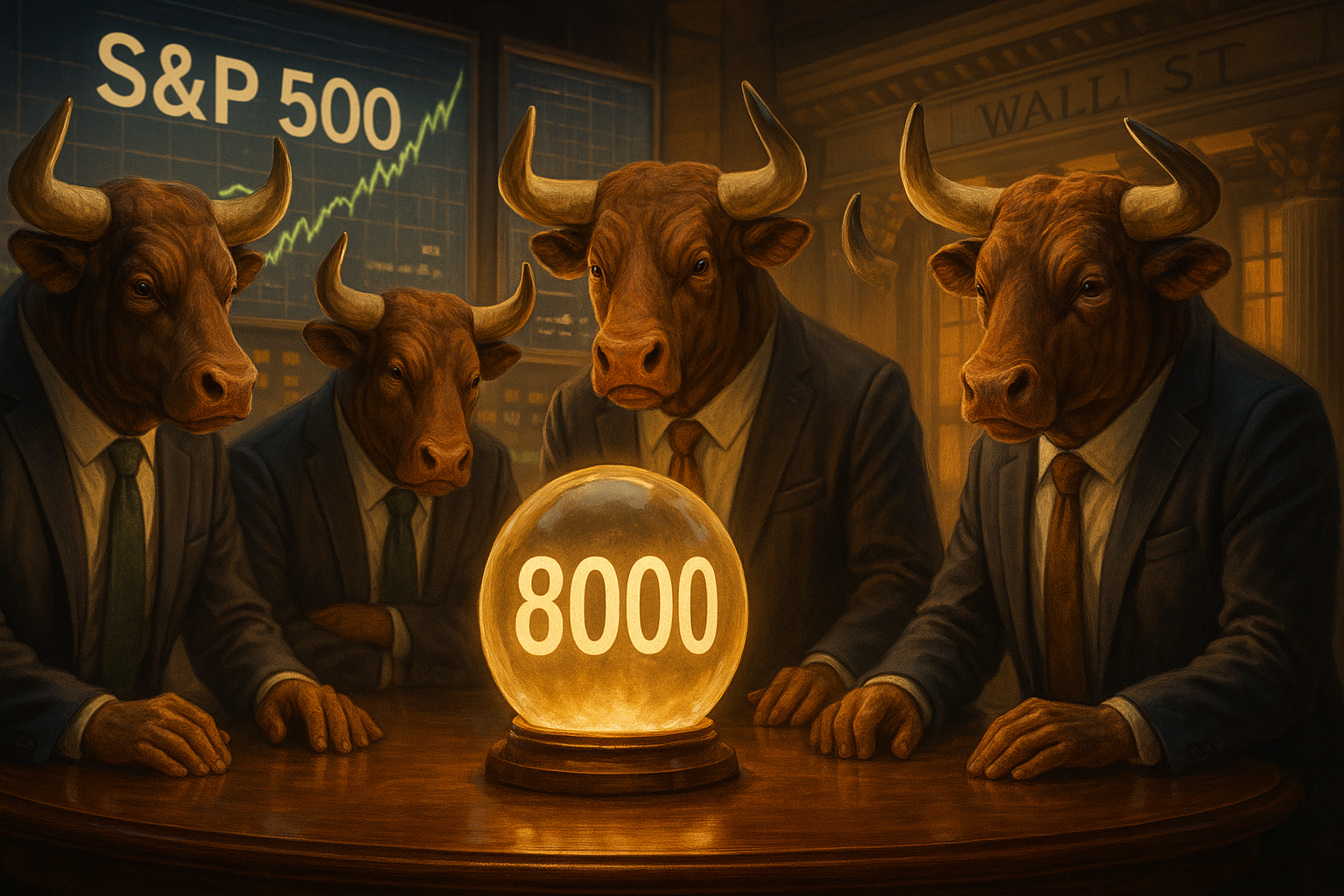
So Deutsche Bank thinks the S&P 500 will hit 8,000 by the end of 2026. JPMorgan agrees. Morgan Stanley and Wells Fargo are slightly more conservative at 7,800. I find myself wondering: Have we entered the "take my price target and add 500 points" phase of market prognostication?
Look, I've spent enough time on Wall Street to know that long-term price targets are part science, part showmanship, and part corporate branding exercise. They're the financial equivalent of weather forecasts for three years from now – technically based on models, but perhaps best taken with several tablespoons of salt.
What's interesting isn't the specific numbers (though I'll get to those), but the near-uniformity of the bullish chorus. When Deutsche Bank, JPMorgan, Morgan Stanley, Wells Fargo, and HSBC all start humming variations of the same optimistic tune, it's worth asking what melody they're following.
The "New Bull Market" Thesis
Morgan Stanley's strategists are calling for a "New Bull Market," which sounds suspiciously like the kind of phrase that gets workshopped through multiple marketing meetings. But behind the branding, there's a substantive argument: earnings strength continues, policy remains supportive, and – this part they don't say explicitly – fear of missing out becomes a self-reinforcing cycle.
The consensus view among these forecasts rests on two primary pillars:
- The AI investment supercycle continues unabated, driving earnings growth across tech and adjacent sectors
- Monetary policy remains accommodative enough not to crash the party
JPMorgan expects two more rate cuts before the Fed pauses. The CME FedWatch Tool shows an 84.9% probability of another 25 basis point cut at the December meeting. This creates the Goldilocks narrative – enough easing to support growth, not so much that inflation roars back.
There's a certain convenient circularity to this thesis. AI spending drives growth, which supports valuations, which funds more AI spending. It's either a virtuous circle or a feedback loop, depending on your perspective and time horizon.
The "This Time It's Different" Tension
Wells Fargo's commentary acknowledges the elephant in the room – this AI-driven bull market bears uncomfortable similarities to previous tech bubbles. But they offer the reassurance that "policy and liquidity should provide support" through the election cycle.
I'm reminded of the old Wall Street adage: "The market can remain irrational longer than you can remain solvent." Updated for 2024, perhaps it's "Markets can remain elevated longer than bearish strategists can keep their jobs."
The tension here is palpable. These forecasts implicitly acknowledge that valuations are stretched by historical standards, yet argue they'll become more stretched. The justification is essentially: "Yes, but..." followed by explanations about AI's transformative potential, favorable policy backdrops, and the increasingly symbiotic relationship between big tech and the broader economy.
There's a model that I often use when thinking about consensus forecasts: they're rarely designed to be correct so much as to be defensible. An S&P at 8,000 by 2026 represents roughly 13% compound annual growth from current levels – ambitious but not outlandish. If markets surge beyond that, clients won't complain about conservative targets. If markets falter, well, "unforeseen circumstances" can always be cited.
The Short-Term Signals
Tom Lee at BMNR offers a more immediate target – 7,000 to 7,500 by the end of 2025. This bridges the gap between today's market and those lofty 2026 targets, suggesting a relatively smooth ascent rather than a dramatic late-stage surge.
The fascinating thing about these forecasts is how they navigate between two competing narratives: "Markets are rationally pricing in AI's transformative potential" versus "We're in a liquidity-fueled momentum market divorced from fundamentals."
Most strategists are splitting the difference – acknowledging froth while arguing that underlying technological shifts provide justification for continued optimism. It's a nuanced position that essentially says, "This might look like a bubble, but it's a bubble wrapped around a genuine revolution."
The Underexplored Risk Factors
What's notably absent from most of these forecasts is serious consideration of the tail risks. What if AI investments don't deliver the productivity gains promised? What if geopolitical tensions escalate beyond current expectations? What if inflation proves stickier than anticipated, forcing the Fed to reverse course?
The asymmetry of incentives in forecast-making means that exploring downside scenarios in depth rarely benefits institutional strategists. It's safer to acknowledge them briefly before returning to the consensus narrative.
I mean, I get it. No one wants to be the analyst who missed the AI revolution. But the uniformity of these bullish forecasts should itself be a data point worth considering. When everyone sees the same future, the future has a mischievous tendency to deliver something else entirely.
Then again, as the saying goes, "The consensus is often wrong, but the consensus about the consensus being wrong is also often wrong." Maybe this time, the obvious call is the right one.
I guess we'll know in 2026. Until then, I'll be watching the earnings reports to see if they can possibly justify these ambitious targets. The bull case requires not just good news, but an extended series of better-than-expected news. That's a high bar – even for AI.


