
Tax season. It's that time when investors start their annual ritual of trying to minimize what they owe Uncle Sam while staying on the right side of those maddeningly complex IRS rules.
I've been covering tax strategies for years now, and if there's one thing I've learned, it's that the line between clever tax planning and wishful thinking is thinner than most folks realize.
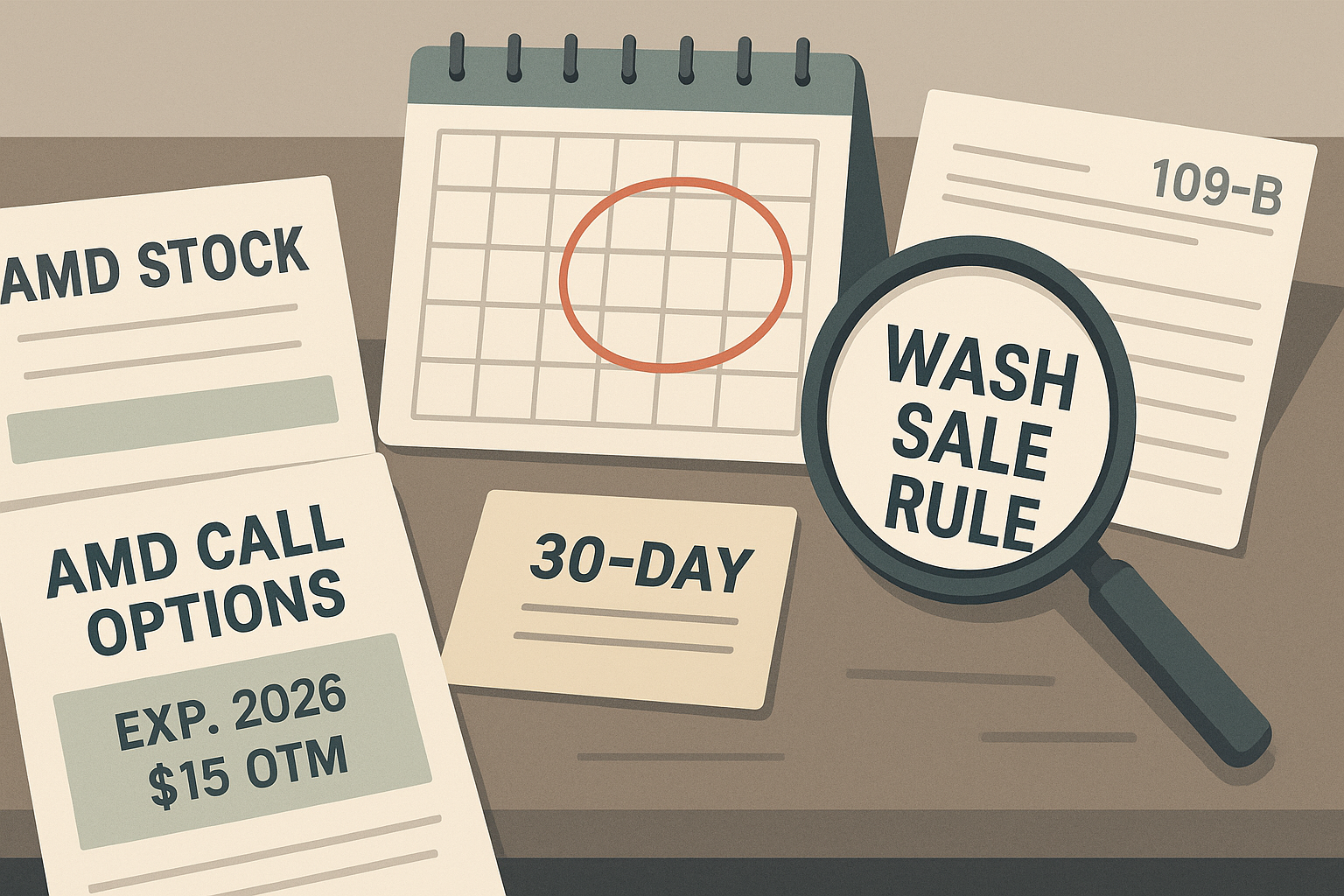
Take this AMD investor's dilemma. They've sold shares at a loss (been there, done that) but still believe in AMD's future. So they've replaced those shares with deep out-of-the-money call options expiring in 2026. Classic tax-loss harvesting play—or so they thought.
The problem? Their broker basically gave them the financial equivalent of a shrug emoji. "That's between you and the IRS, pal." Not exactly reassuring.
The Wash Sale Rule: Clear as Mud
Look, the wash sale rule seems simple enough on paper. Sell something at a loss, buy something "substantially identical" within 30 days before or after, and poof—your tax deduction vanishes like my motivation to exercise in December.
But what counts as "substantially identical"? That's where things get... interesting.
The relevant IRS guidance was written back when options trading was something exotic that only happened on the floor of the Chicago Board of Trade—not something any college kid with a smartphone could do between classes.
Some situations are obvious. Selling Apple and buying Microsoft? Not a wash sale. Selling Apple and buying Apple again two weeks later? Definitely a wash sale (and honestly, what were you thinking?).
But selling Apple stock and buying Apple call options? Now we're in that murky territory where tax advisors start hedging their language and using phrases like "it depends" and "the preponderance of evidence suggests..."
Options: Different Beast or Same Animal in Disguise?
The investor's strategy here raises some genuinely interesting questions. They've bought calls that expire in 2026 (nearly three years out) and they're out-of-the-money by about $15.
I spoke with several tax professionals who pointed out the fundamental differences between stocks and options. Options have leverage, time decay, and can expire completely worthless—all characteristics that regular stocks don't have.
"An option is a fundamentally different security," one CPA told me. "It's a derivative contract, not an ownership stake."
But (and there's always a but in tax matters), the IRS tends to look at substance over form. And the substance here is pretty clear: this investor is trying to maintain economic exposure to AMD while harvesting a tax loss.
Publication 550—not exactly beach reading material, I know—suggests that acquiring an option to buy substantially identical stock can indeed trigger the wash sale rule. So there's that.
When Your Broker Says "Not My Problem"
The broker's non-committal response actually tells us something important. Brokers are required to track and report wash sales for identical securities on your 1099-B. But when it comes to options and the underlying stock? That gets more complicated.
This creates a weird situation where your tax forms might not flag a wash sale, but that doesn't mean the IRS would agree if they decided to take a closer look at your returns. (And isn't that a comforting thought?)
Having covered tax controversies since the early 2010s, I've seen this movie before. It rarely ends with the IRS saying, "You know what? That was a really creative interpretation of our rules. Good job!"
So What's an Investor to Do?
If you're facing this AMD situation—or something similar—you've basically got three paths forward:
Take the aggressive position. Claim the loss, argue that deep OTM calls aren't "substantially identical" to stock, and keep good documentation. Just be prepared to defend this if questioned.
Play it safe. Assume it's a wash sale, which means you can't take the loss now, but the disallowed loss gets added to the cost basis of your calls.
Pay for professional guidance. Get a qualified tax pro's opinion in writing—preferably someone who'll stand by you if the IRS comes knocking.
The safest approach? You probably should've waited 31 days after selling before buying those options. Or maybe invested in a different semiconductor company or an ETF during the wash sale period.
But hindsight is 20/20, isn't it?
Why Is This So Darn Complicated?
This situation highlights something that's always bugged me about our tax code. It's like a game where the rules were written for checkers, but we're all playing three-dimensional chess now.
The wash sale rule exists for a good reason—to prevent people from claiming paper losses while maintaining essentially the same investment position. Fair enough.
But as financial instruments have evolved, the application of these rules has become increasingly complex. And somehow, it's always the sophisticated investors who find the loopholes, while regular folks get caught in the technicalities.
I remember interviewing a tax attorney who put it this way: "The tax code is like a fence with holes. The bigger your legal team, the more holes you can find."
In the end, our AMD investor is caught in a genuine tax gray area—where reasonable professionals might give different advice, and there's no absolutely clear answer.
The broker passing the buck? Frustrating, but understandable. They're essentially saying, "This is a judgment call, and we're not making it for you."
But if there's one principle that's served me well in covering tax issues for over a decade, it's this: when in doubt, the IRS usually wins these arguments.
Plan accordingly.


