
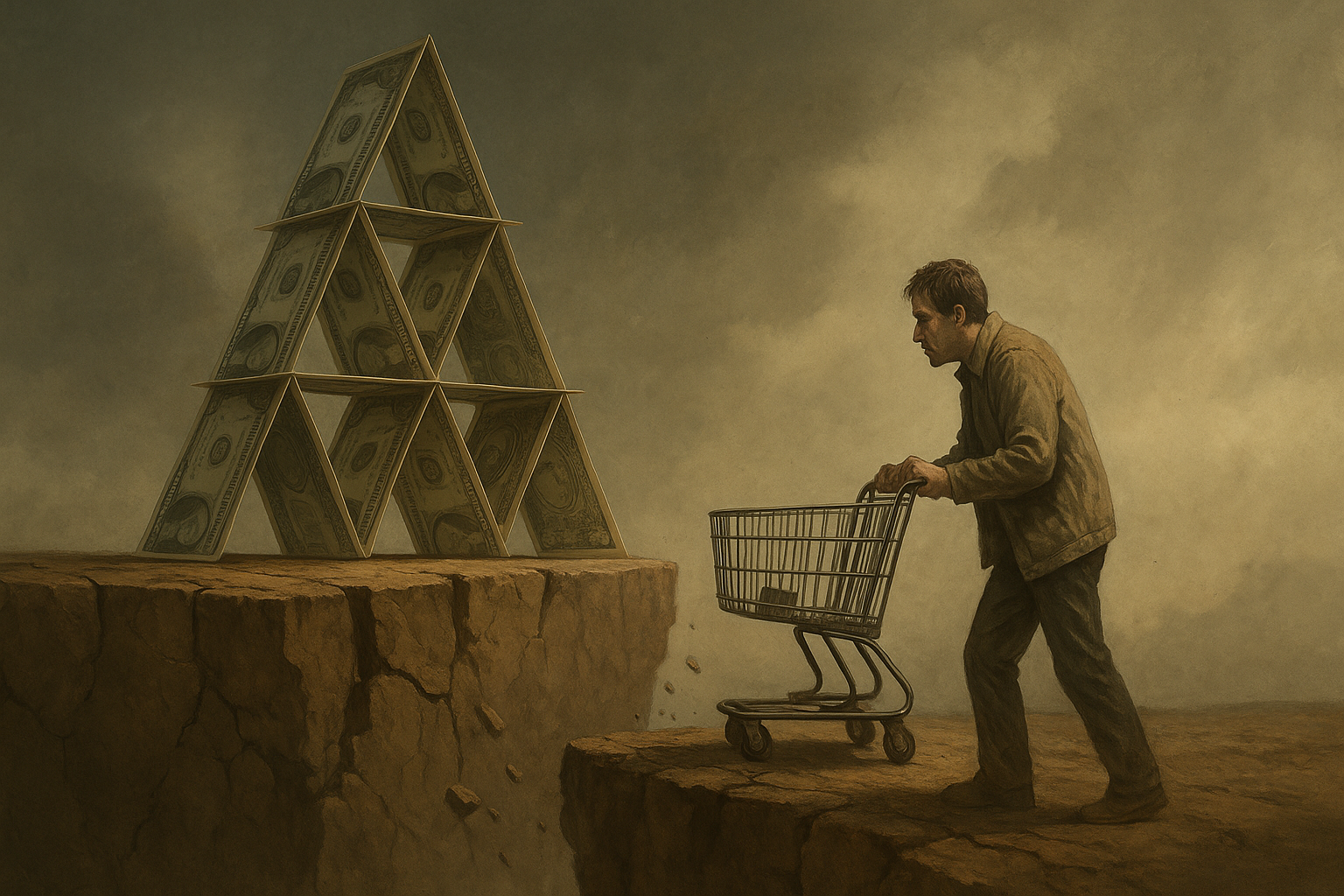
The economic warning bells are clanging—and they're getting harder to ignore.
Last week, Goldman Sachs dropped what should be a bombshell report showing corporate profit margins sitting at 70-year highs. Let that sink in. Not since the post-WWII economic boom have American companies been skimming this much cream off the top. Meanwhile, inflation keeps stubbornly hanging above the Fed's 2% target like an unwelcome party guest who won't take the hint.
But here's the real kicker: American consumers—the reliable workhorses of our economy—are burning through their pandemic savings at a pace that should terrify anyone paying attention.
I've covered economic cycles for years, and this particular combination of factors feels uniquely precarious. It's not just one crack in the foundation; it's several fault lines converging.
The math is brutally simple. Consumers have been heroically propping up this economy through what can only be described as financial acrobatics. Credit card balances? Record highs. Delinquencies? Climbing across the board. Housing costs? The average American now dumps about 37% of their income just to keep a roof over their head.
This isn't sustainable. It never was.
So what happens next? (And trust me, something always happens next.)
First comes the savings exhaustion—a process already well underway. Those stimulus checks and pandemic-era savings that gave households breathing room? Nearly gone. The data doesn't lie.
Then corporations face their moment of truth. They've grown fat and happy on those juicy margins Goldman identified. When consumer demand inevitably softens—and it will—these companies face a brutal Sophie's choice: slash prices and watch those beautiful margins evaporate, or maintain pricing and watch sales volumes cliff-dive. Neither scenario makes for a pleasant quarterly earnings call.
"The disconnect between corporate profitability and consumer health hasn't been this pronounced since the 1970s," a senior economist at a major investment bank told me last week. "Something's gotta give."
And let's talk about commercial real estate, shall we? It's the elephant in the room everyone's trying desperately to ignore. Office vacancies in major metros hovering around 20%? Regional banks sitting on billions—with a B—in unrealized losses? We're all playing a collective game of "don't look down" because acknowledging the problem means recognizing the pain.
The Fed, meanwhile, is trapped in a prison of its own making. They've jacked rates up aggressively to tame inflation, but now they're stuck. Cut rates too quickly to rescue a faltering economy and risk another inflationary spike. Keep rates high and watch consumer spending—already on the ropes—take a knockout blow.
Jerome Powell's dream of a "soft landing" is looking more like fantasy than forecast.
Then there's government debt. Good lord, the government debt. We're running trillion-dollar deficits during what's supposedly a strong economy! What happens when tax revenues inevitably plummet during a recession? The debt service alone is becoming a structural albatross.
Look, I'm not typically one for economic doomsaying. Markets are resilient, innovation happens, people adapt. But there comes a point when financial engineering can't paper over fundamental imbalances anymore.
The real danger isn't some dramatic 2008-style crash. It's worse, actually—a grinding, slow-motion crisis where each sector weakens the others in a vicious cycle. Consumers pull back, corporations slash jobs to protect margins, which further weakens consumers... You see where this is going.
A CEO I spoke with recently (off the record, naturally) put it this way: "We're watching our customer metrics very carefully. The minute we see sustained weakness, we have contingency plans ready. And those plans, unfortunately, start with headcount."
Translation: The jobs axe is already sharpened.
The conventional wisdom says American innovation and dynamism will save us again. Maybe. I hope so! But hope isn't a strategy, and the math is getting harder to ignore.
The last time corporate profits were this disconnected from wages, disco was still popular and Star Wars was a brand-new film franchise. These imbalances have a way of correcting themselves, whether we like it or not.
The question isn't if, but when—and how badly.


