
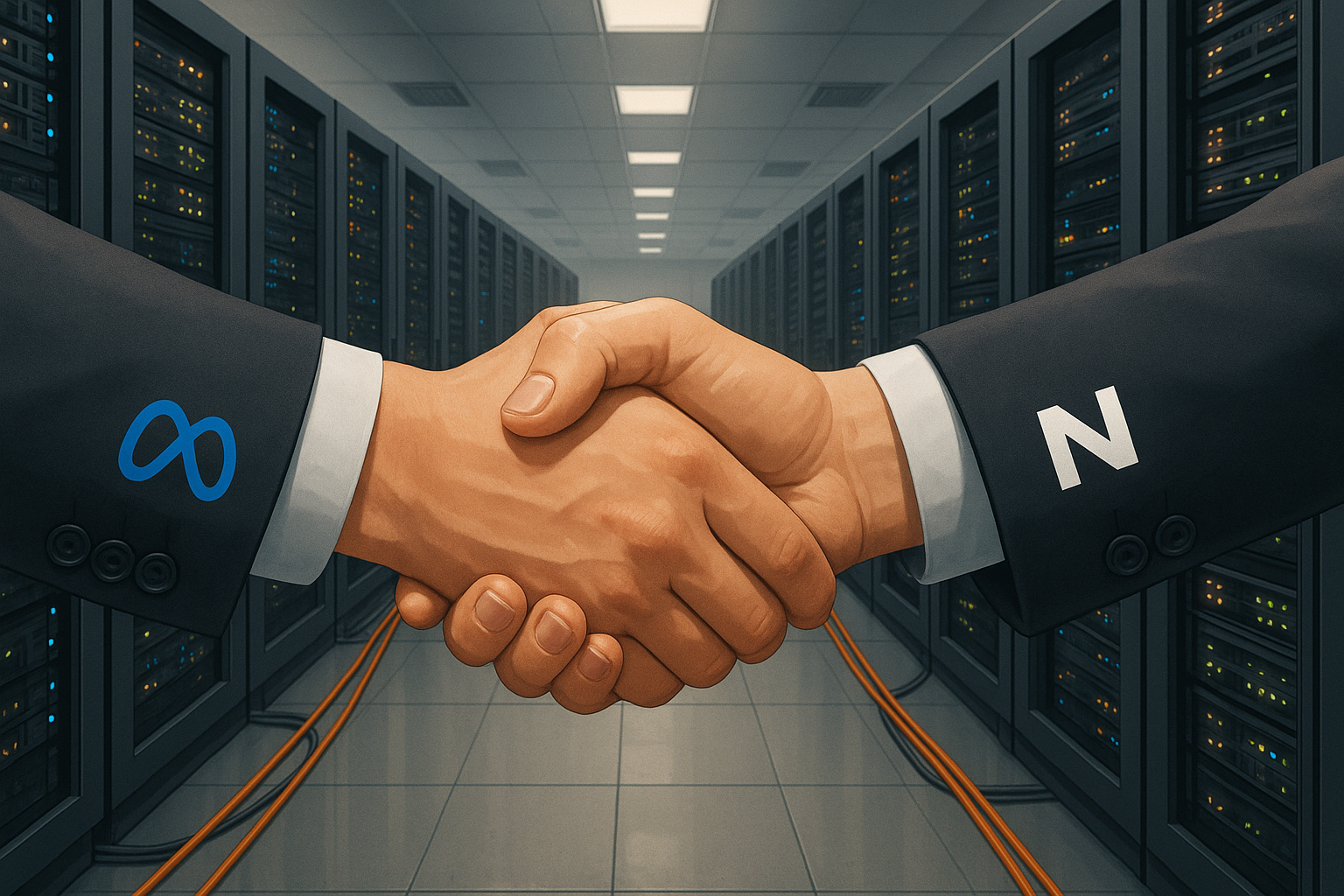
In the crowded, cutthroat world of cloud computing, a company you've probably never heard of just scored a massive win. Nebius—yes, Nebius—signed a $3 billion deal with Meta to provide AI infrastructure over the next five years.
Don't feel bad if you're drawing a blank on who they are. That's part of what makes this story so fascinating.
This relatively obscure AI cloud provider has somehow managed to quadruple its market cap this year to $27.6 billion while flying under most investors' radar. And the Meta contract isn't even their biggest get. Back in September, they landed a staggering $17.4 billion agreement with Microsoft.
Let's call this what it is: the AI infrastructure gold rush is in full swing. And Nebius is selling the digital equivalent of picks and shovels.
I've been tracking cloud infrastructure deals since before the current AI boom, and there's a pattern here that's impossible to miss. While everyone's obsessing over which company has the flashiest AI model, the firms providing the actual computational backbone are quietly building empires.
But here's where it gets interesting. Despite announcing a deal worth about 11% of its entire market cap, Nebius shares actually dropped 3% in early trading. Why? Well, their capital spending has skyrocketed and quarterly losses ballooned to over $100 million—more than double the $39.7 million they lost in the same period last year.
The market's message seems pretty clear: "Nice contract, now how about some profits?"
This tension sits at the heart of the AI infrastructure business. Building the capacity to handle advanced AI workloads requires massive upfront investments. Data centers. Specialized hardware. Cooling systems that would make your home AC unit look like a hand fan.
These companies are essentially betting big—really big—that the AI revolution has staying power. It's a classic "spend money to make money" scenario, but with unusually steep initial costs.
What fascinates me about Nebius specifically is how they represent this emerging second tier of cloud providers. While AWS, Azure, and Google Cloud still dominate the general cloud landscape, specialized players are carving out AI-specific niches.
(And doing a pretty good job of it, apparently.)
The fact that Meta chose Nebius rather than just expanding its relationship with one of the established cloud giants suggests there's real differentiation happening here. Maybe Nebius offers technical advantages. Maybe better pricing. Or maybe Meta just doesn't want all its eggs in the same cloud basket.
We've seen this pattern before. When mobile computing took off, when cloud first emerged—new paradigms create openings for specialized providers before inevitable consolidation. The million-dollar question (or in this case, billion-dollar question) is whether Nebius can build a defensible moat before that consolidation happens.
From an investor perspective, the math gets tricky. On one hand: $20 billion in contracted revenue ain't nothing. On the other: accelerating losses and the fact that building AI infrastructure, while expensive, isn't exactly a business with impenetrable barriers to entry.
When a stock quadruples while fundamentals deteriorate... well, let's just say it raises questions.
Then again, that pretty much describes the entire AI sector right now, doesn't it?
Look, the Nebius story perfectly captures the fundamental tension in today's AI investing landscape: figuring out which companies are making smart investments toward sustainable advantages versus those just burning cash to chase the hot new thing.
Time will tell which side of that line Nebius falls on. But they've certainly secured themselves a seat at the table—a $3 billion seat, to be precise.


