
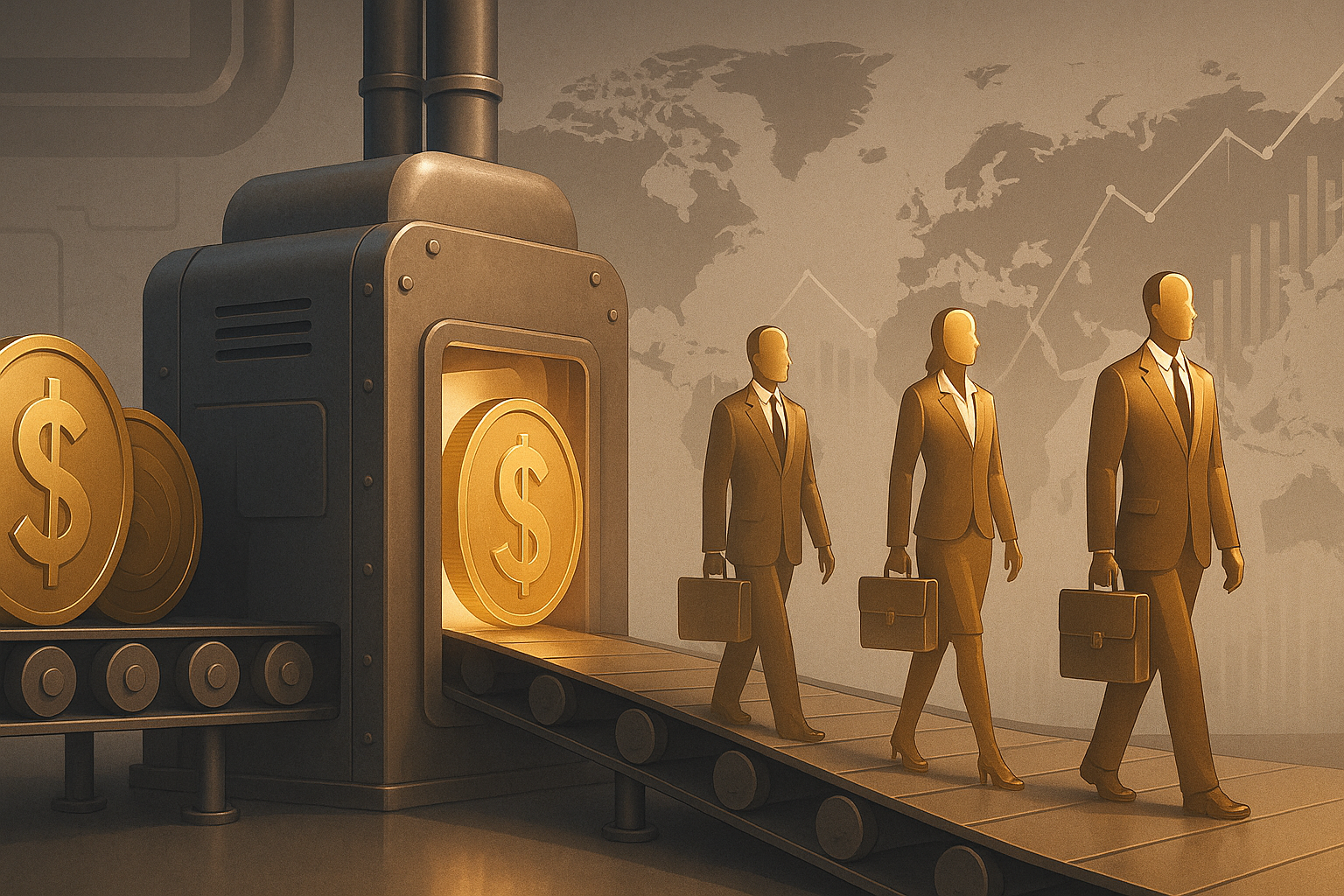
The billionaires just keep coming. And coming. And coming.
In what might be the least surprising news of 2023, the ultra-wealthy have gotten ultra-wealthier. UBS's latest Billionaire Ambitions Report shows we've added another 287 members to the world's most exclusive club, pushing the global billionaire count to a staggering 2,919 individuals.
Let that sink in for a moment. Nearly 3,000 people on this planet now control $15.8 trillion in combined wealth—up 13% from last year alone. That's roughly equivalent to China's entire GDP, or if you prefer a different comparison, the combined economic output of Japan, Germany, and the UK stacked together like some obscene financial sandwich.
I've been tracking wealth concentration trends since 2018, and even I'm a bit stunned by the acceleration. This year's crop marks the second-highest number of new billionaires UBS has ever recorded, trailing only the bizarre pandemic-fueled bonanza of 2021 (remember when everything made absolutely no sense?).
Not Just Tech Bros Anymore
What caught my attention this time wasn't just the numbers but the diversification. While covering previous wealth reports, I'd grown accustomed to the standard "tech founder hits jackpot" narrative. Not anymore.
This year's freshman billionaire class comes from a surprisingly eclectic mix: genetics, infrastructure, natural gas, restaurants—even some industries people actually understand without a Wikipedia deep dive.
Among the newcomers: Colossal co-founder Ben Lamm (who's working on de-extinction technology, which... wait, are we bringing back dinosaurs now?), Stonepeak CEO Michael Dorrell, and Venture Global founders Bob Pender and Mike Sabel, who apparently found the Midas touch in natural gas processing.
The billionaire taxonomy now breaks down to 2,059 "self-made" specimens and 860 inheritance cases. I'm using air quotes around "self-made" because, well, you know. Having a parent who knows a venture capitalist who knows a banker who... you get the picture. But that's an argument for another day.
The Wealth Acceleration Paradox
Here's what's truly baffling. In conversations with economists over the past two years, I keep hearing about sluggish growth, middle-class compression, and industry disruption. Yet somehow—somehow!—the very tippy-top of the financial pyramid experiences nothing but expansion.
It's like watching someone on a diet where only their left pinky finger gains weight.
The traditional wealth-building model suggested you needed to either create groundbreaking technology or control scarce natural resources. But today's billionaire factory operates differently. The financial infrastructure itself seems optimized for wealth concentration across almost any industry with significant cash flow.
Financial instruments that didn't exist twenty years ago now efficiently funnel capital upward with remarkable precision. Private equity, complex derivatives, tax optimization strategies—these aren't just tools anymore; they're industrial-scale wealth concentration machines.
Historical Perspective (Or Lack Thereof)
The last time wealth was this concentrated, people were still debating whether automobiles would replace horses as the primary transportation method.
Having studied several Gilded Age financial archives for a previous story on wealth inequality, the parallels are striking—and, frankly, a bit unsettling. The difference? Today's wealth creation happens at warp speed compared to the industrial revolution's plodding pace.
In 1900, becoming a billionaire (adjusting for inflation) typically required decades of industrial empire-building. Now it can happen through a single successful IPO or SPAC merger.
What This Means For, Well, Everyone
For markets, this trend suggests continuing bifurcation. Companies selling absurd luxury goods (anyone need a $500,000 watch that's less accurate than your phone?) should thrive alongside businesses catering to increasingly budget-conscious consumers.
It's the middle market—just like the middle class—that's getting squeezed into oblivion.
For policymakers, this presents the defining economic challenge of our era: how to maintain growth and innovation while ensuring benefits flow more broadly than to just 2,919 individuals. So far, nobody seems to have cracked that particular code.
And for the rest of us? I tried calling several new billionaires to ask if they're accepting applications for friendships, but strangely, none returned my calls. Their loss, clearly.
The wealth creation machine continues its relentless operation. Markets rise, valuations inflate, and billionaires multiply—just another year in our grand economic experiment, one that most of us never signed up for but can't seem to opt out of.
Look, I'm not saying we should get the pitchforks. I'm just saying maybe, just maybe, when 287 people join the billionaire ranks in a single year, we might want to ask some questions about how our economic system actually functions—and who it's really designed to benefit.


