
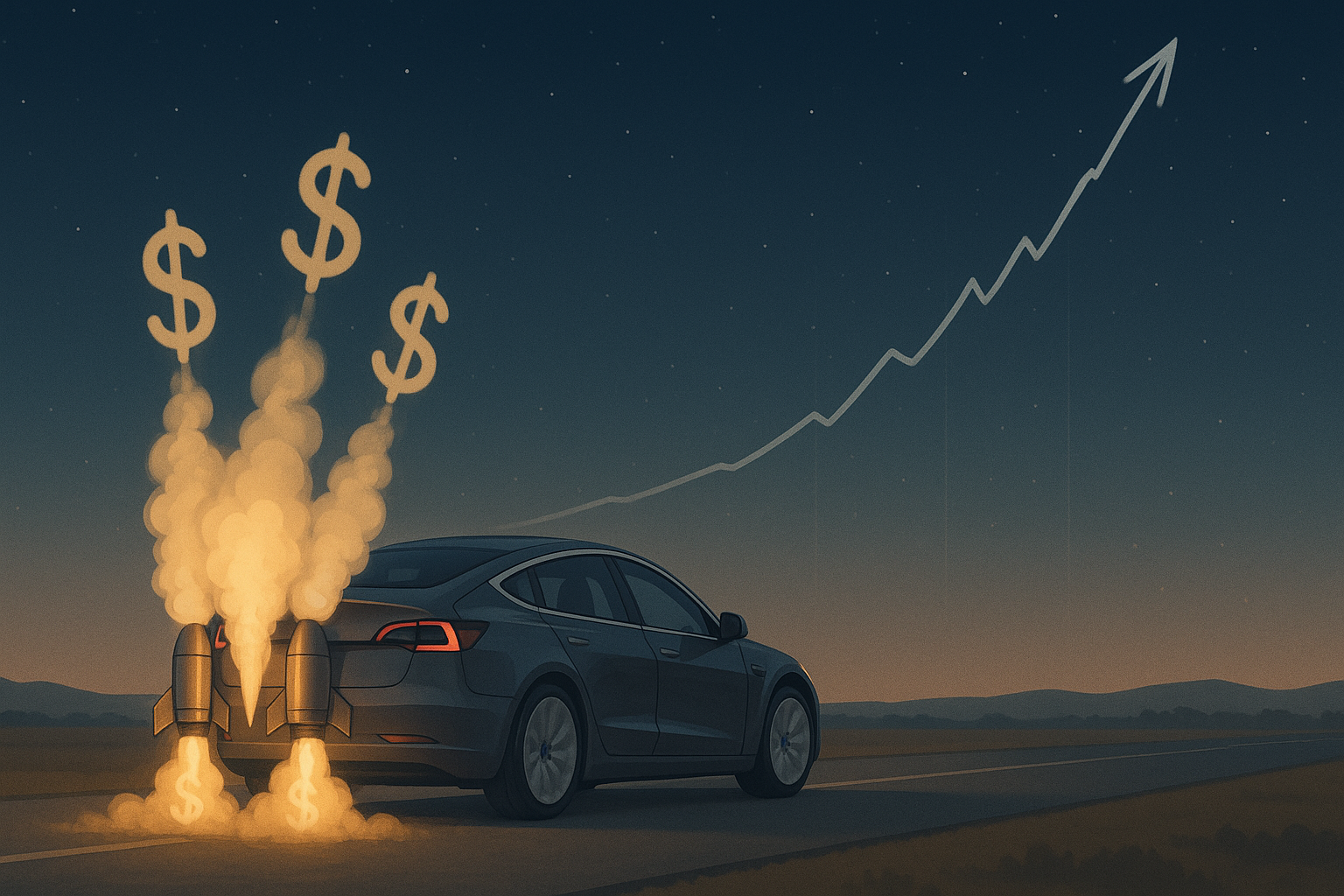
The stock market, as I've noted many times, isn't necessarily in the business of describing reality as it exists today. Rather, it's attempting to price the future—sometimes a very distant future that looks more like speculative fiction than financial analysis. Nowhere is this more evident than in the case of Tesla, whose market capitalization continues to hover in the stratosphere despite what appears to be an increasingly turbulent re-entry into the atmosphere of economic reality.
Auto sales across the industry are indeed slumping. The average American is now keeping their car for over 12 years, a record high. Interest rates have made financing new vehicles painfully expensive. And yet Tesla still commands a valuation that makes traditional automakers look like they're running lemonade stands by comparison.
So what gives?
I think there are three models that help explain Tesla's persistent valuation premium, none of which involve rocket ships (though we'll get to Musk's extracurricular activities in a moment).
First is what I call the "technology platform, not car company" thesis. Bulls argue that Tesla isn't really an automaker—it's a vertically integrated energy and AI company that happens to make its money selling vehicles. The full self-driving software, energy storage business, charging network, and the promised (if perpetually delayed) robotaxi service are all seen as potentially massive revenue streams that traditional automakers simply don't have.
The second model is the "first-mover advantage in a total industry transition" thesis. Here, investors are betting that the entire auto industry is undergoing a once-in-a-century transformation, and Tesla has such a head start in electric vehicle technology, manufacturing efficiency, and brand recognition that it will capture a disproportionate share of the market as it electrifies.
The third framework—and I think the most psychologically important—is what I'll call the "Musk premium." The market has repeatedly shown it will pay extra for businesses associated with Elon Musk, viewing him as a uniquely talented capital allocator and visionary. This is essentially a bet on the man, not the company.
Are these reasonable frameworks? Well, that's where things get interesting.
Look, the "tech platform" thesis has some merit. Tesla's software capabilities and vertical integration are genuinely impressive. But the growth in these adjacent businesses hasn't materialized at the scale or pace needed to justify the current valuation. The energy business remains a small fraction of revenues, and Full Self-Driving is still, well, not fully self-driving.
As for the industry transition thesis, EV adoption has undeniably slowed. Legacy automakers are pulling back on their ambitious electrification timelines. Tesla's growth rate has decelerated significantly. The revolution is happening more slowly than the most fervent evangelists predicted.
Which brings us to the Musk premium. This is where valuation becomes more religion than finance. Musk has certainly delivered remarkable results across multiple companies. But he's also increasingly distracted by Twitter/X, SpaceX, and his various other ventures and controversies. Tesla has gone years without a major new consumer product launch. The Cybertruck, while visually striking, is unlikely to be a volume product. The robotaxi remains vaporware.
There's something else at work here too: the power of narrative in a market awash with liquidity. Tesla became the quintessential story stock during the pandemic-era bull market—a vessel for hopes about a cleaner, more automated future. These narratives create their own reality for a time, as capital flows to the most compelling storytellers, enabling them to fund growth that might otherwise be impossible.
The thing about narrative-driven valuations, though, is they require continuous reinforcement. Miss enough promises or deadlines, and even the most patient investors eventually reassess. Tesla has been testing these limits.
I'm not predicting Tesla's imminent collapse—the company has genuine competitive advantages and a strong balance sheet. But markets eventually reconnect with fundamentals. The question isn't whether Tesla should trade at some multiple of Ford or GM, but whether its future cash flows—properly discounted for time and risk—justify its current price.
Maybe Tesla will prove the skeptics wrong again. Maybe the Optimus robot will revolutionize manufacturing. Maybe the Semi will transform logistics. Maybe Tesla will crack full autonomy while competitors flounder.
But that's a lot of maybes to pay for today.


