
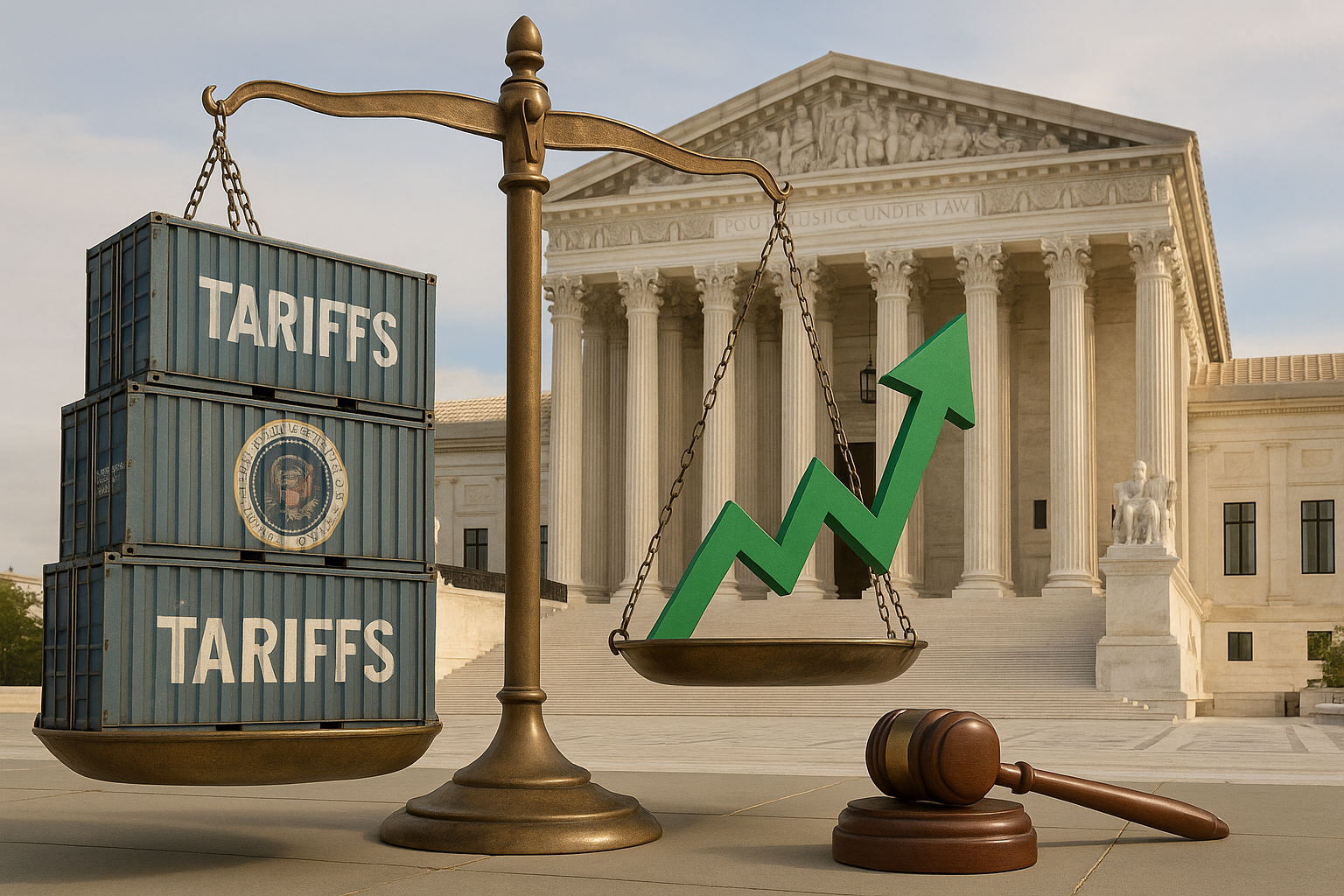
The Supreme Court seems to be eyeing presidential tariff powers with suspicion, and Wall Street is starting to pay attention. During recent arguments, justices from across the ideological spectrum questioned whether the executive branch has seized too much authority over trade policy—potentially setting up what could be a seismic shift in how America manages its economic borders.
Look, predicting Supreme Court decisions from oral arguments is about as reliable as forecasting next month's market moves based on a fortune cookie. But here's the thing: markets don't wait for certainty—they price in possibilities.
And the possibility that Trump's tariffs might be ruled unconstitutional? That's the kind of disruptive scenario that has smart investors quietly repositioning their portfolios.
"This could be liberation day for companies that have been struggling under tariff burdens," said one hedge fund manager I spoke with last week. "We're not betting the farm on it, but we're definitely setting aside capital to move quickly if the Court surprises everyone."
So who stands to win if presidential tariff authority gets clipped?
Auto manufacturers with complex global supply chains would breathe the biggest sigh of relief. Ford and GM have watched their margins compress for years as they've paid tariffs on everything from steel to microchips. Tesla sits in a uniquely awkward position—they'd benefit from cheaper inputs but might face fiercer competition from Chinese EVs. (Elon Musk probably has some colorful opinions about this particular conundrum.)
Best Buy and other electronics retailers have been walking a tightrope between absorbing tariff costs and passing them along to increasingly price-sensitive consumers. Having covered retail earnings calls for the past few years, I've noticed executives becoming increasingly blunt about tariff impacts—usually right after they've muted their quarterly guidance.
Then there's the semiconductor space. Good grief, has any industry been more whipsawed by trade politics? Companies like Nvidia and AMD operate in supply chains that zigzag across borders like a game of industrial hopscotch. Every border crossing creates tariff exposure. Remove those speedbumps, and their margins—already the envy of most industries—could expand even further.
The furniture industry got absolutely hammered by previous tariff rounds. Some products saw 25% levies slapped on overnight. RH (the company formerly known as Restoration Hardware) and Williams-Sonoma have adapted by shifting some sourcing, but their stock performance suggests investors remain wary.
Solar panel installers like Sunrun and SunPower deserve special mention. These companies have lived through what can only be described as regulatory whiplash, with installation costs bouncing around based on whatever tariff regime happens to be in fashion. A judicial limit on tariff authority might finally let them plan beyond the next administration.
But here's where it gets interesting...
The biggest winners might not be who you think. Consider retail giants Walmart and Target. They've muscled through tariff pressures by leveraging their scale with suppliers and carefully managing price increases. But their margins have still felt the pinch. If tariffs suddenly disappeared, these retail behemoths would see immediate benefit without having to change a single operational detail.
I've always thought about tariff exposure as a kind of hidden regulatory tax on corporate efficiency. It's a distortion—and markets generally don't like distortions.
What's particularly fascinating is how some companies have completely reconfigured their business models around tariff realities. Those are the ones with the most "potential energy" stored up—they're coiled springs waiting for release if the regulatory landscape suddenly shifts.
Of course, this whole discussion might be academic. The Supreme Court could uphold presidential tariff powers. They might craft some new limiting principle that threads the constitutional needle. Or they could toss the whole mess back to Congress (where it probably belongs anyway) and tell them to sort it out.
But... what if they don't? What if decades of presidential trade authority gets unwound in a single decision?
That's the scenario smart investors are quietly preparing for. Not betting on—just preparing for.
Because in markets, as in life, it's the unexpected that creates the biggest opportunities.


