
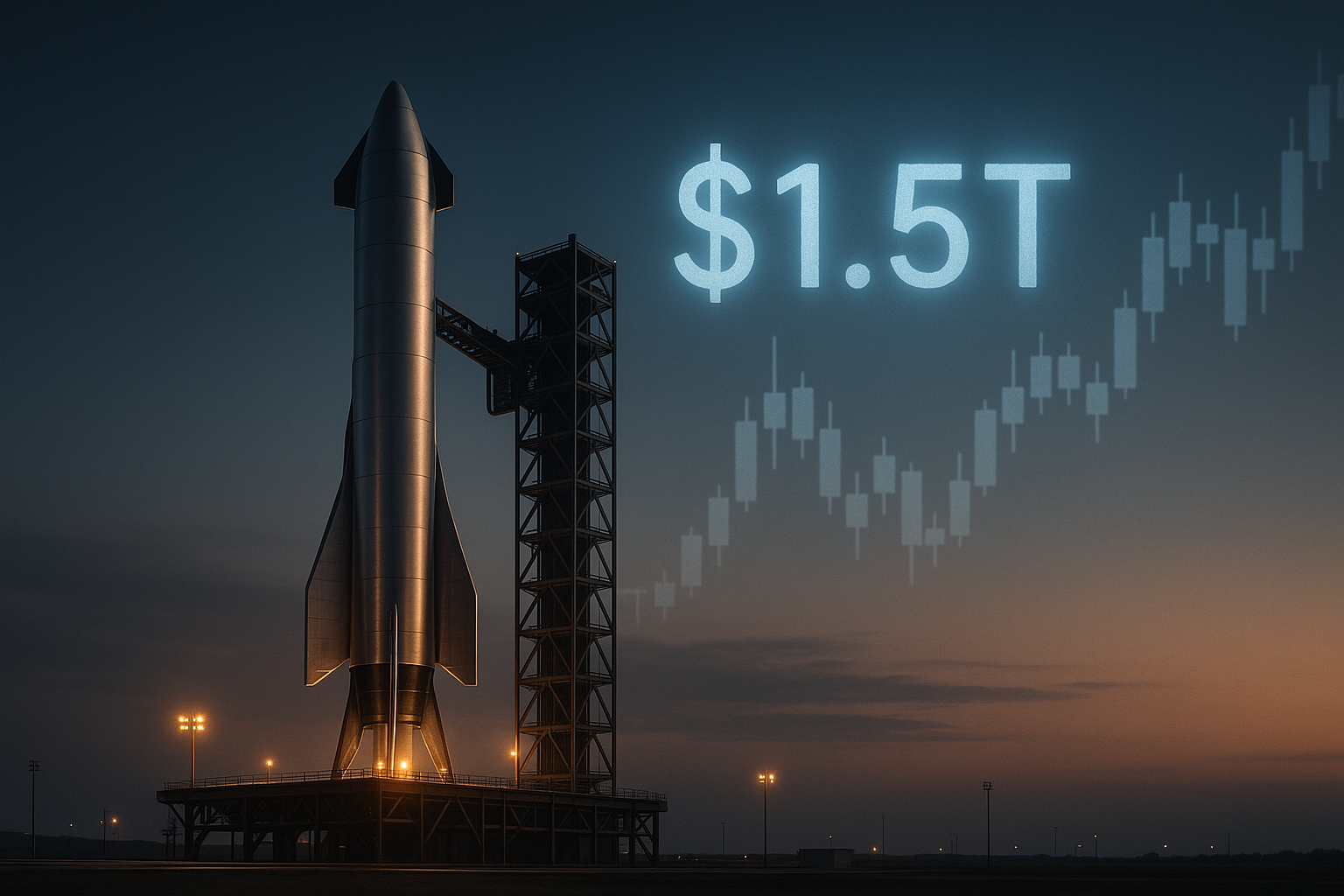
Waiting for a SpaceX IPO has become something of a space enthusiast's pastime—like stargazing, but for your portfolio. After years of "will they, won't they" speculation, it seems Elon Musk's rocket company is finally plotting a trajectory toward public markets. And in typical Musk fashion, the numbers are, well, astronomical.
According to Bloomberg's reporting, SpaceX is eyeing a mid-to-late 2026 public debut that would raise north of $30 billion. The target valuation? A mind-bending $1.5 trillion.
Let me put that figure in perspective. We're talking about a valuation that would immediately catapult SpaceX into the financial stratosphere alongside Apple, Microsoft, and Nvidia—companies that took decades to reach their current $3 trillion-ish valuations. It would position a rocket company (albeit one with a satellite internet business) in the same league as Saudi Aramco, which quite literally sits atop the world's most valuable natural resource.
There's something deliciously audacious about the whole thing.
I've covered tech IPOs since the late 2010s, and this proposed valuation leap—from a reported private valuation of $800 billion to $1.5 trillion upon going public—strikes me as unprecedented. Most companies hope for a modest pop on IPO day. Musk appears to be planning for a full-scale launch.
But here's the thing: conventional valuation metrics simply break down when applied to SpaceX. This isn't some food delivery app or enterprise software play. This is a company building the infrastructure for humanity's expansion beyond Earth.
SpaceX started as a rocket company (pretty cool) but has transformed itself into something far more valuable—a platform business. Starlink, its satellite internet constellation, provides exactly the kind of recurring revenue that makes investors do little happy dances in their ergonomic chairs. It's the difference between selling one rocket (great) and selling millions of monthly internet subscriptions (investor heaven).
"The real value driver here is Starlink," a space industry analyst told me last week. "The launch business gets the headlines, but the satellite business is what could actually justify these numbers."
Of course, we can't discuss SpaceX without acknowledging the Musk factor. The man embodies that classic Silicon Valley paradox—brilliant visionary meets chaotic executive. His presence adds both a premium and a discount to SpaceX's valuation, depending on whether you're focused on his track record of achieving the impossible or his habit of tweeting himself into hot water.
(Side note: Musk actually dismissed reports of the $800 billion private valuation as "inaccurate," which could mean... anything, really. Remember "funding secured"? Yeah.)
What fascinates me about this potential IPO is how it might create an entirely new category of investment. It's not just tech, not just infrastructure, not just transportation. It's... space infrastructure? Interplanetary logistics? The stock ticker categories aren't ready for this.
For investors who've been waiting years to get a piece of SpaceX, the promise of a 2026 offering presents a tantalizing opportunity. But it also raises questions. How much of the company will actually be available to public investors? Will Musk maintain iron-grip control through a multi-class share structure? And most importantly—can SpaceX deliver financial returns that justify a valuation typically reserved for companies selling products people use every single day?
Look, valuing SpaceX requires a different mindset than valuing, say, a bank or retailer. You're essentially betting on humanity's future in space. That's either the most compelling investment thesis of our lifetime or the ultimate example of Silicon Valley's detachment from financial reality.
Either way, when a company targeting one-and-a-half TRILLION dollars goes public, the financial gravity will be impossible to ignore. The market won't just absorb SpaceX—SpaceX will reshape the market.
We have until 2026 (or knowing Musk, probably 2027) to figure out what a reasonable P/E ratio is for a company planning to colonize Mars.
I, for one, can't wait to read that prospectus.


