
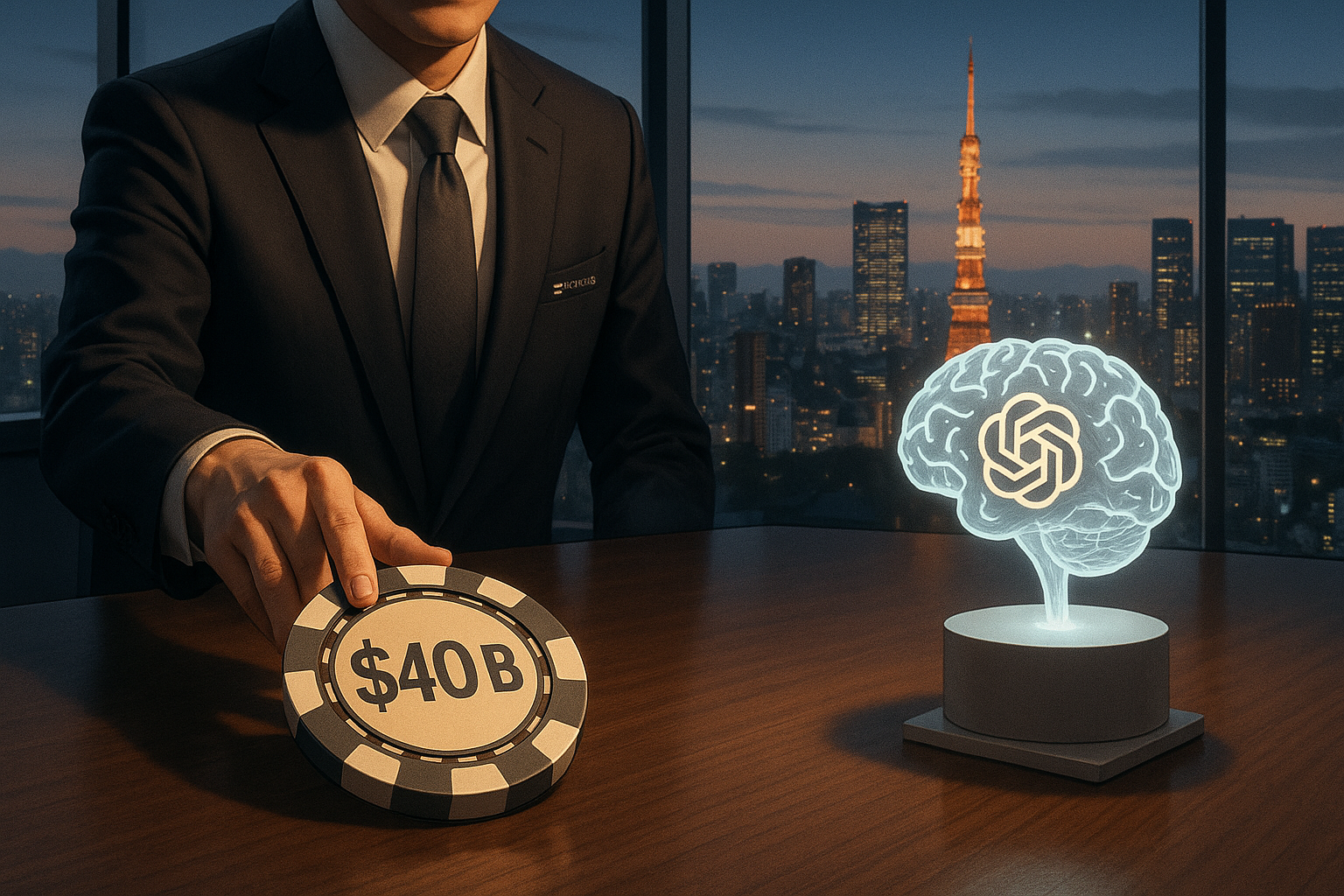
SoftBank just dropped the equivalent of a small nation's GDP into Sam Altman's lap. Yep, $40 billion—let that sink in for a moment.
The Japanese investment behemoth completed its eye-watering investment into OpenAI last week with a final tranche of roughly $22.5 billion, valuing the AI darling at a pre-money valuation of $260 billion. We're talking about a company that most people hadn't even heard of until ChatGPT burst onto the scene in late 2022.
I've covered tech investments for years, and this one leaves me genuinely slack-jawed. It's more than Ford's entire market cap. More than the GDP of countries like Jordan or Bolivia. And all this for a company that—let's be honest here—still hasn't quite figured out its business model.
The financial gymnastics behind this deal are fascinating. Just last month, SoftBank unloaded its entire $5.8 billion position in Nvidia—you know, that insanely profitable chipmaker whose stock has been on a rocket ride thanks to AI demand. They sold a proven winner to double down on the promising but unprofitable pioneer.
That's classic Masa Son.
(For those unfamiliar with SoftBank's founder, his career has been built on massive, concentrated bets that sometimes pay off spectacularly—Alibaba—and sometimes crash and burn in spectacular fashion. WeWork, anyone?)
What's happening here isn't just investment; it's a kind of financial engineering that creates its own gravity. By pumping in $40 billion, SoftBank isn't merely buying equity—they're purchasing runway for OpenAI. They're buying the ability to outspend, outlast, and outmaneuver competitors during what might be an extended period of economic uncertainty.
The timing couldn't be more interesting, either. This massive cash infusion arrives after OpenAI weathered significant internal turmoil, from last fall's boardroom coup attempt to ongoing tensions about development priorities and safety concerns. With this kind of war chest, Altman has effectively made himself bulletproof. When you bring $40 billion to the table, you're not just getting shares—you're buying yourself stability and autonomy.
But let's talk about that valuation for a second.
$260 billion pre-money puts OpenAI ahead of established giants like Coca-Cola, Exxon Mobil, and Bank of America—companies that, you know, actually make profits. Traditional metrics simply don't apply here. This isn't about current earnings; it's a massive bet on artificial general intelligence reshaping the global economy, with OpenAI holding the master key.
The investment also raises questions about OpenAI's peculiar corporate structure. Remember, this organization began as a non-profit research lab before evolving into this strange "capped-profit" hybrid where commercial interests supposedly coexist with broader safety missions. How exactly does a $40 billion investment fit into that framework? What governance provisions come attached to a check of that magnitude? The details remain murky.
Look, there's another reading of all this. Perhaps—and I'm just thinking out loud here—this investment marks the final gasp of AI euphoria before reality sets in. History has a funny way of repeating itself. Massive late-cycle investments often mark the top of a bubble. AOL-Time Warner, anyone?
Having watched technology cycles since the early 2000s, the pattern feels eerily familiar: visionary founder, revolutionary technology, unlimited capital requirements, and a business model that'll definitely work out once scale is achieved... sometime in the future.
Whether this represents the birth of the next technological paradigm or the most expensive case of FOMO in financial history remains to be seen. What's undeniable is that the game has changed. We're now playing with sovereign-scale capital.
And somewhere in Tokyo, Masa Son is pushing his chips into the center of the table once again, betting that this time—after decades of waiting—the technological revolution he's been anticipating has finally, definitively arrived.
The rest of us? We're just along for the ride.


