
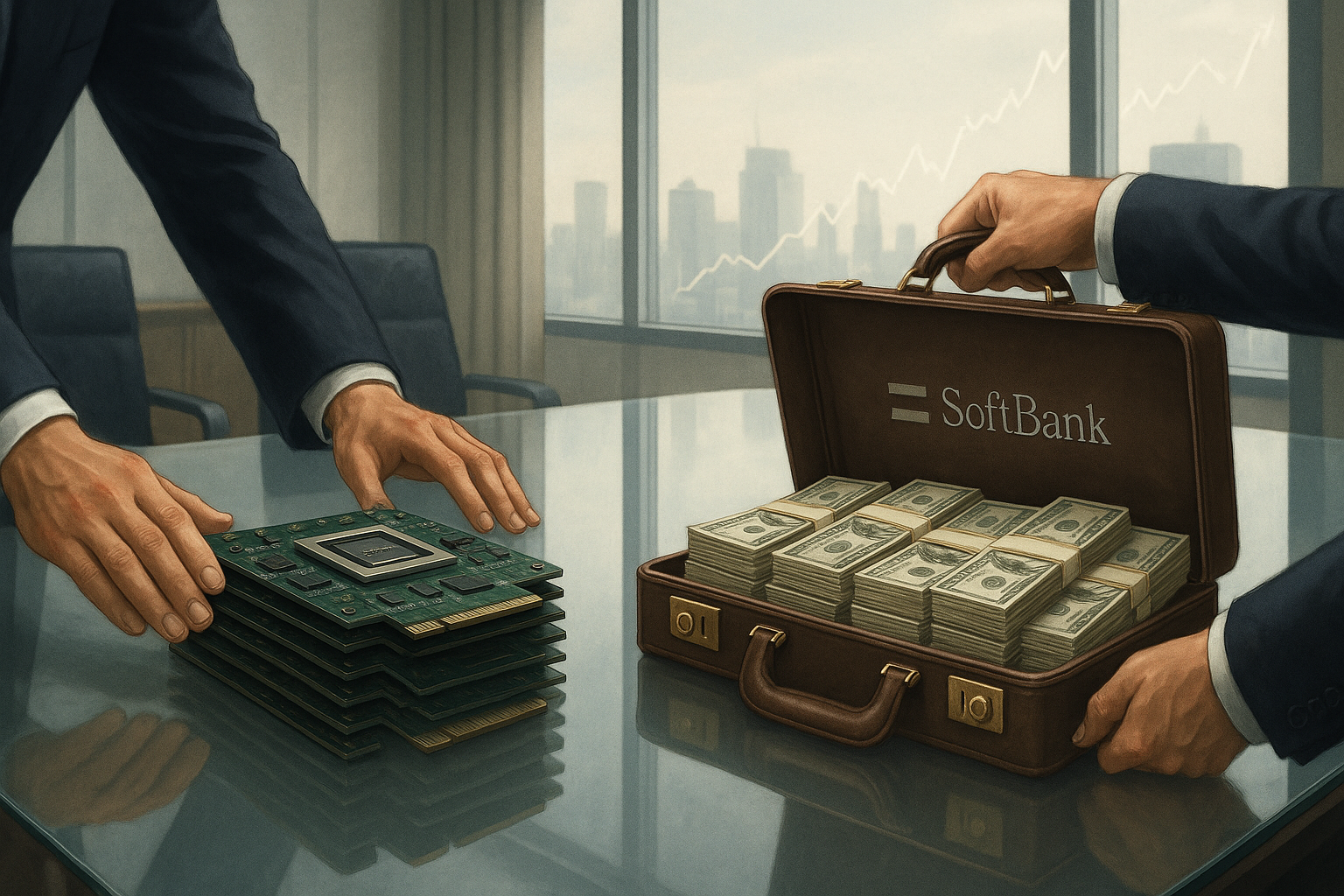
In the world of big money moves, timing is everything. Or... maybe it's nothing at all. SoftBank just pushed away from the AI casino table, selling its entire Nvidia position for a staggering $5.83 billion. The question hanging in the financial air: is Masayoshi Son crazy like a fox or just plain crazy?
I've watched Son's investment strategy evolve over years, and if there's one consistent thread, it's his absolute commitment to inconsistency. The man whose investment philosophy might charitably be described as "throw billions at the wall and see what sticks" has now completely divested from what has become tech's golden goose.
Let's be clear about what just happened. SoftBank—yes, the same company that lost billions on WeWork—just walked away from one of the most successful tech investments in recent memory. Nvidia, the chip maker powering virtually every significant AI advancement, continues its market domination while SoftBank... takes its chips off the table.
Weird timing, right?
The move comes as Nvidia's stock has been on an absolute tear. The company's market cap has swelled to stomach-churning proportions as data centers worldwide scramble for their AI-capable GPUs. If there was ever a company positioned to ride the artificial intelligence wave, it's Nvidia.
So why sell now?
Having covered SoftBank's rollercoaster finances since the Vision Fund's inception, I suspect this comes down to what I call "bird-in-hand economics." Son has watched paper fortunes evaporate before (remember Alibaba's peak valuation?). There's something psychologically satisfying about converting theoretical billions into actual billions sitting in your account.
"SoftBank's decision reflects a classic portfolio rebalancing strategy," one Wall Street analyst told me yesterday, before adding with a laugh, "though with Son, strategy might be giving him too much credit."
The broader context matters here. SoftBank's Vision Fund—once the $100 billion behemoth that was supposed to shape the future of, well, everything—has been humbled by reality. For every DoorDash success, there's been a WeWork catastrophe. For every Slack, an Uber IPO that fizzled rather than sizzled.
Son has been in quiet retrenchment mode lately. Less talk about hundred-year visions, more focus on balance sheet stability. In that light, cashing out a winning lottery ticket makes perfect sense.
The market's reaction (or lack thereof) tells its own story. Nvidia barely flinched as SoftBank unloaded its position. That kind of liquidity—the ability to absorb a $5.83 billion sale without meaningful price impact—speaks volumes about current investor enthusiasm for anything AI-related.
Look, there's a certain irony here that can't be ignored. SoftBank, which positioned itself as the ultimate true believer in technology's transformative power, is stepping away from perhaps the purest play on the AI revolution. It's like watching a climate activist sell their Tesla shares to buy an oil tanker. The cognitive dissonance is... noticeable.
What does all this mean for Nvidia itself? Probably not much in the short term. The company's fundamental story remains intact—demand for its chips continues to outstrip supply, and competitors remain years behind in key technologies.
But when smart money exits a position this size? It at least raises questions.
For SoftBank, the real story begins now. What does Son do with nearly $6 billion in fresh capital? Does he pay down debt (the responsible choice), or is he already dreaming up the next big swing (the Son choice)? If history is any guide—and with Son, it rarely is—that money won't sit idle for long.
This whole saga reminds me of a conversation I had with a hedge fund manager last year about realized versus theoretical gains. "Nobody ever went broke taking profits," he told me, before adding with a wink, "but nobody ever made history that way either."
Son, for better or worse, has always seemed more interested in making history than making sensible investment decisions.
The clock starts now on whether this Nvidia exit will be remembered as Son's shrewdest move—getting out at the top—or yet another example of leaving billions on the table. Either way, in the high-stakes game Son plays, $5.83 billion just counts as another chip to be wagered.


