
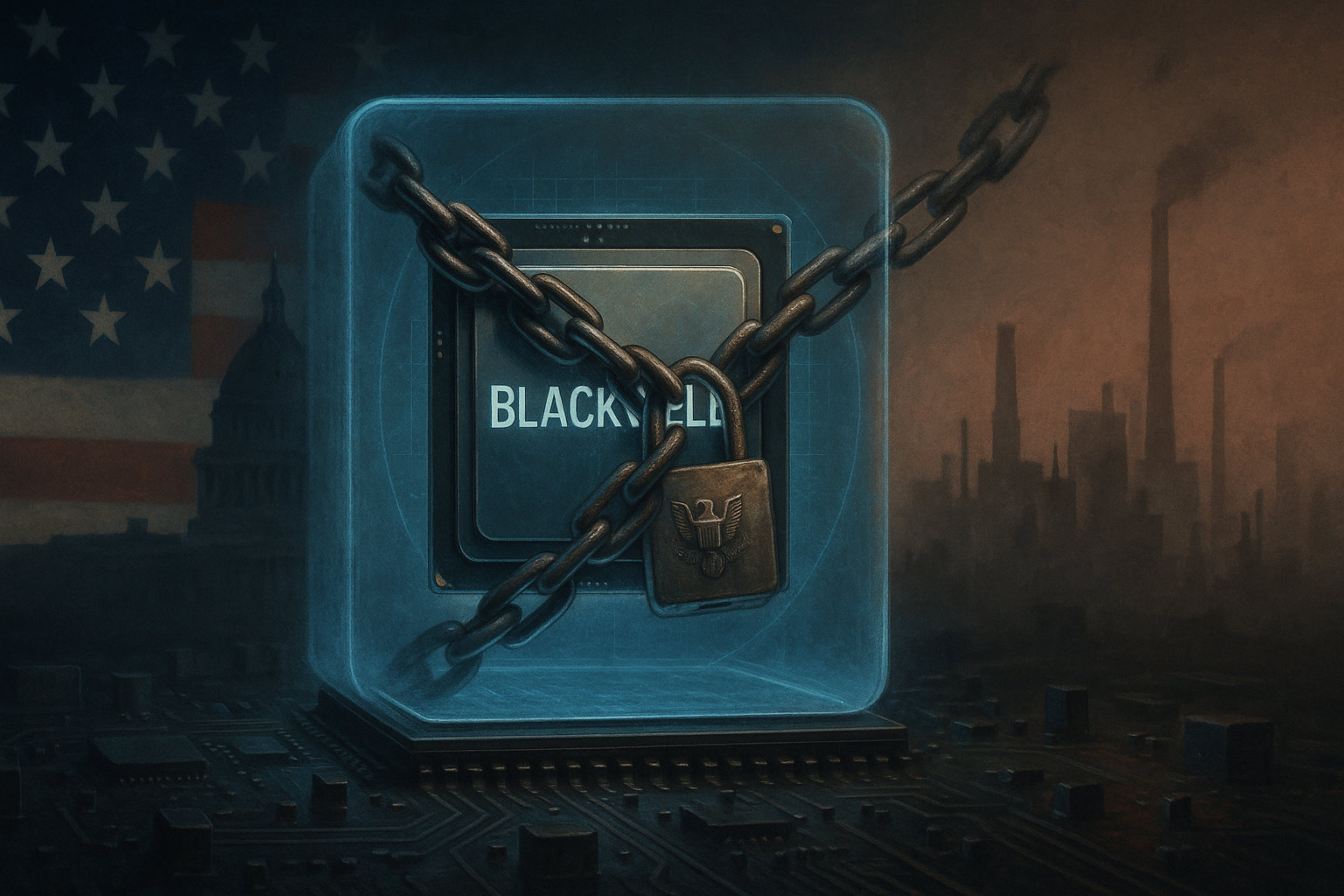
President Trump just dropped what might be the tech world's equivalent of the iron curtain. During a "60 Minutes" interview, he declared America's most advanced Nvidia Blackwell AI chips off-limits to the rest of the world—especially China.
"The most advanced, we will not let anybody have them other than the United States," Trump stated flatly, in a move that sent ripples through the tech industry but surprised almost nobody watching the geopolitical chess match unfolding around computational power.
Look, we're witnessing something I've been calling "Computational Mercantilism"—a modern twist on those old-school economic policies where countries once hoarded gold and spices. Except now, the currency is processing power.
The timing couldn't be more ironic. Nvidia—which recently claimed the crown as the world's most valuable company—built its colossal success on the back of global markets. Just days earlier, they'd announced plans to ship more than 260,000 Blackwell chips to South Korean companies. Their CEO Jensen Huang has repeatedly stressed how important Chinese revenue is for funding American research.
But here's where the story gets nuanced (and more interesting than the headlines suggest).
Trump's actual statement included a crucial qualifier: "We will let them deal with Nvidia but not in terms of the most advanced." This suggests something more complex than a simple ban—it's what you might call a "semiconductor gradient," where chip capability decreases as political distance from America increases.
Your closest allies? They get the good stuff. Frenemies? Last year's models. And rivals like China? They're stuck with what amounts to technological table scraps.
I've been following this tech-nationalism trend since the Biden administration first tightened export controls, and the fundamental tension hasn't changed. Companies want to maximize profits by selling everywhere. Governments want to maintain technological supremacy. The resulting policies are inevitably messy compromises that leave both sides grumbling.
What fascinates me is how markets have largely shrugged at these announcements. Nvidia's stock barely budged—investors had already priced in these restrictions. But the second-order effects? Those are worth watching.
When Congressman Moolenaar compared Blackwell chips to "weapons-grade uranium," he revealed just how dramatically our understanding of national security has shifted. Processing power is the new strategic asset.
(Though comparing AI chips to nuclear material strikes me as a bit overwrought—these are fundamentally dual-use technologies with countless commercial applications.)
There's something almost self-defeating about extreme restrictions, isn't there? As parents everywhere know, nothing makes something more desirable than declaring it absolutely forbidden. By elevating these chips to forbidden-fruit status, America might inadvertently accelerate China's determination to develop domestic alternatives.
The history of technology control is pretty clear on this point. Technological knowledge eventually spreads—it's just a question of how and when.
Meanwhile, a curious disconnect is forming. While politicians fight over who gets physical access to these silicon wafers, the AI systems they power are increasingly becoming borderless cloud services. You might not be able to buy the chip, but you can probably rent time on services it enables.
In my conversations with semiconductor executives last month at an industry conference in Taiwan, this point came up repeatedly. "The hardware is just one piece," a senior exec told me between sessions, requesting anonymity to speak freely. "The services built on top are where the real action is."
The final twist? Capital always finds a way around barriers. So does computational power. Smart policy would acknowledge this reality rather than pretend it doesn't exist.


