
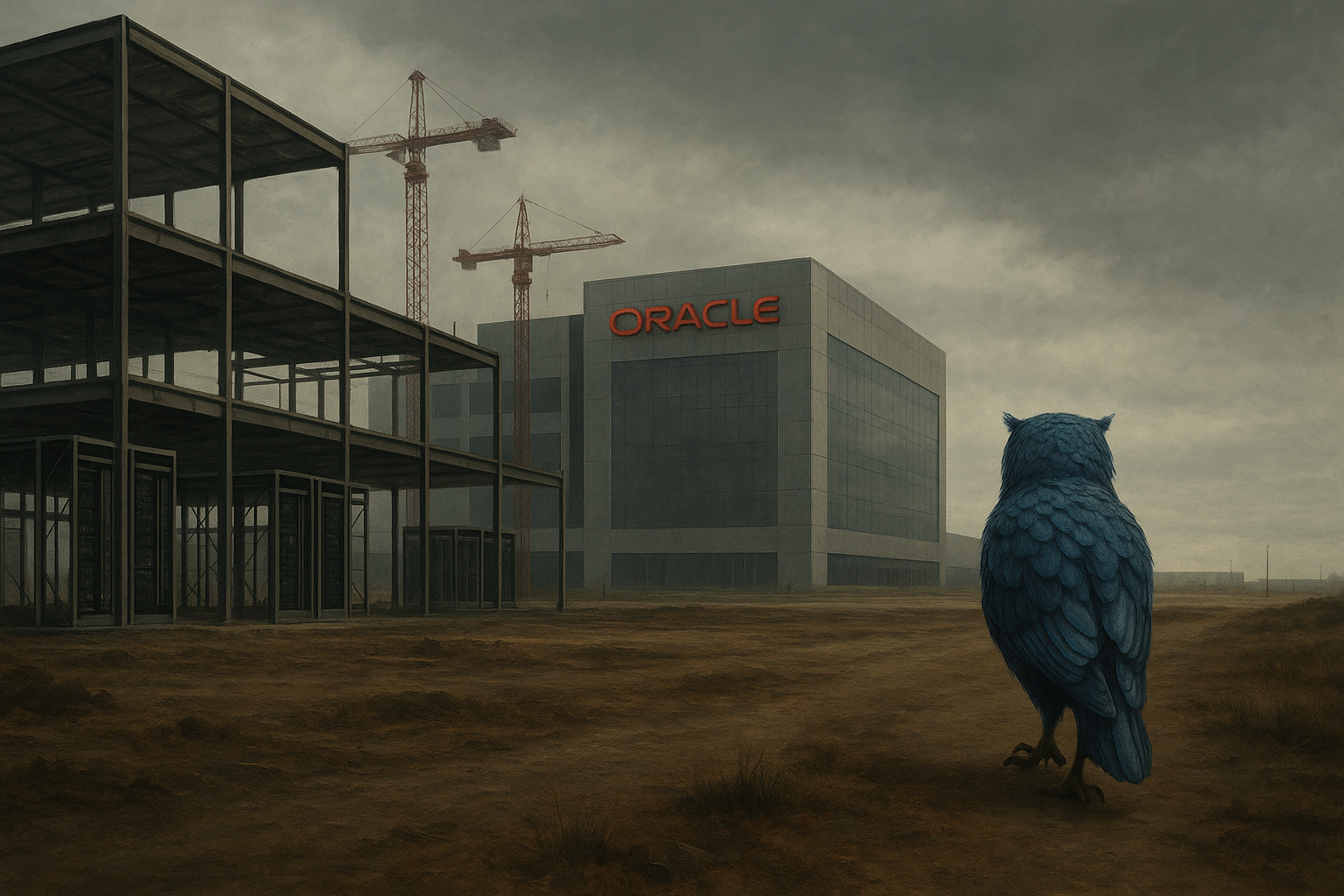
Oracle shares tumbled 4% yesterday on news that Blue Owl Capital has backed out of a potential $10 billion financing package meant to fuel the company's aggressive data center expansion. The rejection comes at a particularly awkward time for Larry Ellison's enterprise tech giant.
For months now, Oracle has been trying desperately to rebrand itself as an AI infrastructure player rather than just that company that sends you licensing audit notices. Ellison himself has been practically evangelical about Oracle's cloud transformation, making bold promises about competing with the industry's heavyweights.
But here's the thing—data centers aren't cheap. They're massive energy-sucking complexes that cost billions before generating a single dollar in revenue. Oracle needed that $10 billion badly if it wanted to play in the same sandbox as Microsoft and AWS.
What makes Blue Owl's rejection particularly stinging (and telling) is how it bucks the trend. Private capital has been absolutely flooding into tech infrastructure lately. Money for AI hardware? Take it. Need billions for server farms? Here you go!
So why the cold shoulder for Oracle?
I've covered tech financing for years, and this feels like one of those moments where smart money is starting to question the "if you build it, they will come" narrative around AI infrastructure. Blue Owl isn't some skittish investor—these folks know what they're doing.
The reality? Oracle remains a distant also-ran in cloud services. Despite all the AI buzzwords Ellison sprinkles into earnings calls, they're still miles behind AWS, Azure, and Google Cloud in market share. And Blue Owl knows it.
There's also timing to consider. We might be witnessing the first subtle shifts in the AI computation equation. OpenAI just released GPT-4o, which delivers better performance while actually requiring less computing power than earlier models. Huh. If that trend continues (and that's admittedly a big if), the economics behind massive data center expansions might need serious recalculation.
Look, this story fits a pattern we've seen repeated throughout tech history. The kings of one era often struggle to maintain their crowns in the next. IBM dominated mainframes but missed the PC revolution. Microsoft owned desktop computing but whiffed on mobile. Oracle has ruled enterprise databases for decades, but cloud infrastructure? That's unfamiliar territory requiring totally different expertise and investment strategies.
The 4% stock drop suggests investors are beginning to question Oracle's AI-powered reinvention story. Not abandoning it completely—just adding a healthy dose of skepticism.
(As an aside, Oracle has always had this fascinating corporate personality—absolutely dominant in its core business while perpetually playing catch-up elsewhere. Their acquisition strategy sometimes feels like watching someone frantically buy lottery tickets.)
What happens next? Oracle could scale back ambitions, find alternative financing (likely at worse terms), or fundamentally rethink their approach. None of those options will make Wall Street particularly happy.
The situation reminds me of something a venture capitalist told me over drinks last year: "When financing for big tech projects starts getting harder, it's not the canary in the coal mine—it's the coal mine noticing the canary looks sick." We're not necessarily at full market correction territory for AI infrastructure spending, but Blue Owl's reluctance might be the first few notes of a changing melody.
Meanwhile, the tech world keeps spinning: Nvidia briefly surpassed Apple as the world's second-most valuable company yesterday... Bitcoin miners are getting crushed as crypto slides post-halving... and Deutsche Bank finally escaped its DOJ deferred prosecution agreement—a rare win for a bank that's had more regulatory problems than I've had coffee this week.


