
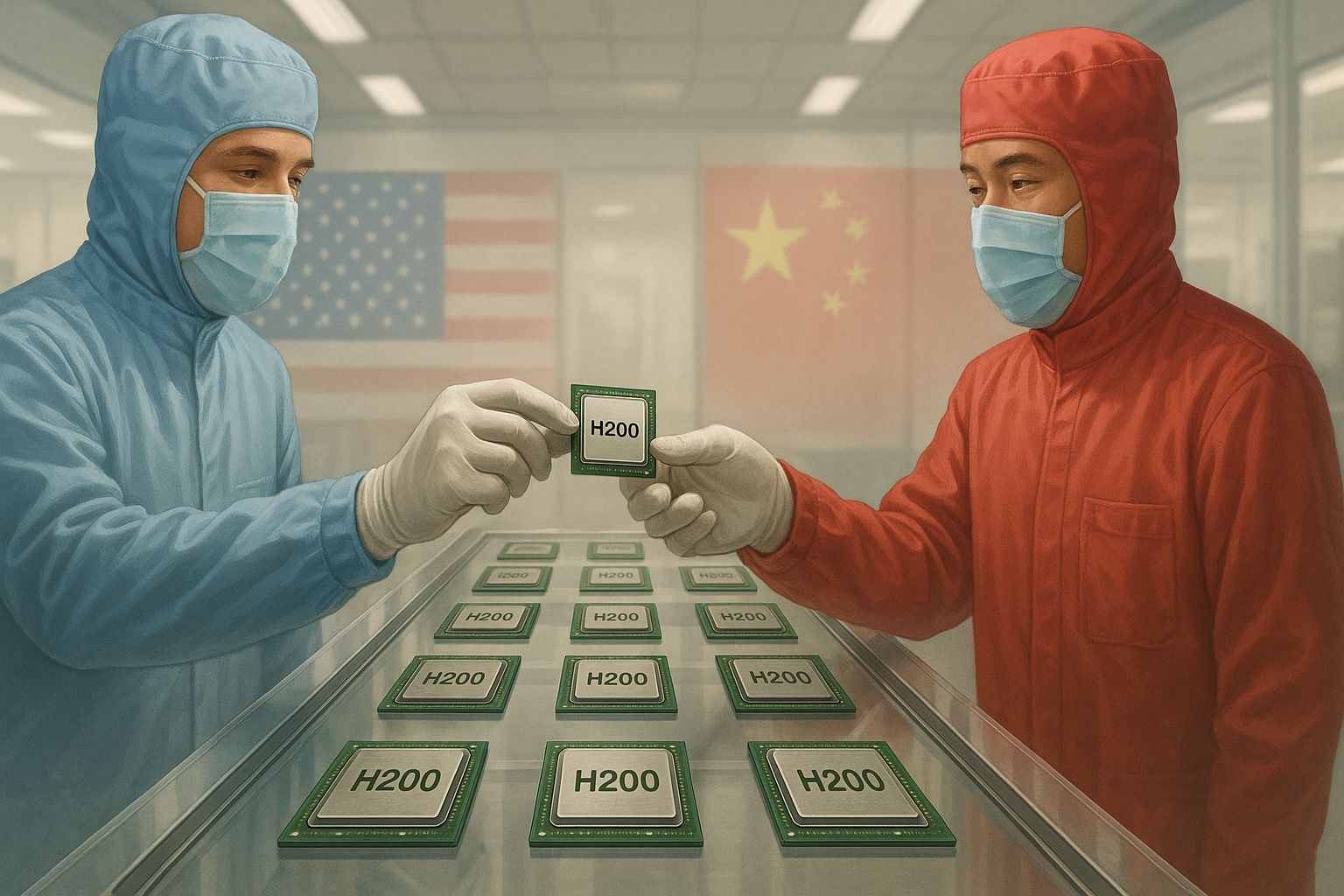
The Commerce Department has apparently found what we might call the "technological sweet spot" in the U.S.-China chip war. Secretary Lutnick's plan to greenlight Nvidia's H200 chip exports to China represents one of those rare Washington compromises that might actually make sense—give or take your perspective on national security.
I've covered tech export controls since they became the diplomatic flashpoint du jour, and this 18-month obsolescence standard strikes me as particularly clever. Not cutting-edge, not Stone Age—just yesterday's news.
Think of it as technological hand-me-downs on a global scale. "Here, China, you can have my old jacket. It's still pretty nice! Just not, you know, this season's model."
The beauty of this approach (and I suspect this wasn't lost on Lutnick, given his Cantor Fitzgerald background) is how it threads multiple needles simultaneously. The national security hawks get their buffer zone—China remains perpetually behind. The business community gets access to the world's largest emerging AI market. Everybody wins! Sort of.
What's fascinating is China's reaction. They've been blocking imports of less capable chips like the H20, essentially saying "don't patronize us with your technological crumbs." There's something almost comically predictable about this dance—one side carefully calculating exactly how much technology to withhold, the other side insulted by the transparent strategy.
Look, we've seen versions of this before. Remember the encryption wars of the 90s? First it was "no strong encryption exports," then it was "okay but with key escrow," and eventually the policy collapsed under the weight of its own contradictions.
The 18-month gap represents a bet—a wager that American innovation moves fast enough that yesterday's tech can be monetized globally while tomorrow's remains protected. It's either brilliantly calibrated or a fantasy, depending on how quickly you think the innovation cycle actually turns.
But here's what I think is actually happening beneath the surface: this isn't just about chips. It's about standards. By allowing Chinese companies to build on Nvidia's slightly outdated architecture, the U.S. ensures China remains tethered to American technology standards.
It's the digital equivalent of allowing someone to build their house on your land. Sure, they get a nice place to live, but guess who still owns the property?
The financial stakes couldn't be higher. China represents somewhere around a quarter of the potential global AI chip market. Nvidia's stratospheric valuation depends partly on threading this particular needle—selling enough chips to justify their market cap without triggering more restrictive regulations.
(And yes, I checked Nvidia's stock price while writing this—up nearly 2% on the news. The market, at least, believes in this approach.)
What makes this particularly interesting is how it reflects a more sophisticated understanding of technology competition. The blunt instrument of total export bans rarely works as intended. Technology, like water, finds a way through the cracks.
Instead, this policy acknowledges reality: China will advance technologically no matter what. The question isn't whether to allow it, but how to shape it.
By maintaining that 18-month gap—just wide enough to matter but not so wide as to force complete technological independence—America keeps its hand on the throttle. Chinese AI development proceeds, but at a pace and along a path that preserves American advantage.
I spoke with several tech executives (off the record, naturally) who confirmed what I suspected: they'd prefer a predictable export regime with reasonable restrictions over the uncertainty of constantly shifting policies. This approach gives them that.
But does it actually work for national security? That's... complicated.
The policy essentially says: "We believe our innovation cycle moves fast enough that an 18-month lead is sufficient." That's either profound confidence or dangerous complacency. We'll know which in, well, about 18 months.
In the meantime, Nvidia keeps selling chips, China keeps building AI systems, and the technological cold war continues its peculiar dance—not quite confrontation, not quite cooperation, but something uniquely fitted to our interconnected world.
Something like strategic obsolescence. Yesterday's Ferrari, today's export approval.


