
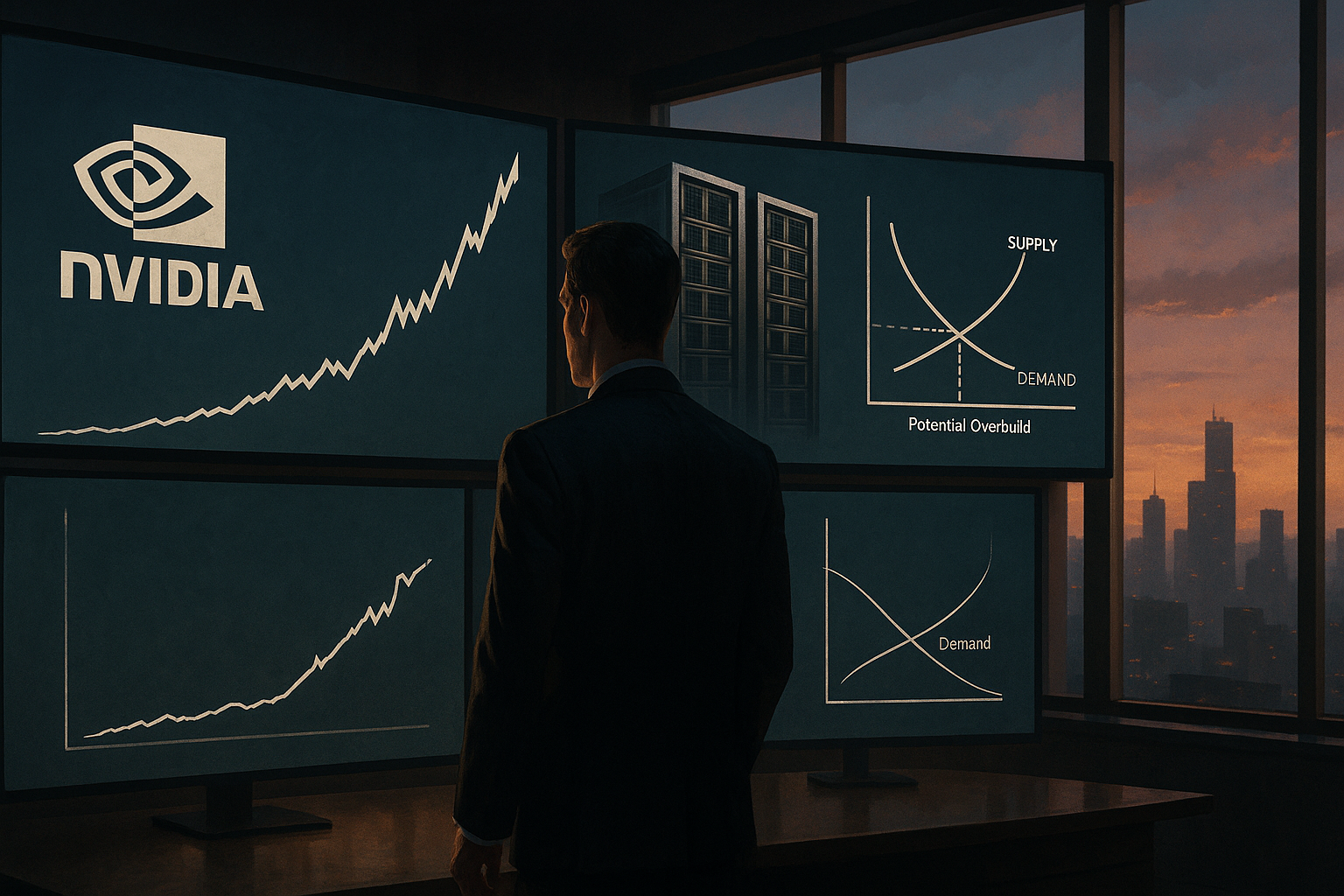
The pressure's on. Nvidia reports earnings Wednesday in what feels like a high-stakes financial showdown that could either validate or puncture the AI narrative that's driven markets all year.
The semiconductor giant—now worth a jaw-dropping $2.7 trillion—has been riding the artificial intelligence wave like a champion surfer, propelling itself to become the world's third most valuable company. Only Apple and Microsoft stand taller. But here's the thing: Wall Street's starting to get jittery.
After watching Nvidia's stock price rocket up 200% this year (yes, triple its value), investors are whispering about something that could spoil the party. Overbuilding. It's a simple concept with potentially devastating implications. What if companies are constructing AI infrastructure faster than they actually need it? What happens when supply outpaces demand?
I've been covering tech cycles for years, and this feels eerily familiar. Remember the fiber optic boom back in the late 90s? Companies laid enough cable to wrap around the planet multiple times. The capacity took years—years!—to absorb. Or think about those crypto mining hardware cycles, with their dizzying peaks and gut-wrenching valleys.
Look, Nvidia's performance has been nothing short of spectacular. Last quarter's data center revenue exploded 141% year-over-year to $16.2 billion. For this quarter, analysts are expecting around $32.9 billion in total revenue, representing 80% growth.
But the stock has pulled back about 8% from its recent peak. Markets aren't stupid; they're recalibrating.
Jensen Huang, Nvidia's charismatic CEO, faces perhaps the trickiest earnings call of his career. He's gotta show massive growth (which, frankly, investors already expect) while simultaneously convincing everyone that demand will remain insatiable. That's getting harder to do.
"Potential overbuild concerns have become more top of mind for investors," noted Bernstein analyst Stacy Rasgon recently. And when Elon Musk—heading perhaps the most AI-obsessed major company on Earth—claims Tesla has "more GPUs than we can use right now," well... that raises some serious questions.
The immediate focus when the numbers drop Wednesday will be guidance. Wall Street wants to see about $37 billion for the current quarter—representing 70% growth. Miss that target significantly? Watch out below. Beat it handily? The rally could reignite faster than you can say "artificial intelligence."
(The stock is essentially priced for perfection, which never seems like a comfortable place to be in tech.)
One potential saving grace? Nvidia's diversifying customer base. The initial AI surge came primarily from tech giants—your Microsofts, Googles, Metas, and Amazons. Now enterprises, governments, and startups are all scrambling for chips. That broader foundation might help if any single customer group tightens its belt.
There are fundamentally two ways this story unfolds. Either we're approaching peak AI infrastructure spending—with companies soon realizing they've built more capacity than needed in the near term—or we're still early in a multi-year transformation that'll keep demand robust for years to come.
What makes Wednesday's report particularly consequential isn't just what it means for Nvidia. As the primary beneficiary of AI infrastructure spending, the company serves as a barometer for the entire movement. The numbers will tell us something about where we are in this cycle.
The irony? Nvidia faces these overbuilding questions precisely because it's been so damn successful. Its dominance is so complete that its results aren't just company news—they're industry news.
Throughout his career, Jensen Huang has repeatedly proven doubters wrong. He built a graphics card company that transformed into an AI powerhouse before most people even understood what AI would become. Now he needs to convince investors one more time that he sees something they don't.
Wednesday's report won't just be another earnings event. It might be the most consequential financial moment of the year.


