
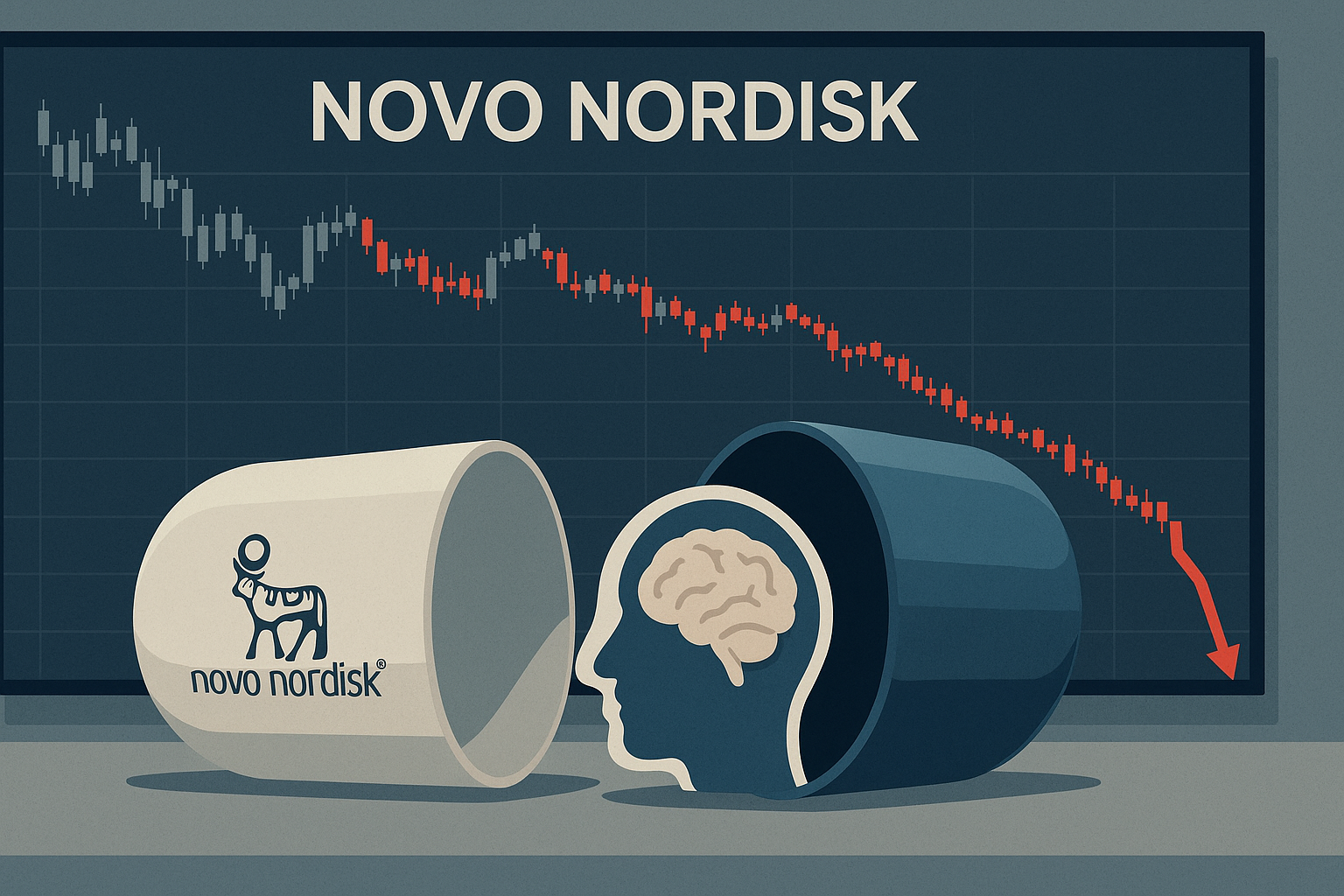
Danish pharmaceutical behemoth Novo Nordisk watched $40 billion in market value evaporate yesterday—poof, gone—after its experimental Alzheimer's treatment failed to deliver in a mid-stage clinical trial. Shares plunged 9% when investors learned the company's once-promising drug couldn't hit its primary endpoint.
It's the classic pharmaceutical comeuppance story. You know the one.
The company had been riding an almost supernatural wave of success with its GLP-1 drugs Ozempic and Wegovy. These weight-loss wonders transformed Novo into Europe's most valuable company, with a market cap swelling to around $460 billion. That's not just pharmaceutical success—it's market distortion on a continental scale.
Look, Denmark's stock market has essentially become "Novo Nordisk plus some decorative smaller companies." I've covered Nordic markets since 2018, and I've never seen anything like this concentration of value.
The Alzheimer's trial tested semaglutide—yes, the same stuff in those ubiquitous weight-loss shots—to see if it could improve cognition in early-stage patients. The theory wasn't ridiculous. There's growing evidence connecting metabolic health and brain function. But when the data came in? Nothing statistically significant between the treatment and placebo groups.
Novo's executives, bless 'em, still pointed to "trends" toward positive effects on some secondary endpoints. In pharma-speak, "trends" is basically code for "please don't panic-sell our stock." (They did anyway.)
What's fascinating to me—having watched this pattern repeat throughout biotech—is how investors hallucinate potential applications once a company hits one breakthrough. Call it "breakthrough extrapolation syndrome." They cracked obesity, so naturally they'll solve the most vexing neurological puzzle in medicine too, right?
Not so fast.
Alzheimer's drug development has been a pharmaceutical killing field for decades. The failure rate hovers around 99%. Those are odds that would make even the most desperate gambler back slowly toward the exit.
Remember Biogen's Aduhelm debacle in 2021? Initial approval, stock soaring, then... commercial disaster. I spoke with several neurologists after that launch who described the efficacy data as "underwhelming at best." History rhymes, if not repeats.
For Novo, the question becomes whether this 9% haircut was an overreaction. That's roughly the GDP of Jordan—vaporized because one application of their wonder drug didn't pan out. Their core franchises remain intact, growing, and protected by significant moats.
But markets aren't just discounting lost Alzheimer's revenue. They're reassessing how far the GLP-1 kingdom might extend. If brain health is off the table, what about those whispered applications for addiction? Parkinson's? The GLP-1 halo just dimmed considerably.
The cruel irony? Novo Nordisk remains an absurdly successful company by normal standards. Their problem is that normal standards became irrelevant months ago. When you're priced for pharmaceutical divinity, merely being excellent feels like failure.
I've developed what I call the "breakthrough discount rule" for investors: when valuing companies with a revolutionary product, mentally subtract 30% of whatever speculative applications management dangles before you. Make it 40% if Alzheimer's is mentioned.
In the meantime, Novo executives are probably consoling themselves with their quarterly reports. They still have the most successful drug franchise on the planet. That ain't nothing.
But in a market that had priced in everything—including solving arguably medicine's hardest problem—something is now missing.
And yesterday, at least, that something was worth $40 billion.


