
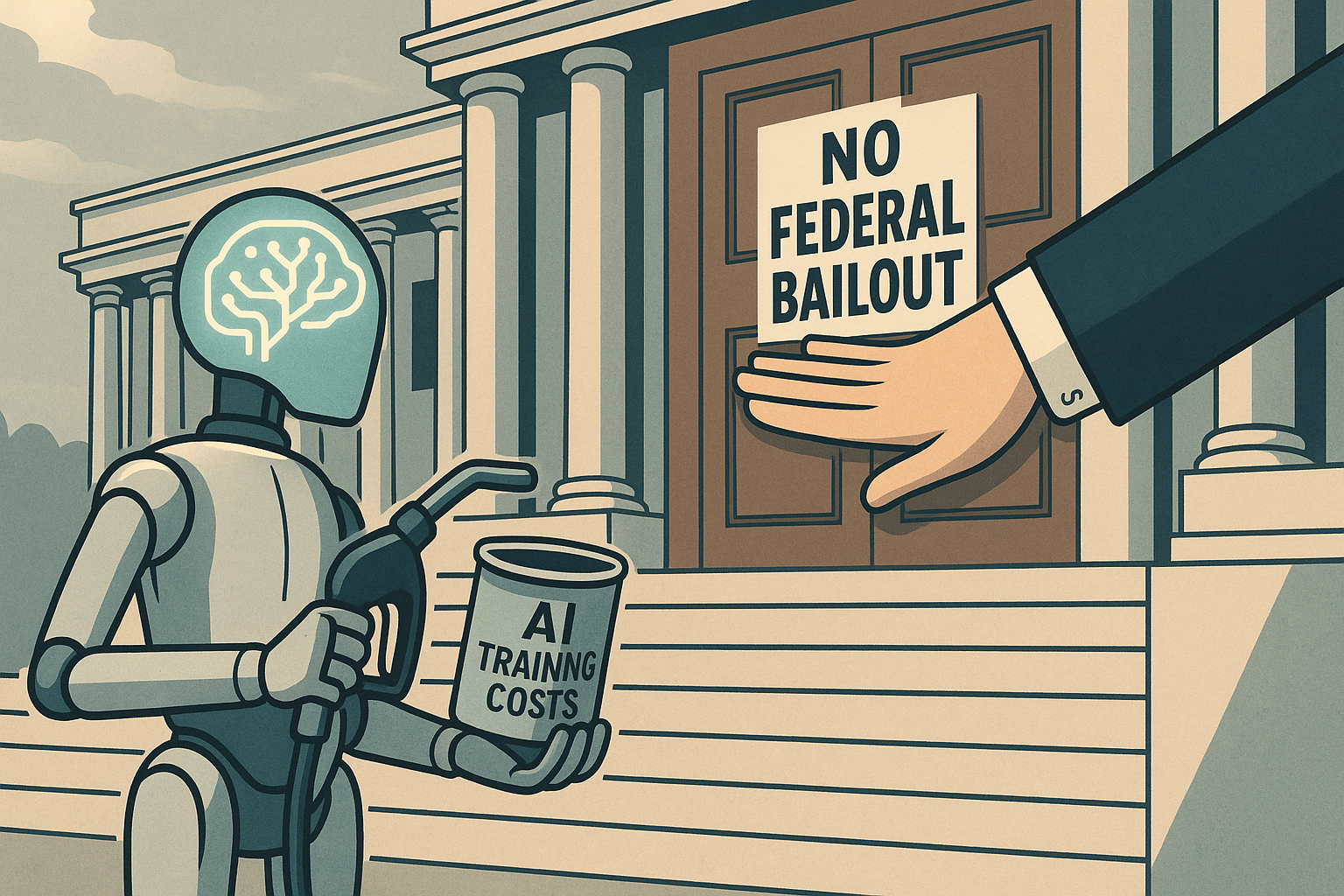
David Sacks, freshly minted as Trump's AI czar, has effectively slammed the door on the tech industry's latest funding fantasy. After OpenAI's CFO hinted that Uncle Sam might need to help bankroll the eye-watering costs of training advanced AI models, Sacks delivered what amounts to a parental "nice try" – there will be "no federal bailout for AI."
The timing is almost comical. We've barely finished our collective panic attack about AI destroying civilization, and now the same companies are essentially saying, "By the way, could you help with our electricity bill?" It's the technological equivalent of a teenager wrecking the family car and then asking for gas money.
What we're witnessing is a predictable chapter in the Silicon Valley playbook – one I've seen repeat itself countless times while covering tech finance. Companies paint visions of world-changing technology to attract billions in private investment, then discover that actually building said technology costs even more billions. And suddenly, public funding starts looking mighty attractive.
Let's be clear about the numbers here. Training a single frontier AI model can cost hundreds of millions of dollars. The computing infrastructure, electricity, and specialized talent don't come cheap. OpenAI's Sarah Friar wasn't exaggerating that part.
But here's the rub: these same companies have been showered with private capital at astronomical valuations. Microsoft dumped $13 billion into OpenAI. Anthropic raised over $7 billion from Amazon, Google, and others. Investors weren't exactly tricked into this – they knew what they were signing up for.
(And let's not forget these are the same companies selling services based on models they're now suggesting are too expensive to build without taxpayer help.)
Sacks – who made his fortune as part of the PayPal mafia before co-founding Craft Ventures – has long been skeptical of government intervention in markets. His appointment signals the Trump administration's likely approach to AI development: sink or swim based on market forces, not federal life preservers.
"This is classic corporate welfare seeking," a venture investor told me off the record. "Build a business model that actually works instead of assuming the government will backstop your losses."
What's particularly fascinating about this moment is how it reveals the economic contradictions at the heart of the AI boom. The industry has simultaneously argued that: 1) AI will generate trillions in economic value, 2) AI presents existential risks requiring careful development, and 3) AI is too expensive for private companies to build responsibly without government help.
Pick a lane, folks.
The historical precedent for government funding of transformative technologies does exist, of course. DARPA's investments gave us the internet. The Human Genome Project unlocked our genetic code. NASA's contracts helped build the semiconductor industry.
But... those were explicitly public research initiatives from the start, not private companies that raised billions before deciding their business model needed taxpayer supplements.
I spoke with several AI researchers who pointed out an uncomfortable truth: the astronomical costs of training frontier models might actually be a natural safety mechanism. "If these systems are as potentially dangerous as some claim," one Stanford professor told me, "maybe we should be glad they're expensive enough that companies must think carefully about when to build them."
Look, the tension here isn't going away. We're really arguing about who should bear the costs and risks of developing powerful technologies while capturing their benefits. It's capitalism's oldest question dressed in new algorithmic clothes.
For now, Sacks has made it clear: don't expect the federal checkbook to solve the AI industry's economic challenges. Which means companies might need to confront something truly disruptive – profitable business models that don't require government subsidies.
What a concept.


