
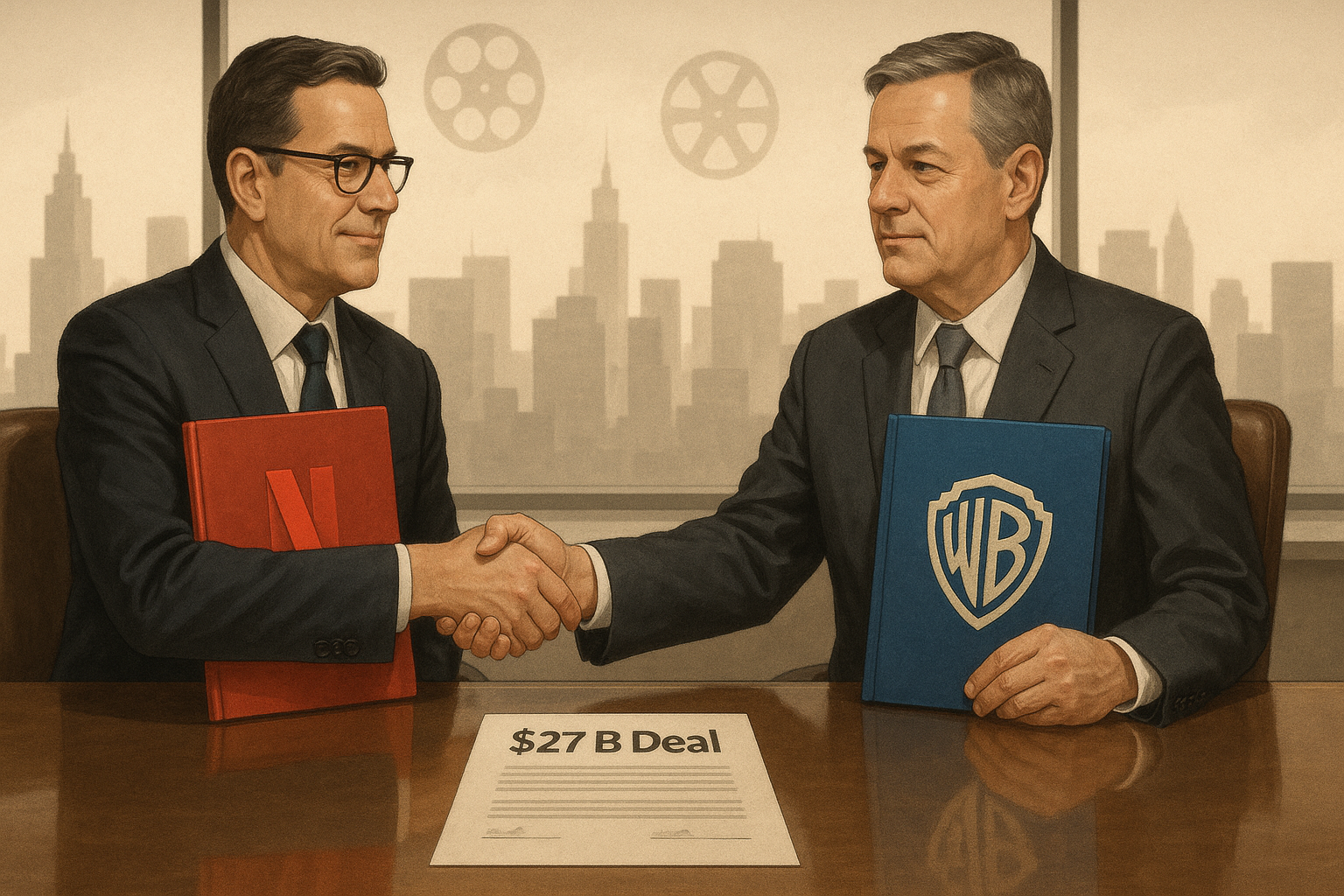
In a plot twist worthy of a streaming series finale, Warner Bros. Discovery appears ready to swat away Paramount's eye-popping $108.4 billion offer and instead curl up with Netflix's earlier proposal. It's corporate America's version of "thanks, but I'm going back to my ex."
The Warner board is reportedly set to reject the Paramount-Skydance advances despite the higher price tag — a decision that has industry insiders buzzing over cocktails from Burbank to Manhattan.
Look, this corporate tango has been something to behold. Having covered media mergers since the AT&T-Time Warner debacle, I've rarely seen such a public courting ritual. The prize? Only Warner's legendary studio, a content vault spanning from Bogart's Casablanca to the wizarding world of Harry Potter, plus the HBO empire that fundamentally changed television forever.
This isn't just another merger. It's existential.
"The streaming wars have entered their 'desperate measures' phase," a senior Warner executive told me last week, requesting anonymity because they weren't authorized to speak publicly about board matters. "Nobody's sure if the traditional model is sustainable, but everybody's terrified of being left behind."
Netflix's apparent victory (securing Warner's non-cable assets for a mere $27 billion) marks a stunning evolution for a company that started by mailing DVDs in those little red envelopes. Remember those? I still have one somewhere in my junk drawer.
The Paramount camp didn't go quietly. CEO David Ellison launched a $30-per-share direct offer that had Wall Street analysts reaching for their calculators. The financing package was... ambitious, shall we say? $41 billion in equity (backed largely by the Ellison family fortune) and a whopping $54 billion in debt commitments.
Those are numbers that make even seasoned bankers sweat.
What's particularly fascinating about this corporate chess match is how it reveals fundamentally different visions of media's future. Netflix's cash-and-stock approach suggests confidence in long-term synergies and platform integration. Paramount's all-cash bid screams "we need this now before we're irrelevant."
Perhaps the most telling development was Jared Kushner's Affinity Partners reportedly backing away from the Paramount financing consortium. In the world of high-stakes dealmaking, that's the equivalent of someone discreetly exiting a dinner party early. Not a great sign.
The sheer scale of these numbers is mind-boggling. We're talking about nine and ten-figure sums for businesses in an industry that's still trying to figure out whether people will pay for three streaming services, let alone seven. (They won't, by the way. Something's gotta give.)
I spoke with three former Warner executives yesterday who all expressed the same sentiment: Netflix simply makes more strategic sense. The technology infrastructure is there. The global distribution network exists. The brand alignment works.
"Warner doesn't need another traditional media partner," one former executive told me. "They need someone who understands the digital transition. And frankly, the Paramount financing just looked... complicated."
In the end, this is another chapter in media's ongoing consolidation story — albeit with a record-breaking price tag. We'll be left with fewer, larger players controlling more of what we watch, which raises legitimate questions about creative diversity and consumer choice.
The ultimate irony? All this frenzy over content libraries is happening just as AI threatens to generate endless hours of watchable content. Studios are spending billions to acquire content catalogs while the very nature of content creation is being upended.
But that's Hollywood for you. Always focused on the sequel when the paradigm shift is happening right outside the theater.


