
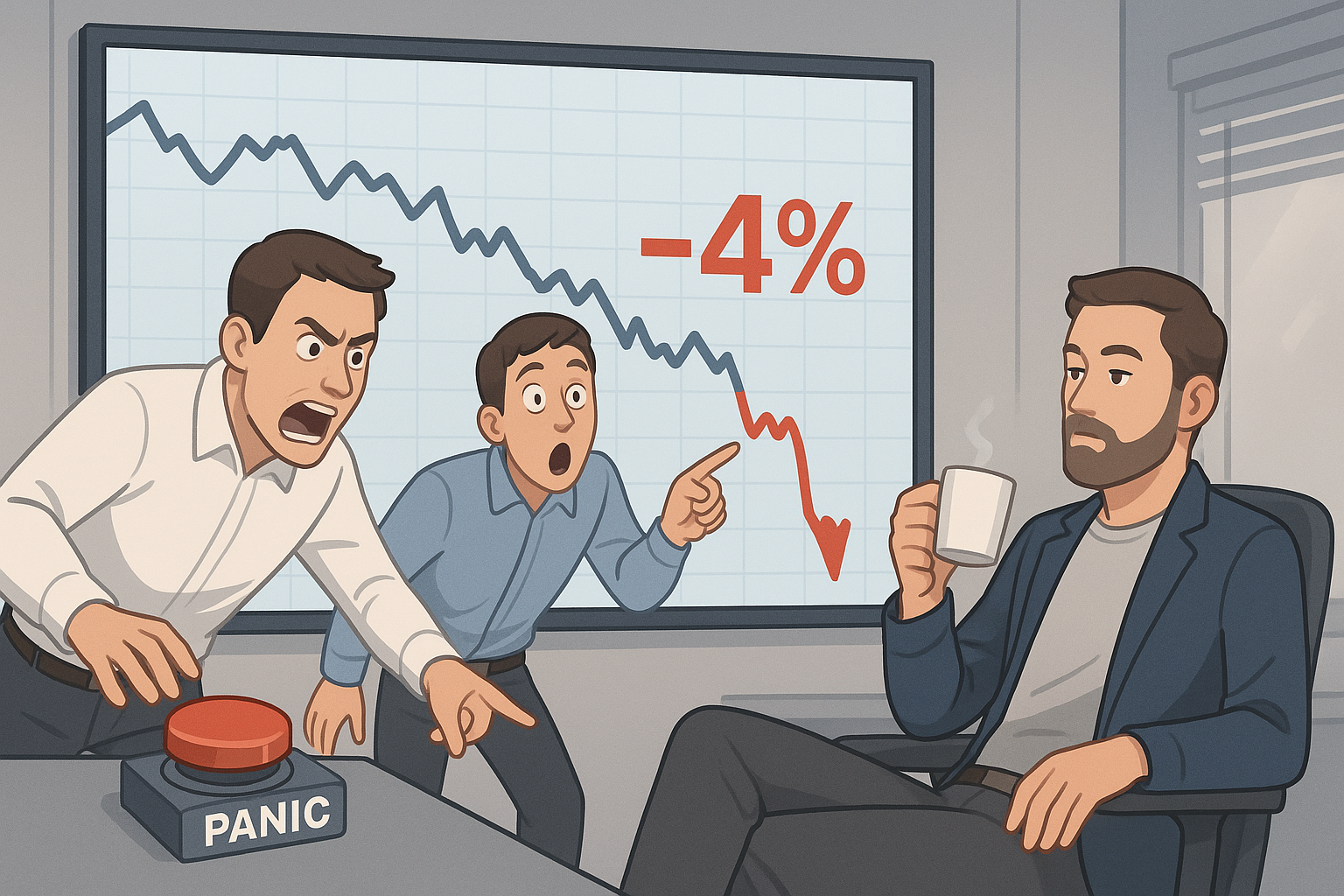
The stock market slips a few percentage points and suddenly everyone's reaching for the panic button. I've seen this movie before.
Social media is ablaze with doomsday charts comparing this dip to 2008's financial apocalypse. Newsletter writers (who've been predicting crashes quarterly since 2011) are dusting off their "cash is king" templates. And that Fear and Greed Index? Flashing a shade of red that would make a stoplight look pale.
All this—and we're not even down 5%.
Look, I've covered market psychology for years, and what we're witnessing in 2024 reveals something telling. We've become so conditioned to expect the Fed to swoop in and save the day that normal market behavior gets mistaken for the end times. Remember when 5-10% corrections were considered routine? Pepperidge Farm remembers.
The actual economic data tells a different story. Employment? Still solid. Earnings season? Generally positive, with a few expected misses. Inflation? Continuing its slow march downward.
Are there legitimate concerns lurking out there? You bet. The Middle East remains a powder keg (when doesn't it?), election uncertainties have everyone on edge, and yes—some AI stocks got ahead of themselves. Way ahead.
But these factors don't add up to 2008 redux. Not even close.
What we're experiencing feels more like a sentiment correction than a fundamental one. Markets had frankly gotten a bit drunk on AI enthusiasm, particularly with second-tier players promising disruption without clear paths to actually making money from it. Novel concept, I know.
The META decline that has one investor down 20%? That's the market asking legitimate questions about the company's AI spending spree, not some grand rejection of technology valuations.
I've always found it useful to distinguish between revaluation and deterioration. The first is when we collectively decide something's worth less than we thought yesterday. The second is when a business actually gets worse. This pullback has all the hallmarks of the former.
The market is simply asking some overdue questions. (Should've asked them sooner, if you ask me.)
"Hold up—exactly how many $10,000 Blackwell GPUs does a company need to remain competitive? Will every corporate AI initiative actually generate returns? Do regular humans actually want AI assistants embedded in their toasters?"
These are healthy questions! A market that never questions itself is far more dangerous than one that occasionally stops to wonder if it's lost its mind.
As for those extreme fear indicators... they've typically been contrarian signals throughout market history. When everyone's bearish, there's nobody left to sell. The real time to worry isn't when people are openly panicking—it's when your Uber driver is giving you stock tips and nobody sees trouble ahead.
So no, we're not crashing. We're recalibrating—taking a collective breath to consider whether our recent enthusiasm might've gotten slightly ahead of reality. This isn't 2008, when the financial system's plumbing was fundamentally broken. It's more like a sobriety checkpoint on what remains, for now at least, a functioning highway.
Sometimes a 5% decline is just a 5% decline, not the prologue to financial armageddon. Though by the time you read this, we'll either be down another 5% or fully recovered—making this entire discussion as outdated as last week's AI breakthrough.


