
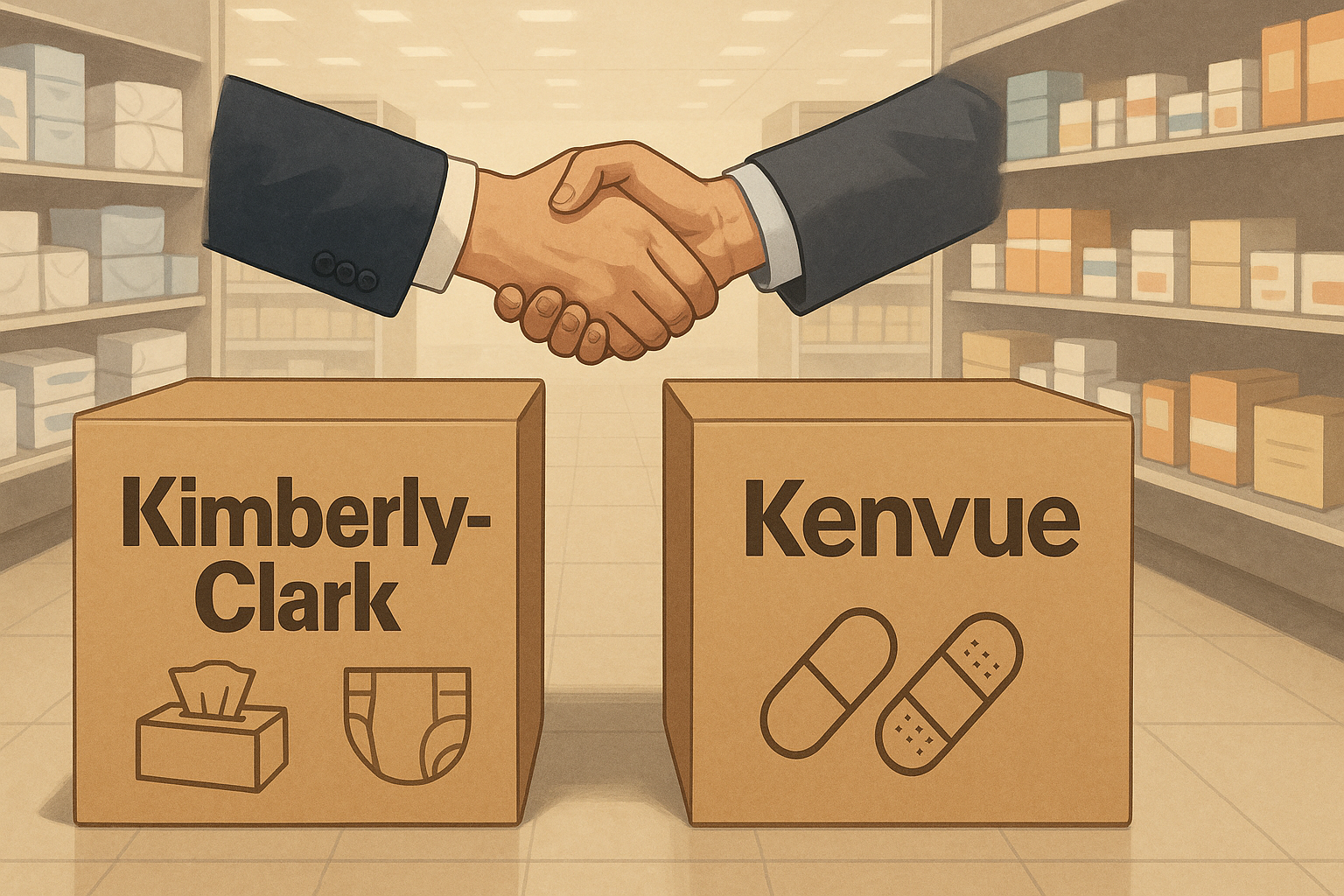
Well, I'll be damned. In the "corporate moves I absolutely didn't see coming" category, Kimberly-Clark just announced it's buying Kenvue—you know, the Johnson & Johnson consumer health spinoff—for a jaw-dropping $48.7 billion.
The deal structure? A mix of cash and shares: $3.50 plus 0.15 Kimberly-Clark shares for each Kenvue share. When I first spotted the headline scrolling through my phone this morning, I nearly spilled my coffee. The Kleenex and Huggies people are buying the Tylenol and Band-Aid folks? Come again?
But after making a few calls and thinking it through, there's a peculiar logic to this corporate marriage—though whether it's brilliant strategy or boardroom folly remains an open question.
Marriage of the Medicine Cabinet and the Paper Products Aisle
What we're witnessing here is essentially a middle-aged corporation's version of portfolio diversification. Kimberly-Clark, after decades of dominating bathroom tissue and diaper aisles, is essentially saying, "Maybe we should branch out a bit before our core categories get completely disrupted."
The strategy makes a certain sense. Both companies traffic in what economists call "consumer staples"—products people buy regardless of economic conditions. Your headache doesn't care about inflation rates, and your baby certainly won't stop needing diapers during a recession.
"The combination is highly complementary," Kimberly-Clark CEO Mike Hsu declared in the announcement. Translation: "We already own the bathroom and nursery shelf space, might as well grab that medicine cabinet real estate while we're at it!"
I've covered consumer goods for years, and this move reflects a defensive posture as much as an offensive one.
Fighting the Private Label Menace
Let's talk about the elephant in the retail aisle: store brands. Both Kimberly-Clark and Kenvue have watched with horror as retailers from Walmart to Amazon have rolled out increasingly sophisticated private label alternatives at significantly lower price points.
When Target can sell acetaminophen for 40% less than Tylenol, or toilet paper that's "just as soft" as Cottonelle for a fraction of the price... well, you've got a problem.
The traditional corporate defense? Get bigger. Much bigger.
With combined annual revenue pushing $25 billion, the new Kimberly-Clark will command significantly more shelf space and negotiating power with retailers. It's the corporate equivalent of bulking up to avoid getting sand kicked in your face at the beach.
But haven't we seen this movie before? The consumer products industry went through massive consolidation in the '90s and 2000s, only to see many of those same conglomerates later break apart when activist investors started demanding "focus" and "unlocking shareholder value." (Remember when Kraft split into Kraft and Mondelēz? Or when Altria spun off Kraft in the first place?)
Heck, Johnson & Johnson only spun off Kenvue last year, and here we are already repackaging it into another conglomerate. The corporate circle of life moves mysteriously fast these days.
The Debt Question: A $50 Billion Elephant
Let's not sugarcoat it—this deal is expensive. At roughly 15 times EBITDA for Kenvue, Kimberly-Clark isn't exactly finding a bargain in the clearance bin.
The company is taking on massive debt to finance this acquisition. While interest rates are finally moderating after the Fed's recent cuts (making the timing somewhat sensible), Kimberly-Clark already had about $8 billion in debt. This deal will multiply that several times over.
Can they handle it? The company is betting big that the combined entity will generate enough cash to manage this debt mountain while delivering the promised $450 million in annual cost "synergies" (corporate-speak for "we're firing a bunch of people with redundant jobs").
Sometimes these bets pay off handsomely. Sometimes they lead to years of crippling interest payments and eventual write-downs. I've seen both scenarios play out over my years covering these industries.
The Circular Logic of Corporate Strategy
There's something almost poetic about the circularity here. Johnson & Johnson decided just last year that it wanted to focus on its pharmaceutical and medical device businesses, spinning off its consumer brands. Now Kimberly-Clark is essentially saying, "Thanks for decluttering—we'll take those consumer brands off your hands!" Just with a hefty markup attached, of course.
It's worth remembering that pharmaceuticals (even over-the-counter ones) and paper products operate on fundamentally different business models. One depends on patents, R&D pipelines, and regulatory approvals; the other on brand loyalty, distribution networks, and incremental innovation.
Companies have been combining and separating these businesses for decades, like corporate strategists with ADHD who can't decide what portfolio structure works best.
The Risks Nobody's Talking About
When deals this size get announced, it's always worth asking what might lurk beneath the surface.
Kenvue still faces ongoing litigation related to talc in baby powder, though J&J kept most of the significant liabilities in the spinoff. Still, is Kimberly-Clark inheriting more risk than they realize? I asked two M&A attorneys about this—both expressed mild concern but thought the due diligence process had likely caught any major issues.
There's also the existential question facing all premium consumer brands: Will inflation-weary shoppers continue paying top dollar for branded products when cheaper alternatives sit right next to them on the shelf? The premium that Tylenol commands over generic acetaminophen has been shrinking for years.
And never, ever underestimate integration challenges. I've watched dozens of mergers fall short of their lofty synergy targets while integration costs ballooned. Combining two massive corporate cultures is messy, expensive work—no PowerPoint presentation can fully capture the human complications.
Wall Street's Cold Shoulder
Investors seem... unimpressed. Kimberly-Clark shares dropped nearly 10% on the announcement day. This isn't shocking—acquiring shareholders typically hate big, debt-financed deals, preferring the sugar rush of share buybacks and special dividends to the delayed gratification of strategic acquisitions.
But the market's initial reaction isn't always right. If Kimberly-Clark can successfully integrate Kenvue and deliver those promised synergies while cross-selling across their expanded portfolio, this could look brilliant in retrospect.
The combined company will control an impressive array of brands that people interact with daily, from Huggies to Tylenol to Neutrogena to Cottonelle. That's a formidable consumer products empire spanning multiple high-margin categories.
In a way, this strategy is refreshingly simple: If people need it regularly and will pay a premium for a trusted brand, it's worth owning. From cradles to medicine cabinets to toilet paper dispensers, Kimberly-Clark is positioning itself as the company that helps you through life's messiest moments.
Whether that positioning justifies a $48.7 billion price tag? That's the multi-billion-dollar question that'll take years to answer.


