
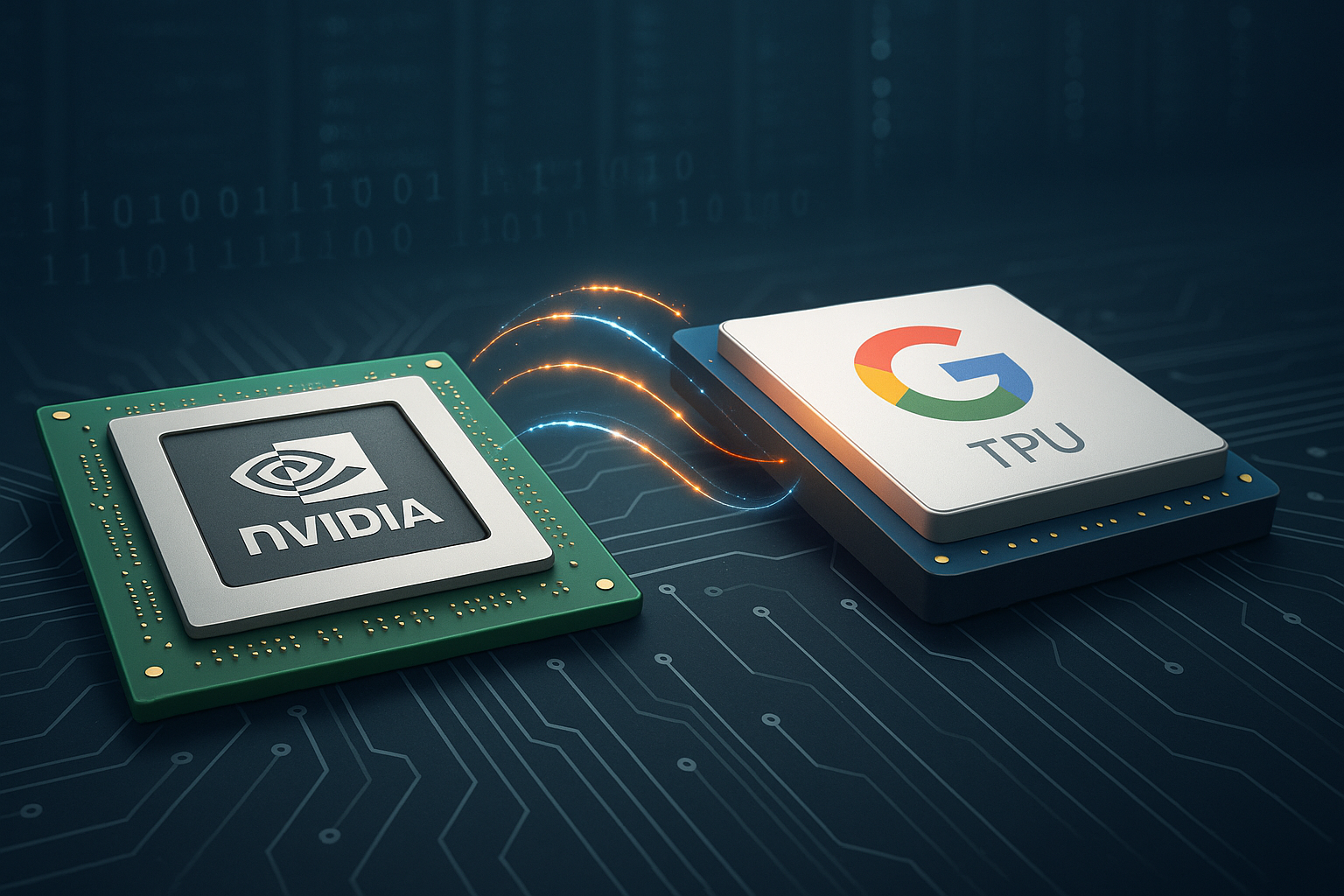
Google's Tensor Processing Units have been making waves lately, prompting a flurry of hand-wringing about NVIDIA's seemingly unassailable position in the AI hardware market. The anxiety isn't entirely misplaced, but it misses some fundamental realities about how technology ecosystems evolve.
I've been tracking the semiconductor space for over a decade now—back when AMD was that scrappy underdog folks thought might someday capture 10% of the server market. (Quaint, isn't it?) The pattern repeats with almost clockwork precision: dominant player sits comfortable, challenger emerges, markets panic, and then... well, we all realize technology rarely works as a winner-take-all proposition.
NVIDIA at $180? Still looks undervalued to me, despite that jaw-dropping run-up. My analysis points to $210 by December and potentially—if several factors align just right—$260 by late 2025. Here's why the TPU threat isn't keeping me up at night.
First, let's get clear about what TPUs actually are. They're specialized accelerators—not GPU replacements—designed specifically for deep learning workloads, particularly those massive language models everyone's obsessed with. Google built them initially for their own use, then made them available through Google Cloud. Impressive silicon? Absolutely. Direct NVIDIA killers? Not even close.
This distinction matters more than most investors realize. GPUs function as the Swiss Army knives of computational acceleration—they handle training, inference, scientific computing, graphics (obviously), and practically anything requiring parallel processing. NVIDIA's real moat isn't just their chips but the CUDA ecosystem that's become the de facto language of AI development. Every ML engineer I've spoken with, every research lab, every startup with AI ambitions is building on CUDA. That kind of entrenchment doesn't evaporate overnight just because Google built a better matrix multiplication chip.
We've seen this movie before, haven't we? AWS developed their Graviton processors, but Intel and AMD still dominate data centers. Apple created those remarkable M-series chips, yet Qualcomm continues to thrive. Markets segment. They specialize. They rarely produce single winners.
Look, the AI compute market is expanding so explosively that multiple players will inevitably prosper simultaneously. We're witnessing the early innings of a computational revolution that will demand magnitudes more processing power than currently exists. So NVIDIA captures a smaller slice of a vastly larger pie? That's still growth any company would kill for.
For serious investors (rather than the Twitter punditry), the question isn't "Will TPUs hurt NVIDIA?" but "How is the AI acceleration market stratifying?" The natural segmentation is becoming clearer:
- Cloud giants building custom silicon for internal infrastructure (Google's TPUs, Amazon's Trainium)
- GPUs maintaining dominance for general-purpose AI development and enterprise applications
- ASICs proliferating for specific workloads and edge computing
Jensen Huang—having covered his presentations since 2018, I can tell you he's one of the sharpest CEOs in tech—understands this dynamic better than most analysts. That explains his pivot from selling chips to offering full-stack AI solutions. The Blackwell architecture, the upcoming Rubin platform, their expanding software ecosystem... these aren't just silicon plays but calculated ecosystem moves.
Markets overreact to competitive threats. Always have. Remember when the iPhone was supposedly going to destroy NVIDIA because mobile GPUs would make desktop graphics obsolete? Or when crypto mining collapsed and was "definitely" going to devastate their business model? The doomsayers keep getting it wrong because they underestimate both market expansion and NVIDIA's adaptability.
So yes, at $180, NVIDIA remains a buy in my book. Not because TPUs won't succeed—they will, within their domain—but because AI computing needs multiple winners, and NVIDIA has positioned itself at the center of the broader ecosystem.
Could NVIDIA stumble? Sure. But it won't be because Google made a good TPU. It would be because they missed the next paradigm shift entirely. And so far, Jensen has demonstrated an almost uncanny ability to skate where the puck is heading.
(Disclaimer: I hold positions in NVIDIA and other semiconductor companies mentioned in this analysis. This represents my personal opinion, not investment advice.)


