
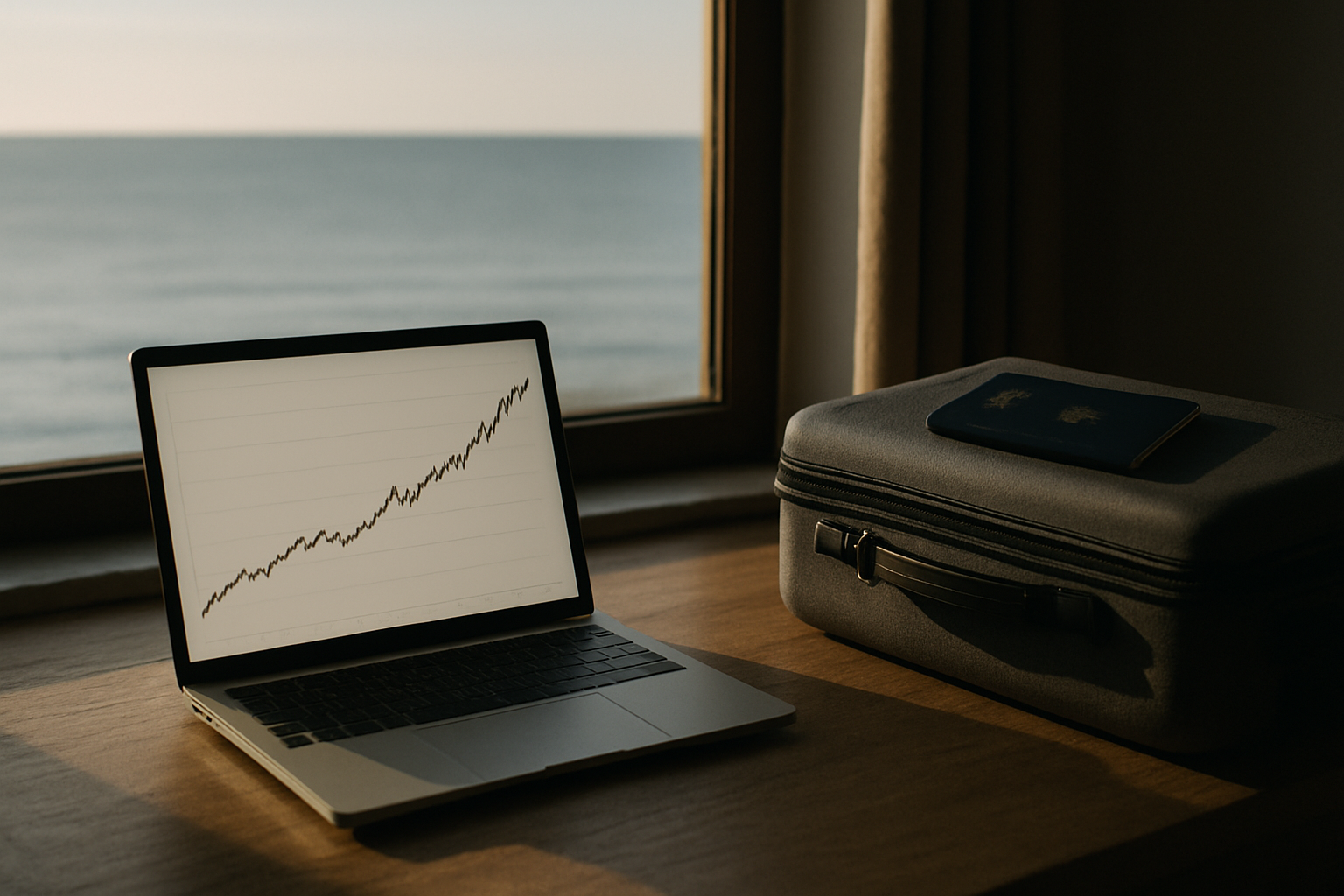
Have you ever wondered what would happen if you just... walked away from your investments for years? Not checked a single balance, ignored every market correction, and simply let compound interest do its mysterious dance undisturbed?
It's a thought experiment that became reality when I received an unusual query recently: what should someone do with their investments if they're about to embark on a multi-year technology fast? No portfolio checking, no panic selling during crashes, no jubilation during rallies. Just set it and forget it—for years.
There's something deliciously contrarian about this approach in our hyperconnected age. While most of us are tapping our investment apps with the regularity of lab rats hitting a pleasure lever, someone's preparing to place their financial future in suspended animation.
From Day Trading to Deep Freeze
The irony wasn't lost on me. A day trader—someone accustomed to the adrenaline rush of minute-by-minute market movements—forced to think in terms of half-decades rather than half-hours. Talk about an extreme lifestyle pivot.
Look, the instinct to shift from active trading to broad market indexes shows good sense. Historically, the S&P 500 has delivered average annual returns around 10% (though inflation takes its bite, of course). More importantly, the mathematics of probability work in your favor with a longer timeline—the chance of positive returns over multi-year periods approaches something close to certainty.
But what about those "global tensions" that seem to be multiplying like rabbits these days? Should our soon-to-be-disconnected investor hedge with gold?
Gold vs. Stocks: The Long-Term Matchup
Gold has an impressive resume—5,000 years as humanity's go-to store of value isn't nothing. But here's the catch (and it's a big one): over the past century, it's been thoroughly outshined by ordinary equities.
Since Nixon severed the dollar's connection to gold in 1971, the shiny metal has returned approximately 7.5% annually. Not terrible... until you compare it to the S&P 500's 10.5%. That three-percentage-point difference, compounded over decades, is the difference between retiring comfortably and retiring extravagantly.
I've spent enough time analyzing gold's performance to know its one true strength: it tends to zig when markets zag. During the 2008 financial crisis—which feels like ancient history now but was absolutely terrifying in the moment—gold gained about 5% while the S&P 500 plunged 37%.
The problem? Gold typically outperforms during specific crisis windows. And our investor won't be around to time anything.
The Buffett Approach (Minus the Billions)
Warren Buffett—who has forgotten more about investing than most of us will ever learn—once proposed what might be the ultimate low-maintenance portfolio: 90% in an S&P 500 index fund and 10% in short-term government bonds.
His reasoning was characteristically straightforward: "Any investor can obtain such an index at virtually no cost and with minimal effort. Those who passively put 10% of their money in short-term government bonds and 90% in a very low-cost S&P 500 index fund will actually outperform most investment professionals."
When someone who could afford literally any investment advice in the world suggests something this simple... maybe we should listen?
For our tech-fasting investor, this approach has several compelling advantages:
- Zero maintenance required (critical when you'll be unreachable)
- Built-in diversification across 500 major companies and sectors
- Rock-bottom fees (more of your money actually working for you)
- Historical reliability—this approach has never lost money over any 20-year period
That last point bears repeating. Never. Lost. Money. Over. Twenty. Years.
The "I'm Outta Here" Portfolio
If I were personally vanishing from the financial grid for several years (sometimes I'm tempted, honestly), I'd structure what I call the "Sleep Well" portfolio:
- 70-80% in a total market index fund (VTI or equivalent)
- 10-20% in international developed markets (VEA or similar)
- 10-20% in short-term government bonds (VGSH or similar)
And maybe—just maybe—a small 5% gold allocation as insurance against truly apocalyptic scenarios. Though if we enter a world where gold is the only performing asset, our investor might emerge to bigger problems than disappointing returns.
What I absolutely wouldn't do is make sector bets on what might outperform during the absence. Having covered markets since before the 2008 crash, I've seen too many "sure thing" predictions implode spectacularly. Remember when clean energy was guaranteed to dominate the 2020s? Or when crypto couldn't possibly crash? Or—for those with longer memories—when tech stocks were considered invincible in 1999?
Yeah, about those...
The Psychological Advantage
There's something almost Zen-like about this approach to investing. No financial news. No earnings calls. No panic-selling because some analyst with a questionable track record downgraded a stock you own. No FOMO because your insufferable brother-in-law claims to have made a killing on some cryptocurrency you can't even pronounce.
Just the steady drumbeat of compound interest—the force Einstein supposedly called the eighth wonder of the world.
The greatest irony? This forced hands-off approach might actually deliver better returns than what most active investors achieve. Sometimes the biggest threat to your investment success is... yourself.
I've interviewed countless financial advisors over the years, and they all tell me the same thing: their job isn't primarily picking investments—it's preventing clients from sabotaging themselves during market extremes.
Wherever our investor is going for these next few years, perhaps they'll return not just financially better off, but with a perspective that makes them a more patient, disciplined investor than when they left.
After all, distance provides clarity. And in investing, clarity is worth its weight in gold—or better yet, index funds.


