
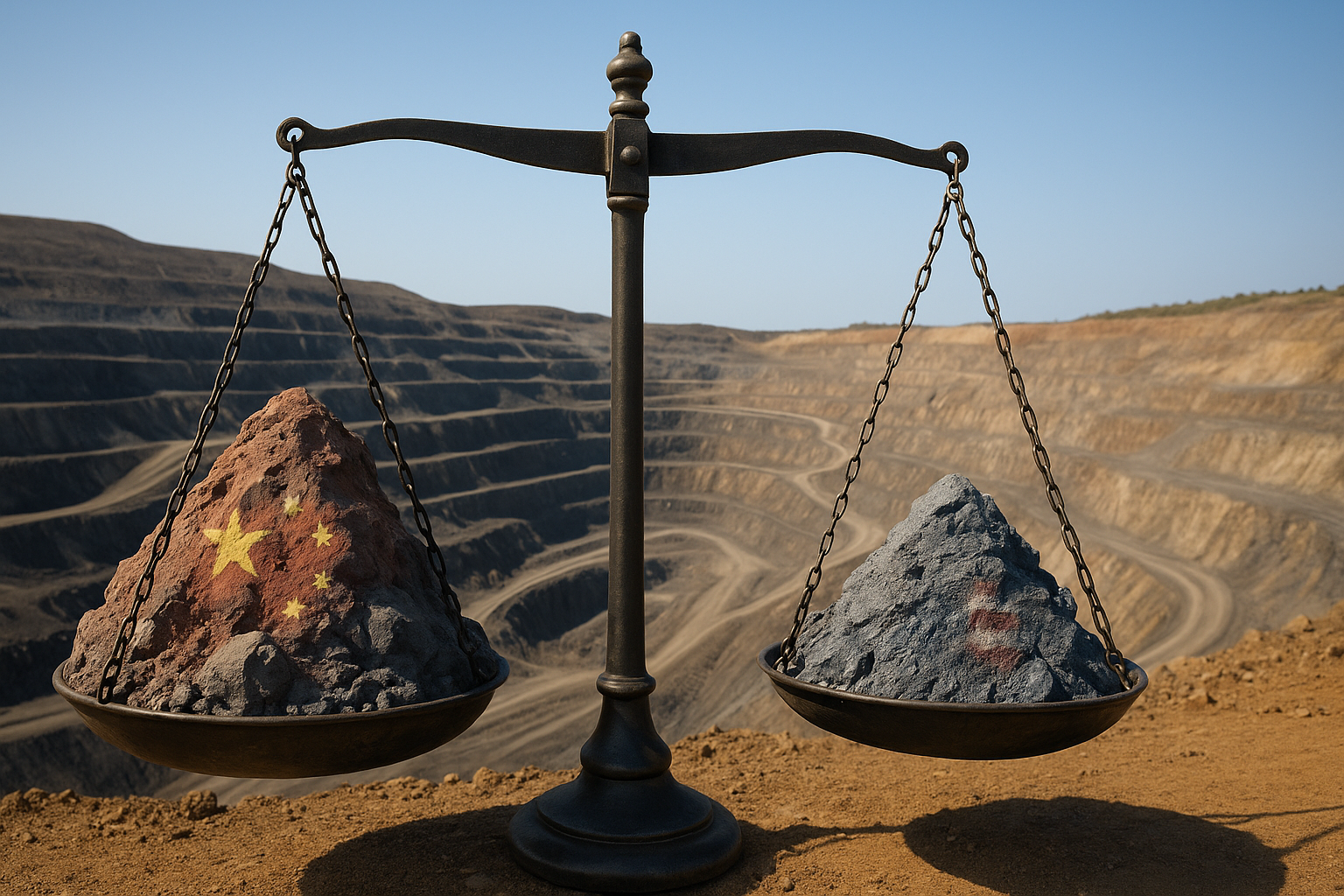
The economic tug-of-war between Washington and Beijing has found a new battleground—and it's buried in the Earth's crust. Next week, the House Select Committee on the Chinese Communist Party (can we please get a shorter name for this committee?) will hold a hearing with the not-so-subtle title "Predatory Pricing: How the CCP Manipulates Global Mineral Prices to Maintain Its Dominance."
So much for diplomatic ambiguity.
The witness list reads like a who's who of America's fledgling critical minerals resistance. Jonathan Evans from Lithium Americas will be there, representing a company fighting to open the country's first major lithium mine in what feels like forever. Matthew Sloustcher from MP Materials—operators of the lone American rare earths mine—will share the spotlight with Jonathan Rowntree of Niron Magnetics, a firm developing alternatives to China's near-monopolized rare earth magnets.
I've covered resource politics for years, and this lineup signals something important: Washington is finally getting serious about mineral security. Maybe.
How China Cornered the Market
Let's back up a bit. China's stranglehold on critical minerals didn't materialize overnight—it's the result of decades of strategic patience and planning that would make Machiavelli proud.
The playbook went something like this: invest heavily in mining and processing, undercut global competitors on price (environmental regulations? what environmental regulations?), watch Western operations fold, then—voilà—enjoy monopoly status. Economists have fancy terms for this strategy. I prefer to call it "the mineral long con."
The numbers tell the story. China controls roughly 60% of rare earth mining and—this is the kicker—nearly 90% of processing capacity. For minerals essential to everything from smartphones to fighter jets to those Tesla Model Ys clogging California highways, that's... concerning.
"This is a textbook case of market manipulation," a congressional staffer told me last week, speaking on background because they weren't authorized to comment publicly. "We've essentially outsourced our industrial future to a strategic competitor."
Washington's Industrial Policy Renaissance
What makes this particular hearing fascinating isn't just the diagnosis but the treatment plan. The committee's bipartisan report reads like industrial policy's greatest hits album.
They're proposing everything from a "Critical Minerals Czar" (because what Washington needs is definitely another czar) to a Strategic Resources Reserve modeled after the petroleum reserve. There's even talk of temporary price floors for imports to prevent Chinese dumping—essentially creating a protective umbrella for domestic producers without resorting to blunt tariffs.
Look, this represents a sea change in American economic thinking. After decades of "the market knows best" orthodoxy, we're witnessing real-time evolution toward something more... interventionist.
Some of these ideas have genuine merit. The Strategic Resources Reserve concept would allow the government to act as buyer of last resort, providing price stability and ensuring mines can stay open during market downturns. Having covered mining finance since the mid-2010s, I can tell you this kind of stability mechanism would be a game-changer.
Then there's the permitting reform piece—and hoo boy, that's where things get sticky.
The U.S. has incredible mineral deposits. Really world-class stuff. But they typically stay buried while environmental impact statements multiply and lawsuits stack up like Jenga blocks. I've visited proposed mining sites where executives joke (grimly) about whether they'll see production before retirement. Usually, the answer is no.
The Green Energy Paradox
Here's the thing about critical minerals that makes this whole situation deliciously ironic: we need massive amounts of them to build a green economy.
According to International Energy Agency estimates, a typical electric vehicle requires six times the mineral inputs of a conventional car. An onshore wind plant needs nine times more mineral resources than a gas-fired power plant. Solar? Mineral-intensive. Grid-scale batteries? Extremely mineral-intensive.
So we're caught in this absurd catch-22: we can't address climate change without clean energy technologies, but we can't build those technologies without minerals currently dominated by... the world's largest carbon emitter.
(The universe has a strange sense of humor, doesn't it?)
This creates what energy analysts call a "strategic minerals trilemma": security of supply, environmental protection, and affordable prices. Pick two—because getting all three seems nearly impossible under current conditions.
Wall Street's Mineral Fever
The market has been anticipating some form of government action in this space. Shares of companies like MP Materials have been bouncing around like a seismograph during an earthquake as investors try to gauge how much federal support might materialize.
MP's stock has dropped nearly 70% from 2022 highs but has shown recent signs of life as industrial policy gains momentum. I spoke with three investment analysts covering the sector last month—all expressed cautious optimism about Washington's newfound minerals enthusiasm.
"The question isn't whether government support is coming," one told me, "it's whether it will be substantial enough and last long enough to matter."
That's the rub. Previous attempts to rebuild America's critical minerals supply chain have fizzled amid bureaucratic complexity, environmental opposition, and simple lack of follow-through. The Defense Department has been warning about these vulnerabilities for years, but translating concern into action has proven... challenging.
This time feels different, though. The geopolitical stakes are higher, and even traditional free-market Republicans are embracing industrial policy when it comes to countering China. Nothing brings Washington together quite like a common adversary.
Where Do We Go From Here?
The upcoming hearing represents an important step in recognizing the problem, but recognition alone won't mine a single gram of lithium or rare earths.
Creating a domestic supply chain for critical minerals isn't a quick fix—it's a decade-long marathon requiring consistent support across presidential administrations and congressional sessions. That kind of persistence hasn't exactly been America's strong suit lately.
For now, the question remains: Is this the beginning of a serious national effort to secure mineral supply chains, or just another congressional hearing that generates headlines but little action?
I'll be watching next week's testimony closely for clues. After decades of neglect, America is finally waking up to the mineral security challenge. Whether we're waking up in time—well, that's the trillion-dollar question.
In the global mineral game, China has been playing three-dimensional chess while we've been playing checkers with missing pieces. Maybe, just maybe, we're finally learning some new moves.


