
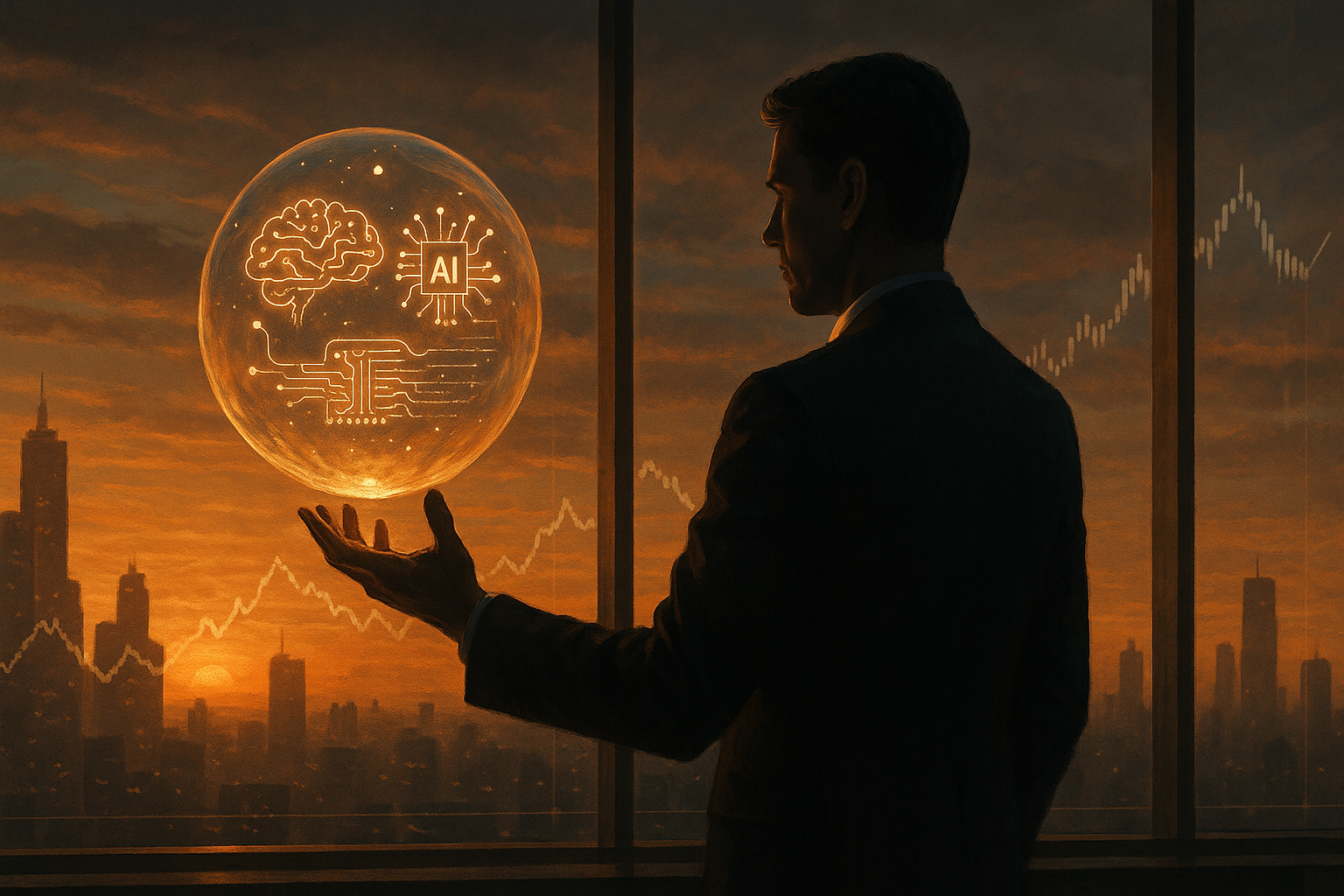
Sundar Pichai just had his Alan Greenspan moment.
In a remarkably candid BBC interview, Google's parent company Alphabet CEO warned that "no company is going to be immune" if the AI bubble bursts. He acknowledged "some irrationality" in today's AI investment frenzy—words that instantly transported me back to Greenspan's famous "irrational exuberance" speech before the dotcom crash.
The timing couldn't be more ironic. Here's a tech executive acknowledging potential market insanity while his company pours billions into the very technology that might be overheating. Talk about having your cake and eating it too.
I've covered tech bubbles since the early 2000s, and Pichai's high-wire communication act fascinates me. On one hand, he's signaling to Wall Street that Alphabet sees the risks clearly (we're the responsible adults!). On the other, he's carefully defending AI's fundamental value, comparing it to the internet's undeniable impact.
"None of us would question whether the internet was profound," Pichai noted. Well, sure—after the survivors emerged from the dotcom wreckage.
What we're witnessing is what I'd call "preemptive bubble acknowledgment." Tech executives learned from 2000 that total bubble denial makes you look foolish later. The smarter play? Acknowledge the excess while positioning your company as a likely survivor.
The parallels to the late 90s are striking:
- Astronomical capital flowing into unproven business models
- Companies with minimal revenue commanding staggering valuations
- A gold rush mentality gripping investors
- Tech leaders simultaneously warning about and feeding the frenzy
- The persistent belief that "this time is different" (is it ever?)
Look, Pichai isn't wrong that the internet ultimately transformed everything despite the crash. Amazon was nearly written off in 2001... before becoming one of history's most valuable companies. Google itself emerged from that era to dominate digital advertising.
So the real question isn't whether AI matters—it clearly does—but which companies are the next Amazons and which are the next Pets.coms.
I'm particularly struck by Pichai's framing that "no company is going to be immune." This distributes risk across the industry (we're all exposed!) while subtly implying that Google's massive war chest gives it better survival odds than most. Clever.
What Pichai conveniently omits speaks volumes. No mention of how current AI revenue compares to investment levels. Nothing about the staggering electricity consumption these models require. Radio silence on the regulatory risks that could upend AI economics overnight.
The cycle we're witnessing isn't new. A promising technology emerges, capital floods in, expectations skyrocket beyond reality, a correction follows, survivors emerge stronger, and the cycle resets around something new. We've seen this movie before—with PCs, the internet, mobile, social media, crypto... and now AI.
But this bubble has a unique wrinkle. Unlike recent tech booms fueled by free money policies, this one's happening as interest rates rise. Companies must justify these massive AI investments when capital actually costs something. What a concept!
Having watched several tech bubbles inflate and pop, I'd bet my journalist's salary (such as it is) that we're heading for an AI winter—not AI's death, but a sobering period where expectations crash back to earth, funding dries up, and companies must show actual returns on these billions they're spending.
AI is important. Revolutionary, even. But are current valuations rational? History suggests we typically overestimate short-term impacts while underestimating long-term transformations.
And y'know what? Bubbles aren't entirely bad. They fund infrastructure and R&D that outlive the eventual correction. The internet backbone built during the dotcom boom served us for decades.
As for Pichai's warning... it's refreshing, even if calculatedly strategic. In tech's endless boom-bust cycle, sometimes acknowledging the game is the savviest move of all.
Just don't expect him to be the one to stop the music while everyone's still dancing.


