
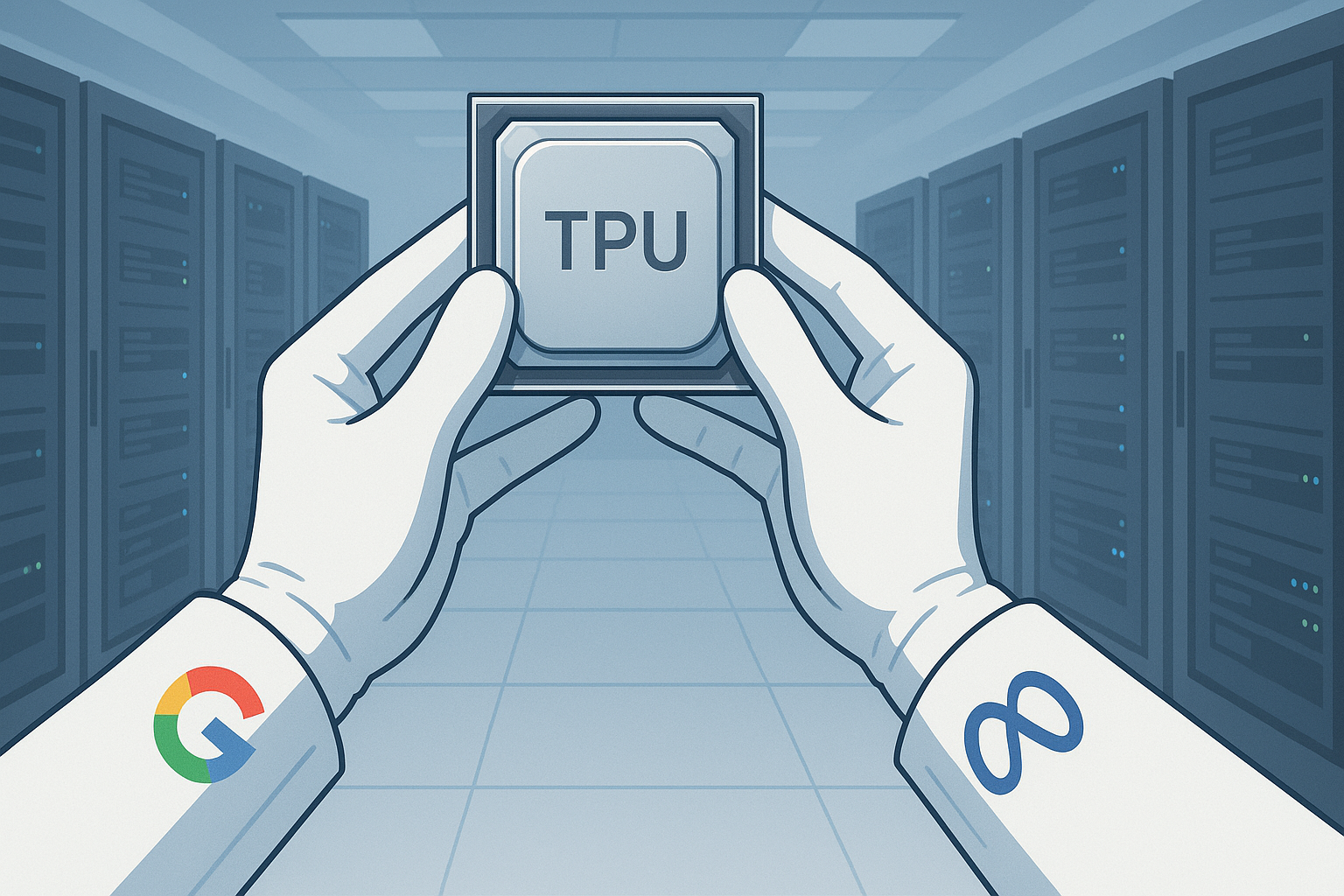
Google and Meta are in early talks about a potential partnership that could see Meta deploying Google's Tensor Processing Units (TPUs) in its data centers, according to sources familiar with the discussions. The negotiations—still preliminary and far from any guarantee—represent the latest attempt to challenge Nvidia's stranglehold on the AI chip market.
Look, we've all watched Nvidia transform from a gaming graphics card maker into the indispensable backbone of the AI revolution. The company has been printing money faster than the Fed during a financial crisis. Its recent quarterly results didn't just beat expectations—they obliterated them, sending the entire stock market into a tizzy.
But the dynamics might be shifting.
Google has been developing its TPU chips since 2016, though they've remained largely an in-house solution powering the company's own AI systems. Despite Google's pioneering role in developing the machine learning technologies that sparked the current AI boom, the company has struggled to convert that technical leadership into the kind of market dominance Nvidia now enjoys.
I've tracked Google's chip ambitions for years, and there's always been this peculiar disconnect between their technical capabilities and commercial success. They've consistently been early to innovations but late to turning them into products other companies actually want to buy.
For Meta, the appeal is straightforward. The company is burning through billions on AI investments as Mark Zuckerberg pivots the social media giant toward his vision of AI-powered services. That spending spree has been a windfall for Nvidia, which supplies the vast majority of chips powering Meta's AI initiatives.
"Meta is essentially looking for leverage," a senior semiconductor analyst told me last week over coffee (they requested anonymity because they weren't authorized to discuss either company's strategies). "Even if they don't fully commit to Google's TPUs, just having a credible alternative strengthens their negotiating position with Nvidia."
The timing is particularly interesting. Nvidia recently crossed the $2 trillion market cap threshold—a number so massive it's hard to conceptualize without comparing it to the GDP of actual countries. This isn't just about current market share; it reflects Wall Street's belief that Nvidia has built an unassailable moat around its AI chip business.
That belief might be premature.
What we're witnessing is a classic case of supplier concentration risk. When one vendor controls so much of a critical input, customers inevitably get nervous. Meta, Google, Microsoft, Amazon—they're all uncomfortably dependent on Nvidia chips to power their AI strategies, and they're all working on alternatives.
The difference now? There seems to be growing willingness to collaborate rather than go it alone.
"Building competitive AI chips isn't just expensive—it's fiendishly difficult," explained another industry executive who's worked with both companies. "The engineering talent is scarce, the design complexity is enormous, and the manufacturing constraints are real. Partnerships make sense."
For Google, a deal with Meta would instantly transform TPUs from a curiosity into a credible market alternative. It would provide validation that their chips can perform at scale outside Google's own carefully controlled environment. And it would align with Google's broader strategy of positioning itself as essential infrastructure for the AI era—especially as its core search business faces unprecedented challenges from AI-powered competitors.
(Worth noting that Google declined to comment for this article, while Meta representatives didn't respond to multiple inquiries.)
There's also a regulatory angle here that shouldn't be overlooked. As AI systems become increasingly critical infrastructure for everything from healthcare to finance to national security, regulators worldwide are growing concerned about the concentration of computing power. A more diverse chip ecosystem might actually be welcomed by government officials worried about systemic risk.
Will this partnership materialize? History suggests caution. Tech partnerships designed to counter dominant players have a decidedly mixed track record.
Remember when Microsoft and Nokia joined forces to challenge Apple and Google in smartphones? That ended with Microsoft writing down nearly the entire $7.6 billion Nokia acquisition. Or when Intel and Micron collaborated on 3D XPoint memory technology, only to go their separate ways after years of investment?
The technology landscape is littered with the remnants of strategic partnerships that looked promising on paper.
But the AI chip market represents such an enormous opportunity—and Nvidia's dominance has created such a powerful incentive for collaboration—that this time might genuinely be different. Meta and Google both have deep pockets, technical expertise, and compelling strategic reasons to make this work.
The stakes couldn't be higher. We're not just talking about corporate fortunes here, though those are certainly significant. The architectures that power AI systems will shape technological development for decades to come, influencing everything from scientific research to creative industries to how we interact with computers.
Which seems, you know, kind of important.


