
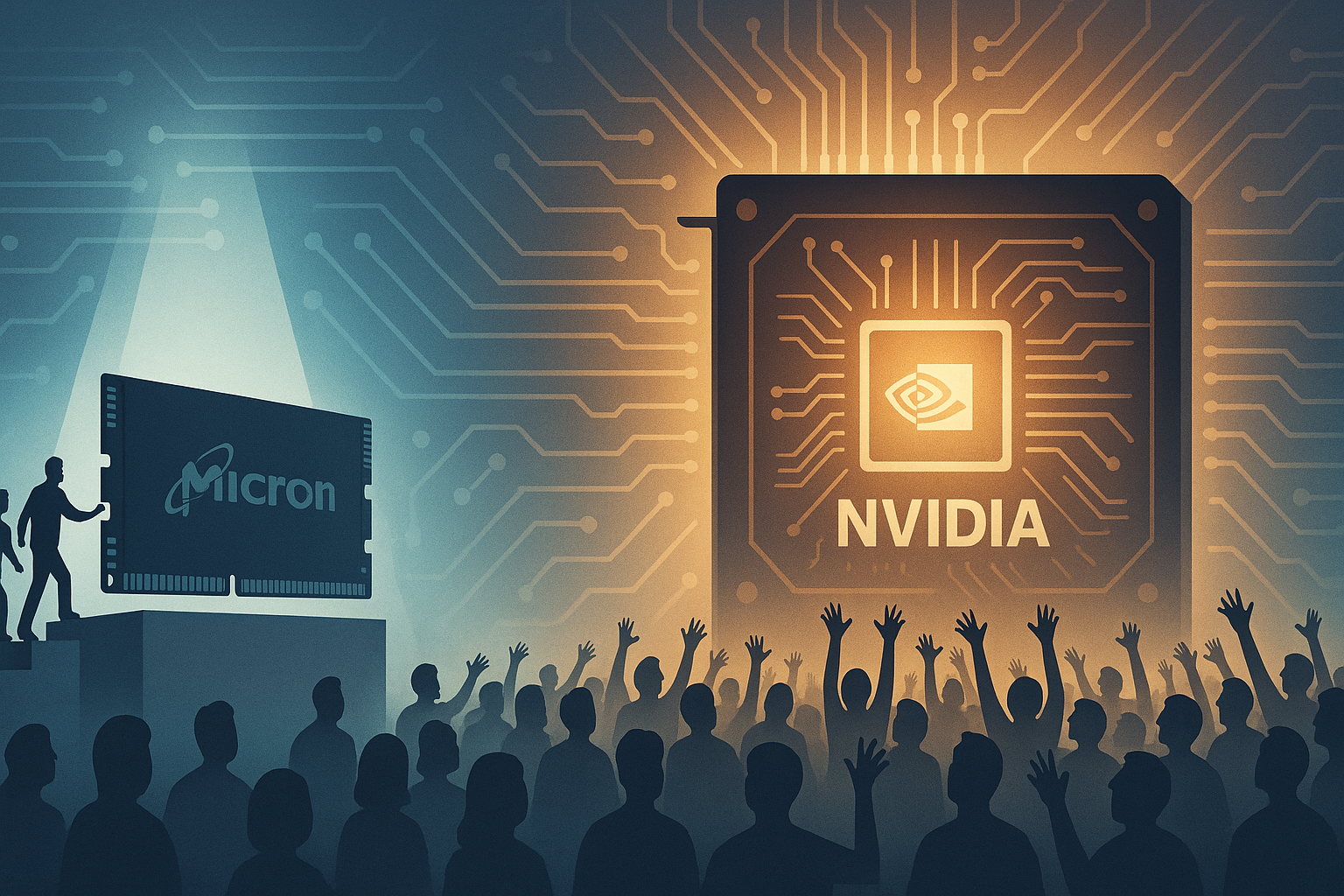
The stock market's obsession with NVIDIA has reached fever pitch, with investors happily paying astronomical valuations for the AI chip giant. But while everyone's fighting for a seat on the Jensen Huang express, they might be overlooking a far more interesting opportunity hiding in plain sight: Micron Technology.
I've been watching this dynamic unfold for months now, and it's becoming increasingly clear that the market's tunnel vision might be creating a genuine investment opportunity.
Let's be straight about this - NVIDIA deserves plenty of credit. They're selling the essential tools in today's AI gold rush, those incredible GPUs transforming electricity into... well, everything from medical breakthroughs to chatbots that write your kid's homework. The company has built an ecosystem that's practically impenetrable at this point. Their market dominance makes perfect sense.
But here's what I keep thinking about: AI isn't just about computing power. It's increasingly about data management. And all that data needs somewhere to live.
The Second Wave of AI Infrastructure
There's been a fascinating shift in the AI conversation lately. We started with "more computing power solves everything!" and have gradually moved to "wait a minute—how do we actually feed all this data to these hungry machines?" It's a classic throughput problem that follows every major computing revolution.
Think of each new NVIDIA GPU generation as a teenager with an increasingly voracious appetite. Sure, they can process more information, but only if you're constantly stocking that digital fridge. That's where Micron comes in with high bandwidth memory, DRAM, and enterprise-grade storage—the components nobody talks about but everybody desperately needs.
I like to visualize AI infrastructure as expanding circles. NVIDIA dominated the first wave—raw compute. Now we're watching the second wave form—memory and storage. And Micron? They're sitting pretty at the center of that second circle.
(The third wave will probably be power infrastructure and cooling systems, but let's save that conversation for when I haven't been up since 5 a.m. tracking earnings reports.)
The Oil in the AI Engine
If NVIDIA represents the engine of the AI revolution, Micron is essentially the lubrication system. And lemme tell you, anyone who's ever run an engine without oil knows exactly how that story ends!
Micron's HBM3E memory is already finding its way into next-generation AI accelerators. Meanwhile, data center DRAM prices are finally recovering after a brutal downturn. The demand is real, and it's growing exponentially with each new model size increase.
Just consider the scale we're talking about. ChatGPT-4 reportedly needed something like 25,000 GPUs for training. The next generation? Probably multiples of that. Each of those expensive GPUs needs high-bandwidth memory to function properly. This isn't complicated math.
A Tale of Two Valuations
Here's where things get truly interesting for investors. NVIDIA currently trades at a valuation that assumes not just industry dominance but possibly galactic domination. The trade is beyond crowded—it's standing-room-only with people fighting over the few remaining seats.
Meanwhile, Micron still sits in what you might call a "valuation basement"—priced more like a cyclical memory chip manufacturer than a critical AI infrastructure provider. The market hasn't fully connected these dots yet, creating what looks to be a significant gap between price and potential.
From what I can see, Micron's performance is likely to show higher sensitivity to actual AI server deployments than even NVIDIA itself. As AI transitions from experimental projects to production-scale deployment, the memory requirements of these workloads will become increasingly obvious to everyone.
The Road Less Traveled
Now, I'm not suggesting Micron will outperform NVIDIA in absolute terms over the next decade. What I am suggesting is that the risk-reward equation might be considerably more attractive for the less glamorous memory manufacturer.
The conventional wisdom in tech investing has always been to buy the highest-quality company in a growing sector. That's NVIDIA, no question about it. But the contrarian approach—buying the overlooked beneficiary of the same trend—has historically delivered some pretty impressive returns during similar technology transitions.
Remember how AMD emerged from Intel's shadow during the cloud computing explosion? Or how Skyworks rode the iPhone supply chain while everyone obsessed over Apple itself? These second-derivative plays often deliver better risk-adjusted returns than the obvious market darlings.
In the long AI cycle ahead of us, the computing companies will certainly dominate the headlines, but memory companies might actually deliver the most impressive profit growth. And isn't that what investing is ultimately about?
The question isn't whether NVIDIA deserves its premium—it probably does. The question is whether Micron deserves to trade at such a discount given its position in the AI supply chain. As investors begin to recognize the comprehensive scarcity of AI infrastructure components, that gap seems likely to narrow.
But hey, I could be completely wrong. Markets are weird that way. Something to think about next time everyone at your neighborhood barbecue is bragging about their NVIDIA shares.


