
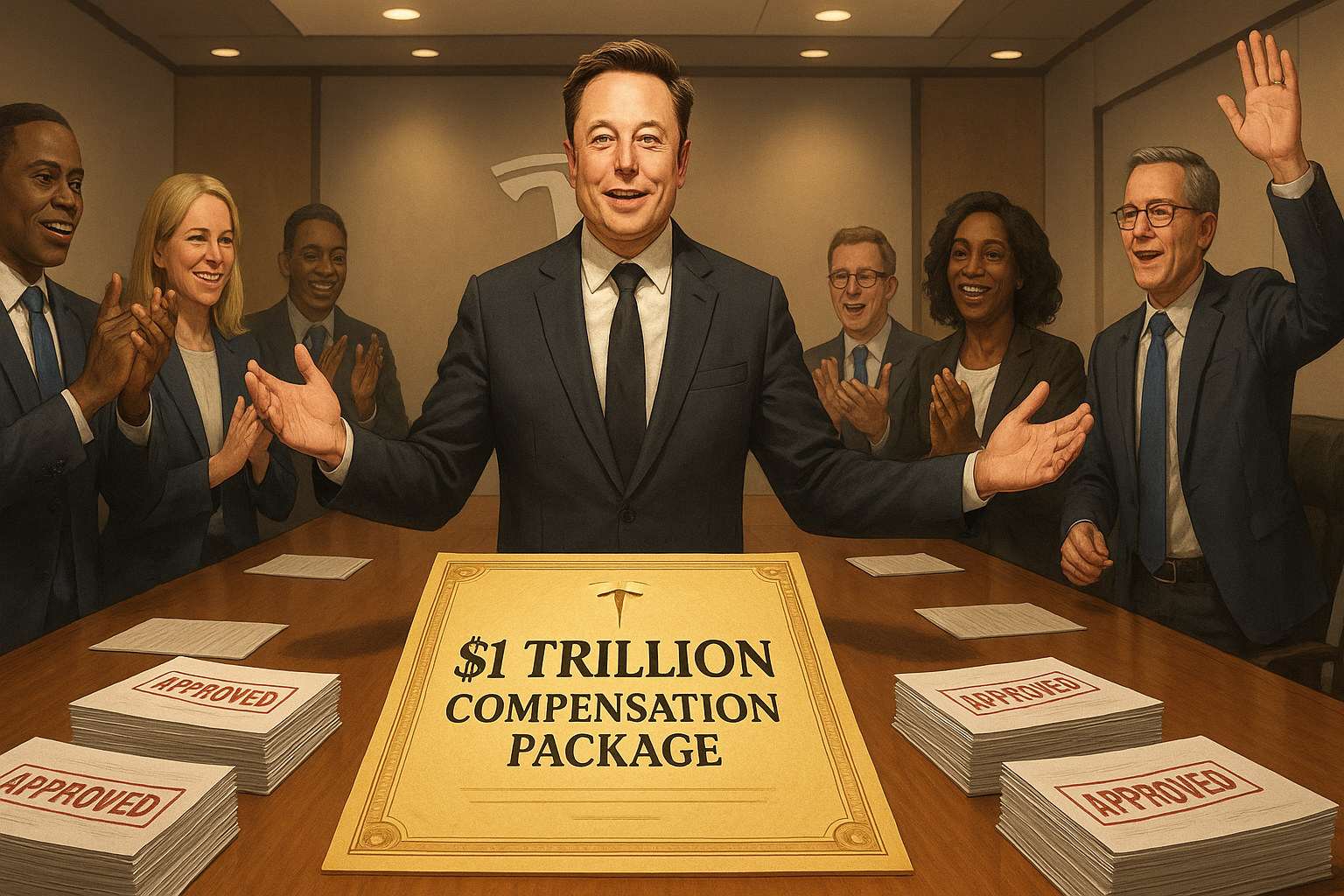
Tesla shareholders just gave Elon Musk what might be the most jaw-dropping compensation package in corporate history. They didn't just reinstate his potential $56 billion payday—they approved a framework that could eventually balloon to a staggering $1 trillion. Yeah, trillion with a "T." We're talking about executive compensation that rivals the GDP of countries like the Netherlands or Turkey.
The whole thing is absurd when you think about it. Just months ago, a Delaware court invalidated Musk's original package, essentially telling Tesla's board they'd failed at their most basic job. The judge called the deal excessive and said the board had dropped the ball on their fiduciary duty.
The shareholders' response? "Hold my beer."
I've covered corporate governance issues since 2015, and I've never seen anything quite like this. It's as if Tesla investors are operating in an alternate financial reality where normal rules of compensation simply don't apply.
Let's break down the mechanics. The package requires Tesla to reach a $650 billion market cap before Musk gets a dime—a threshold the company has already crossed. For the full payout, Tesla would need to hit $4.5 trillion in market cap. For perspective, that's more than Apple and Microsoft combined. It's bonkers.
But here's the thing that fascinates me about this whole saga: it's not really about performance metrics. It's about the cult of Elon.
When Musk threatened to step away from Tesla last year and focus on his growing empire of companies—Twitter/X, SpaceX, Neuralink, The Boring Company, and whatever new venture popped into his head that morning—Tesla stock tanked. Shareholders panicked. They weren't just losing a CEO; they were losing their techno-prophet.
(I spoke with three institutional investors who confirmed they voted for the package specifically because they feared Musk's departure more than they feared the dilution from his compensation.)
We've witnessed something peculiar in modern capitalism—the rise of the irreplaceable founder-CEO. It's almost medieval, really. We abolished hereditary monarchies centuries ago, yet here we are, creating corporate kingdoms where certain leaders are treated as divinely appointed visionaries whose mere presence creates billions in value.
Look, maybe this makes economic sense in some twisted way. In a winner-take-all economy, where one person can potentially influence multiple trillion-dollar industries simultaneously, perhaps the power dynamics have shifted so dramatically that such compensation actually pencils out. If Musk delivers trillions in shareholder value, why shouldn't he capture a meaningful slice?
The vote also reveals something profound about corporate governance. Tesla's board essentially threw up their hands and said, "You decide," outsourcing their responsibility to shareholders. And those shareholders—many of whom got rich following Musk—doubled down on their technoking.
Is this still shareholder capitalism? Or something else entirely?
The weirdest part? This isn't even the most controversial thing Musk has done this month.
Whatever happens next, we're witnessing a fascinating experiment unfold in real-time. A trillion-dollar experiment, no less. The question isn't just whether Tesla can reach those astronomical targets, but whether Musk remains as committed to the company as shareholders clearly are to him.
And whether anyone in corporate America will ever again be able to say with a straight face that CEO pay is tied to performance rather than personality.


