
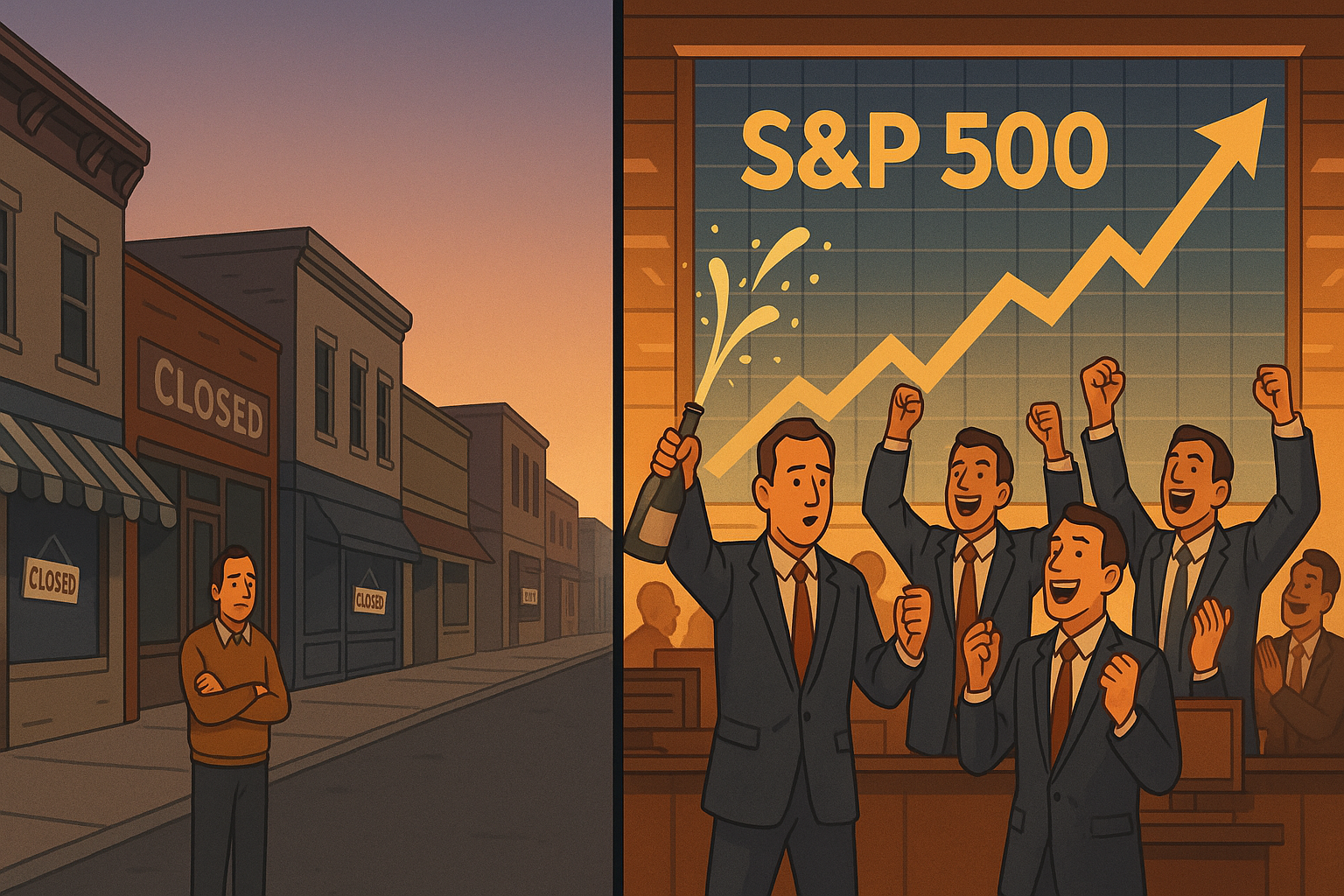
The S&P 500 smashed another record yesterday. The jobs report? A total dud—half the expected growth. Welcome to the bizarre economic landscape of 2024, where bad news somehow translates to champagne corks popping on trading floors.
I've been covering markets for years, and this disconnect still makes my head hurt. GDP barely limping along at 1.6%. Consumer confidence that can't seem to find its footing. Small businesses drowning in high interest payments. And yet...
The market keeps climbing.
Not just climbing—surging, with all the restraint of a lottery winner in a luxury car dealership. PE ratios are stretching into territory that would've seemed hallucinatory a decade ago. (Remember when we used to care about fundamentals? Good times.)
The Divorce of Wall Street and Main Street
Here's the thing—and I know you've heard this before, but it bears repeating—the stock market isn't the economy. Period.
Think about what the S&P 500 actually represents: 500 massive corporations that happen to collect their mail in America. These aren't your neighborhood restaurants or the family-owned hardware store that's been around since your grandpa was a kid. We're talking about behemoths whose operations span continents.
Apple makes more money selling iPhones in Shanghai than many "American companies" generate globally. Microsoft's cloud services exist in some ethereal realm beyond borders. Amazon? Let's be real—it's practically its own sovereign nation at this point.
So when headlines scream about this market-economy divide, what's really happening is simple: corporate giants are feasting while smaller businesses—the actual backbone of employment—are fighting for scraps.
And talk about concentration! The "Magnificent Seven" (Apple, Microsoft, Alphabet, Amazon, Nvidia, Meta, and Tesla) now make up about a third of the S&P's entire value. A third! When seven companies drive most gains, the index becomes about as representative of American business as a Manhattan penthouse is of national housing.
Money, Money Everywhere
Another explanation that doesn't get enough attention: there's still too damn much money sloshing around the system.
Sure, the Fed hiked rates to 5.5%. Sounds restrictive, right? But for major corporations with pristine balance sheets, real rates remain absurdly accommodative. Corporate America's sitting on cash hoards that would make Scrooge McDuck blush. Stock buybacks continue at a pace that would've seemed obscene in earlier eras. Private equity firms are drowning in "dry powder"—Wall Street speak for "we've got billions and need to spend it somewhere."
All this money has to go somewhere. And right now, "somewhere" means stocks—particularly anything with "AI" in the investor presentation.
The AI Religion
Look, I won't pretend to know whether artificial intelligence will fundamentally transform civilization or just give us better autocorrect. What I do know is that markets fall in love with narratives faster than teenagers with pop stars.
The AI story has become the market's new religion. Today's sluggish economic indicators? Mere footnotes compared to the promised land of AI-driven productivity gains that will supposedly rescue us all.
Having covered market manias since the dotcom era, the pattern feels eerily familiar. The technology itself might be revolutionary—but that doesn't mean the valuations make sense.
The Wealth Gap Feedback Loop
Here's the truly troubling part of this whole arrangement. The market boom is creating a massive wealth effect... for people who already have wealth.
Let me hit you with a sobering statistic: roughly 89% of all stocks are owned by the top 10% of households. That's not a typo.
When markets surge while wages barely budge, inequality doesn't just grow—it accelerates. The winners keep winning, economic anxiety spreads like wildfire among everyone else, and eventually, this feeds the kind of political divisions that make Thanksgiving dinner unbearable.
The irony? Markets claim to hate political instability but keep rallying despite (or because of?) increasingly polarized politics. It's like watching someone complain about their diet while devouring a triple cheeseburger.
Where Do We Go From Here?
I wish I had a crystal ball. I don't. Nobody does—though plenty of strategists on CNBC will pretend otherwise.
This disconnect could resolve itself one of two ways: either the economy accelerates to match market expectations, or the market tumbles back to economic reality. History suggests the latter is more common, but timing such corrections is a fool's errand.
The Fed's job right now? Threading a needle in the dark while riding a roller coaster. They're trying to cool inflation without crashing the economy or sending markets into a tailspin. Not exactly an enviable position.
What seems clear is that our current situation—anemic broad economic growth alongside a market rally concentrated in a handful of mega-caps—can't continue indefinitely. Something's gotta give.
Until then, investors keep dancing, some more nervously than others. The music will stop eventually. It always does.
Meanwhile, BlackRock just acquired enough real estate to qualify as a medium-sized country, bond yields did something that made traders choke on their $7 lattes, and somewhere, a hedge fund is imploding spectacularly (we just won't hear about it until the post-mortems three months from now).
Just another day in paradise... for some of us, anyway.


