
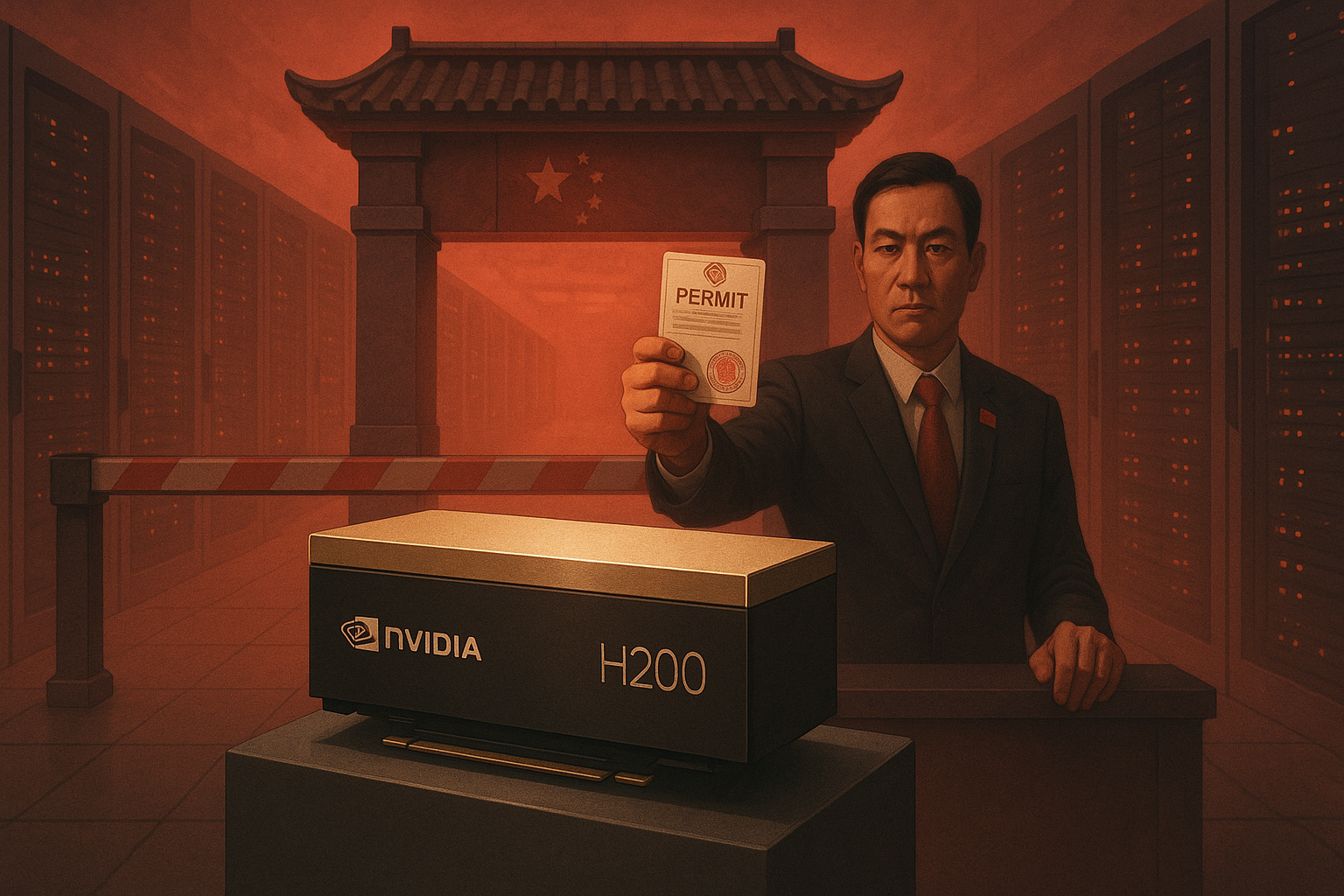
The chess game of global tech politics just took another unexpected turn. China—barely waiting for the dust to settle on the U.S. presidential transition—has apparently decided to restrict access to Nvidia's new H200 AI accelerators within its borders. This comes, ironically enough, right after the Biden administration had green-lit their export.
Talk about perfect timing.
What we're seeing unfold here isn't just another day in the semiconductor wars. It's a fundamental shift in how Beijing approaches technology imports—moving from passive recipient to active gatekeeper. And frankly, it's fascinating to watch.
I've been covering China's tech strategy since before the first export controls were implemented, and this move perfectly illustrates what I call "technological sovereignty through selective access." China isn't rejecting advanced Western tech outright; it's establishing itself as the controlling authority over who gets what within its own ecosystem.
The H200 chips—successors to the vaunted H100s that currently power much of the world's AI infrastructure—aren't just any components. They're the thoroughbreds of the AI race. Sleek, powerful, and absurdly expensive. (A single rack can cost more than a decent-sized house in most American suburbs.)
"This is China signaling that it will control its own technological destiny, even while it continues to leverage foreign innovation," a source at a major Beijing tech incubator told me last week. "They're essentially saying: we'll take your chips, but we'll decide who gets them."
There's something almost poetic about this reversal. After years of American anxiety about technology flowing into China, we've now got China deliberately throttling that same flow.
So what's really happening here?
First off, Beijing is likely using access to these chips as both carrot and stick for domestic tech companies. Those aligned with national priorities will get the good stuff. Those pursuing... other directions? Well, they might find themselves working with last year's models.
More significantly, this appears to be part of China's dual-track approach—adopt foreign technology where necessary while aggressively developing domestic alternatives. Huawei's recent advances in semiconductor design (despite being cut off from advanced foreign manufacturing) show this strategy is bearing fruit, however slowly.
Look, the implications here extend far beyond quarterly earnings reports or tech blogs. We're witnessing the formation of parallel AI ecosystems—one built on American technology and another increasingly powered by Chinese alternatives.
For Nvidia, this creates a particularly awkward situation. Their products are now simultaneously restricted by export controls from Washington and import controls from Beijing. It's like trying to sell umbrellas while being squeezed between two opposing weather systems.
What does this mean for the incoming Trump administration? They're inheriting a tech chess match that's several moves deep, with pieces arranged in complex formations across the board. Their approach to export controls will now need to account for China's willingness to impose its own restrictions as counterbalance.
(And yes, I'm aware I've overused the chess metaphor here, but sometimes the clichés fit perfectly.)
The most worrying aspect—at least for those hoping for rapid AI advancement—is that we're watching the balkanization of AI infrastructure happen in real time. This fragmentation could slow progress as researchers find themselves working in increasingly isolated technological ecosystems.
For investors who thought the Nvidia story was straightforward... well, nothing in the intersection of cutting-edge technology and geopolitics ever stays simple for long.
I suspect we'll see more of these counter-intuitive moves in the coming months. The old assumption that China would always maximize its access to advanced foreign technology is being replaced by a more nuanced reality—one where selective access serves strategic objectives.
The technology cold war just got a little chillier. And a whole lot more complicated.


