
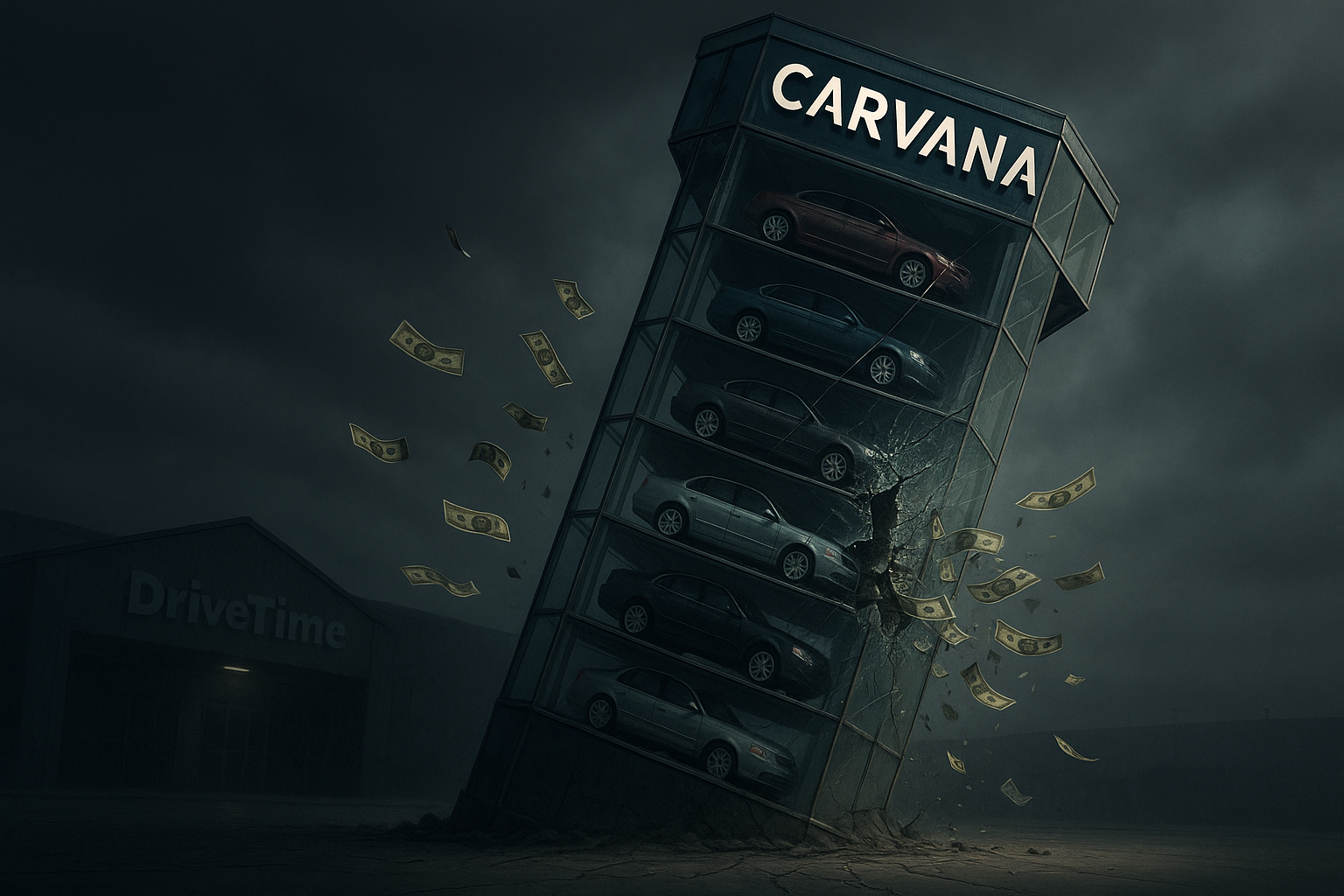
I've covered enough corporate hype cycles to recognize when Wall Street's darling might be more mirage than miracle. Carvana—you know, those gleaming car vending machines that make buying a used Camry feel like you're living in the future—has been posting numbers that don't just raise eyebrows; they practically launch them into orbit.
Let's start with the obvious problem: those margins.
A 19% gross profit margin in used car sales isn't just impressive—it's practically supernatural. Having spent time around dealership operations (more than I care to admit), I can tell you that traditional players consider a good month to be hitting 10-12% margins. Yet somehow, Carvana is nearly doubling that?
In a business where pricing transparency is ruthless and everyone's essentially selling the same commodity? C'mon.
The Garcia Family Connection That Nobody's Talking About
Here's where things get... interesting. Ernest Garcia III runs Carvana. His family also controls DriveTime, a separate used car operation that flies well below the radar of most investors. This relationship deserves way more attention than it's getting.
Last month, I took a little field trip to several DriveTime locations. What I found wasn't pretty. Aging inventory. Vehicles priced above market sitting unbought for months. The kind of operation that makes you wonder how it stays afloat.
Unless, of course, it serves another purpose entirely.
The pattern that emerges—and I'm connecting dots based on inventory flows and timing—suggests something Wall Street analysts haven't caught (or don't want to): DriveTime appears to be a convenient dumping ground for inventory Carvana can't move at those spectacular margins they keep reporting.
It's financial musical chairs, but with billion-dollar consequences.
Follow the Money (Seriously, Follow It)
Garcia has been cashing out—to the tune of $82 million in just the past couple months. Not exactly a vote of confidence from the guy who supposedly knows the business best.
But that's just the appetizer.
The real meal is in the share issuance. Carvana has dumped approximately 15.3 million shares on the market over the past year. At average prices around $330, that's about $5 billion of new stock. Yet their equity only increased by about $1 billion during that period.
So... where did the other $4 billion go? (I've asked Carvana's PR team this question three times. Still waiting for an answer that makes mathematical sense.)
Healthy companies typically return capital to shareholders. This one just keeps diluting them while insiders cash out. Not exactly the hallmark of a business with sustainable fundamentals.
The S&P 500 Safety Net (For Now)
Carvana's upcoming inclusion in the S&P 500 represents the ultimate stamp of establishment approval. It's also a temporary life raft. Index funds will need to buy regardless of fundamentals, creating artificial demand that has nothing to do with the underlying business reality.
Perfect timing for more insider selling, wouldn't you say?
Look, I'm not claiming to have smoking-gun evidence of fraud here. What I am saying is that after decades watching both the auto industry and financial markets, this doesn't pass the basic smell test. The relationship between Carvana and DriveTime looks suspiciously designed to manufacture financial results that couldn't exist in a single, transparent entity.
The car vending machine gimmick was brilliant marketing. I'll give them that. But eventually, even the prettiest package has to contain a product that actually works.
I suspect that once the S&P inclusion boost fades and the Garcia family has extracted maximum value, reality will come knocking—and it won't arrive in a gleaming glass tower with a giant coin slot.
When that happens, investors might discover they've purchased a lemon, not a luxury ride.


