
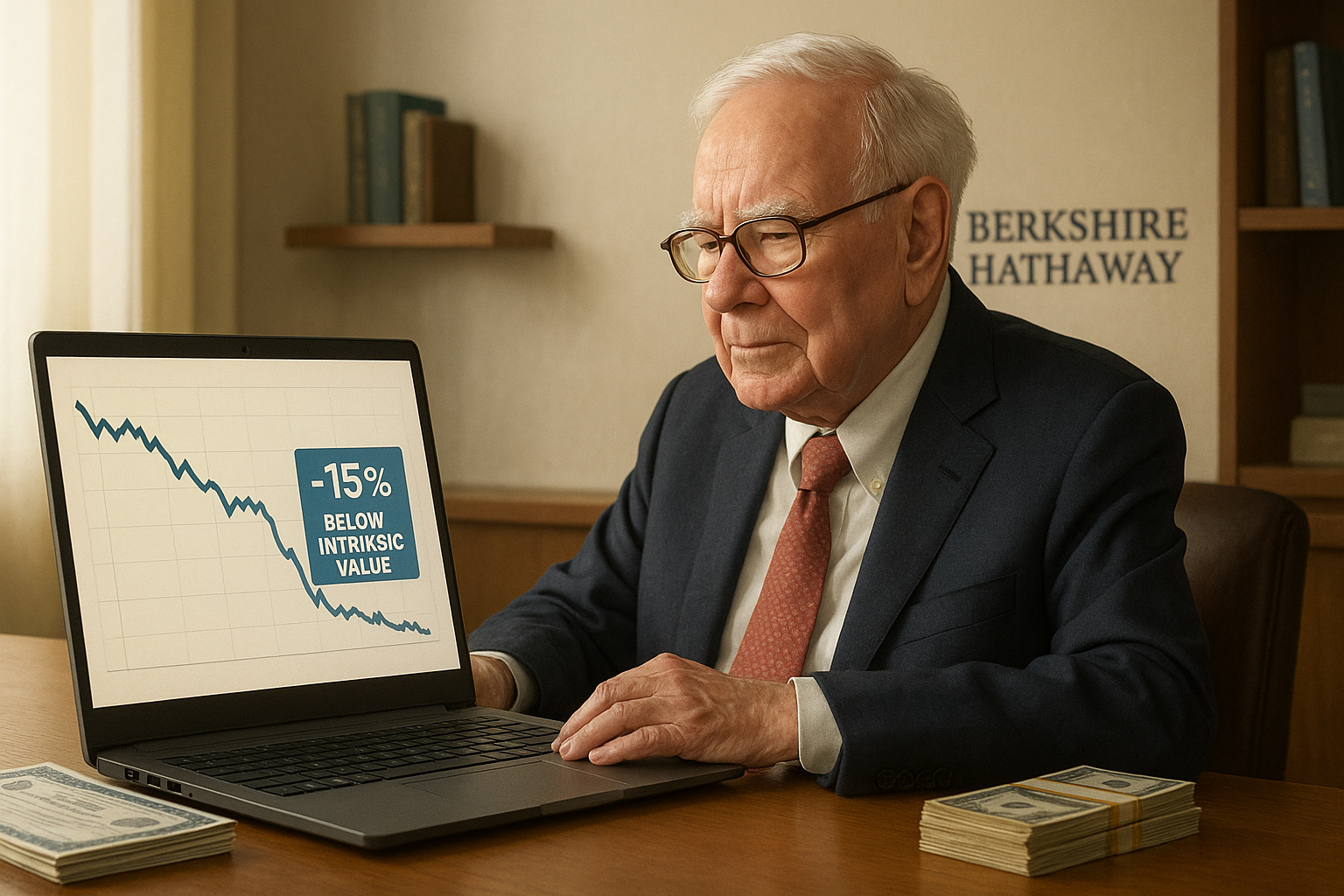
Warren Buffett is sticking to his guns on share repurchases, refusing to accelerate Berkshire Hathaway buybacks even as the company's stock underperforms the broader market. And you know what? There's something deeply reassuring about that.
I've been watching the buyback phenomenon evolve for years now. What began as a reasonable capital allocation strategy has morphed into something resembling an addiction for many public companies—a quarterly ritual where executives smash the "stock price support" button with little regard for actual value.
Buffett? He's having none of it.
The Omaha-based billionaire operates by a startlingly simple principle: Berkshire will repurchase shares only when they trade meaningfully below intrinsic value AND when the company has plenty of cash left afterward. Imagine that! Only buying something when it's cheap and when you can actually afford it. Revolutionary concepts in today's market, apparently.
According to UBS analysts, Buffett operates with something like a 15% rule of thumb—typically pulling the buyback trigger only when Berkshire trades at least that far below his assessment of its true worth. When the company resumed repurchases back in 2018, shares were about 13% undervalued by UBS calculations. As the discount widened to roughly 20%, buybacks accelerated accordingly.
This stands in stark contrast to the broader market. S&P 500 companies have collectively blown through trillions on buybacks since 2010, often regardless of valuation, and frequently using borrowed money to finance purchases at record market highs. It's the corporate equivalent of buying yourself a five-star meal on credit when there's nothing in the fridge at home.
Look, there's a deeper philosophy at work in Buffett's approach—one that's increasingly rare in corporate America. It reveals three principles worth unpacking:
First, patient capital allocation. Buffett views cash as option value—the freedom to pounce when genuine opportunities present themselves. Most corporate treasurers now see cash as dead weight, an inefficiency to be eliminated at all costs.
Second, genuine shareholder alignment. By only repurchasing when shares are undervalued, Buffett ensures buybacks actually benefit continuing shareholders. Compare this to executives who use buybacks to offset dilution from their own equity compensation or hit EPS targets tied to their bonuses. (Not that I'm suggesting anything nefarious, of course.)
Third, counter-cyclical thinking. Buffett naturally buys more when prices fall and less when they rise. Most corporate buyback programs follow the opposite pattern—accelerating at market peaks and vanishing in downturns when shares are actually cheap.
The funny thing is, if more companies adopted Buffett's approach to buybacks, they'd likely create more long-term shareholder value. But it requires something most executives simply don't have: the patience and fortitude to potentially underperform in the short term.
I mean, just think about the alternative scenario for a second. If Berkshire deployed its massive cash pile into aggressive buybacks regardless of price, sure, the stock might jump temporarily. Analysts would cheer the "return of capital." Financial TV would run glowing segments. And then... what? The company would have fewer resources for acquisitions and less resilience when markets inevitably turn south.
Some critics argue buybacks should be "illegal again, like they were until 1982." This misses important nuance, though. The problem isn't buybacks themselves—when executed at appropriate valuations, they're simply a tax-efficient alternative to dividends. The problem is buybacks without discipline, often debt-financed, executed at any price, driven by perverse incentives.
What Buffett represents is a sensible middle path: Use buybacks, but only when the math makes sense. It's a principle so blindingly obvious it shouldn't need stating, yet here we are.
Perhaps what we really need isn't prohibition but better alignment. Imagine if executives' compensation for buyback decisions was determined retroactively based on the five-year performance following those repurchases. You'd see a lot more Buffett-style discipline and a lot fewer buybacks at market peaks, I guarantee it.
While Berkshire may continue lagging in today's frothy market environment, Buffett's cash stockpile represents something increasingly precious: optionality in a world of stretched valuations. When the inevitable correction comes—and it always does, doesn't it?—the Oracle will likely have the last laugh, deploying capital when others are forced to retrench.
In finance, as in life, sometimes the most valuable skill is simply the ability to do nothing. Warren Buffett, at 94, continues to master the art of patience. The rest of corporate America could use a refresher course. Badly.


