
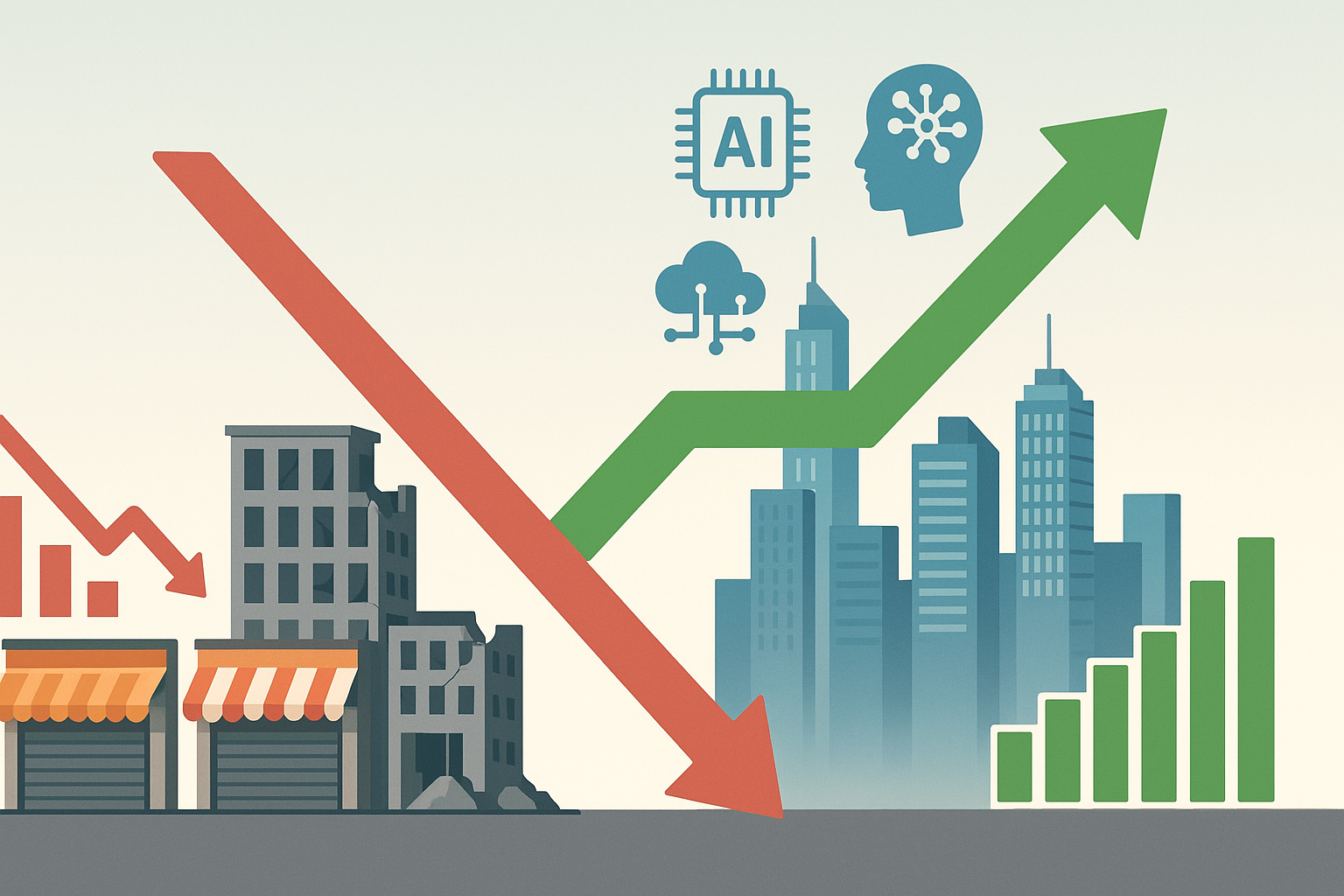
The economic divide that's been quietly widening since the pandemic isn't just sticking around—it's about to become the main character in our financial story. And if market analysts are right, 2026 might be the year this "K-shaped" economy finally forces investors to pick a side.
I've been watching economic cycles for nearly two decades, and something feels different this time. The post-pandemic recovery never really brought everyone along for the ride, did it? Instead, it created two Americas: one soaring toward new heights and another sinking deeper into economic quicksand.
This isn't just economist hand-wringing. It's showing up in real portfolios.
"What we're witnessing isn't a temporary blip—it's a fundamental restructuring of economic power," explained Mira Patel, chief strategist at Hemisphere Capital, when I spoke with her last week. "By 2026, the idea of 'the market' as a single entity might seem quaint."
The driving forces behind this bifurcation have been building for years. Technology—particularly AI and automation—isn't just changing how we work; it's redrawing the entire economic map. Companies that successfully harness these tools are leaving their competitors in the dust. And not just by a little bit. We're talking Grand Canyon-sized gaps in productivity and profitability.
Meanwhile (and this is where things get uncomfortable), the wealth concentration keeps intensifying. The top 20% of American households now control more than 80% of stock market wealth. Think about that. When the market climbs, these folks get richer, reinvest those gains, and... well, you see the pattern.
Look, I'm not trying to sound alarmist here. But when half your economic indicators are flashing green while the others are deep red, traditional market analysis starts looking about as useful as a chocolate teapot.
Take sectors as a simple example. Tech, healthcare, and clean energy? Thriving. Traditional retail, commercial real estate, and many service industries? Fighting for survival. By 2026, don't be surprised if they're barely recognizable as parts of the same economy.
This creates a peculiar challenge for investors—particularly those who've grown comfortable with the "set it and forget it" approach to index funds. When the underlying economic reality splits in two, passive strategies that bet on "the market" as a whole might leave you exposed in ways you never anticipated.
(I still remember how shocked some index fund investors were during the dot-com crash when they discovered just how tech-heavy their supposedly diversified portfolios had become.)
The volatility we're likely to see isn't just about price swings—though expect plenty of those. It's about competing narratives fighting for dominance. When half the analysts see booming growth while the others spot recession signals, price discovery becomes... let's call it "spirited."
The regulatory response adds another wild card. Policymakers aren't blind to widening inequality. Will we see wealth taxes? Antitrust breakups? Higher capital gains rates? Any of these could send shockwaves through certain market segments while barely touching others.
That said... market turbulence creates opportunities for the prepared.
"The investors who thrive in 2026 won't be the ones with the best predictions," noted Raj Krishnan, a portfolio manager I've known for years. "They'll be the ones with the most adaptable frameworks."
For ordinary investors, this might mean rethinking some long-held assumptions. The diversification that protected you in previous decades may need a serious upgrade. Spreading investments across companies facing the same structural challenges isn't diversification—it's doubling down on risk.
Instead, smart money will likely focus on identifying which side of the K different assets occupy, with hedging strategies that acknowledge the growing divergence between winners and losers.
I guess what I'm really saying is this: The market of 2026 won't reward autopilot investing. It'll demand thoughtfulness about structural forces reshaping our economy—and the courage to position accordingly.
Will it be bumpy? Count on it. Profitable? For some. Educational? Absolutely.
As Warren Buffett might remind us, it's only when the tide goes out that we discover who's been swimming naked. By 2026, prepare to see a very revealing shoreline indeed.


