
The markets have been screaming "AI!" for the past two years with all the subtlety of a toddler discovering chocolate for the first time. It's been... relentless.
But as we transition from the frenzy of 2025 to what promises to be a more clear-eyed 2026, I'm wondering if we've all been looking in the wrong direction. Having spent the last three months in conversation with infrastructure players, energy execs, and yes—even some utility companies (not exactly the life of the party, those folks)—I'm seeing a pattern emerge that most investors seem to be missing.
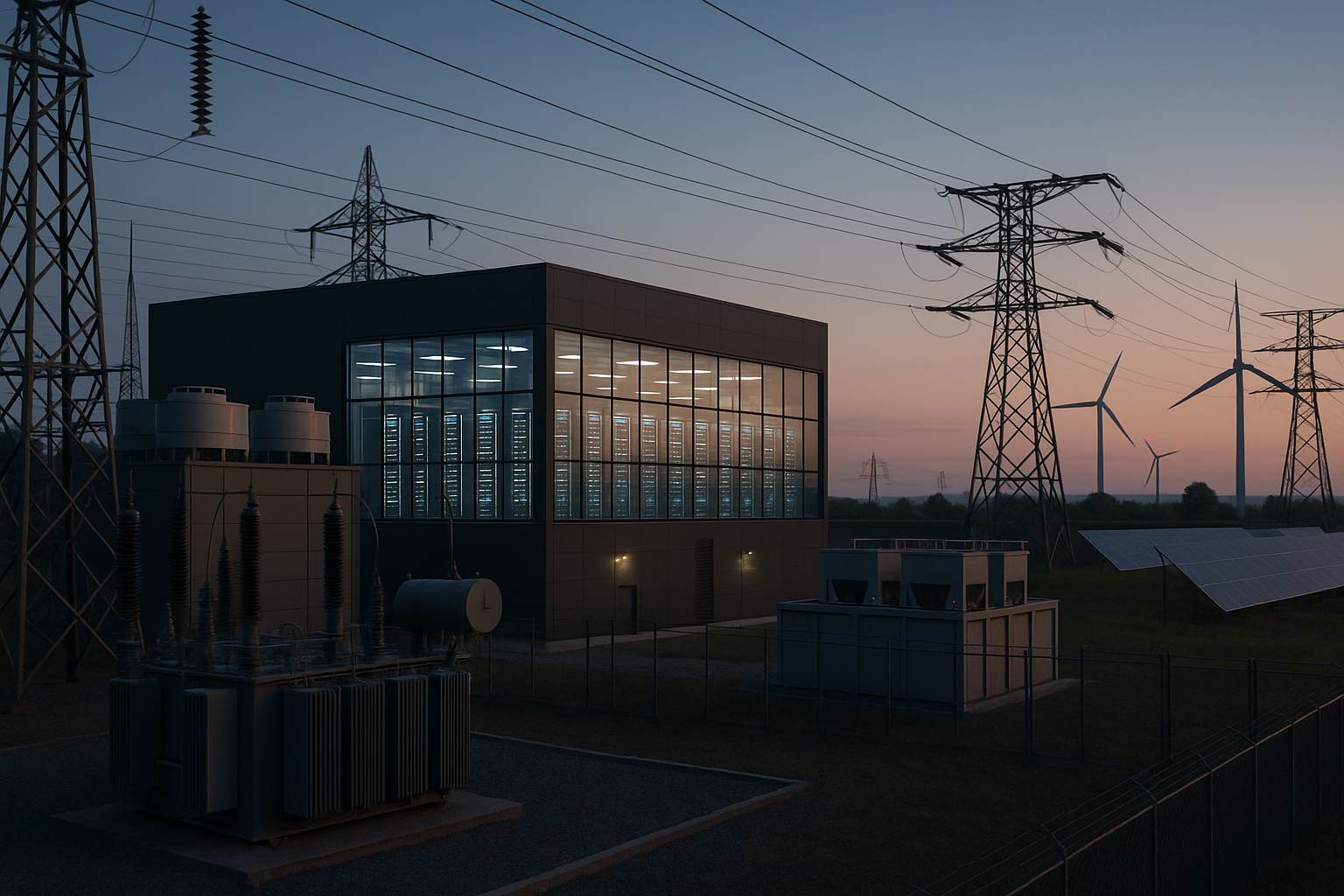
While everyone's been obsessed with which chatbot can write the cleverest haiku, the unsexy fundamentals of actually powering our AI revolution have been sitting there, largely ignored. Like the plumbing in your house, nobody thinks about it until something breaks.
The Power Problem Nobody Wants to Talk About
Here's the thing about artificial intelligence that gets lost in all the hype: it runs on electricity. Lots of it. Not hopes and dreams.
The computing requirements for these systems are growing at a pace that makes Moore's Law look positively sluggish. A single large language model training run now consumes enough juice to power a small town for a month. That's not hyperbole—that's physics.
And this is precisely why I've got my eye on companies like GE Vernova ($GEV) and Vertiv ($VRT). No, they're not making the flashy chips or the consumer apps everyone's talking about at cocktail parties. What they're doing is far more crucial—solving the actual bottleneck: power generation, distribution, and cooling infrastructure.
I visited Vertiv's newest facility last month. The scale is staggering. These aren't your daddy's server racks.
GE Vernova, the energy spin-off that finally escaped its parent company's shadow, has been quietly positioning itself exactly where data centers desperately need solutions. They're at that critical intersection between traditional power and renewables, and let me tell you—AI data centers will need both.
Google: The Giant That Everyone Forgot
The market, in its infinite wisdom (and I use that term loosely), has a fascinating habit of overcorrecting. Microsoft became the AI darling through its OpenAI partnership, while Google—who, may I remind you, LITERALLY INVENTED much of the technology underpinning modern AI—has been treated like a technological has-been.
It's absurd when you think about it.
This creates what might be the most compelling value proposition in big tech right now. Google's TPU architecture offers significant performance-per-watt advantages for certain AI workloads compared to NVIDIA's more general-purpose GPUs. As those energy constraints I mentioned earlier become more binding (and trust me, they will), this efficiency differential becomes increasingly valuable.
Meanwhile, have you been paying attention to Waymo? While everyone's been debating whether ChatGPT should be allowed to write high school essays, Google has been quietly building an actual robot taxi service. That works. In the real world. With real people.
Look, I'm not saying Google doesn't have challenges. They do. But the financial markets have essentially priced them as if search is on its deathbed and their AI efforts are irrelevant. This seems... optimistic about the competition, to put it mildly.
Defense Tech: The Uncomfortable Reality
There's something grimly predictable about how technological revolutions eventually express themselves in military applications. The AI revolution won't be different. In fact, it's already happening.
Palantir ($PLTR) has positioned itself as the operating system for modern governance and warfare—a claim that would sound like something from a dystopian sci-fi novel if it weren't increasingly accurate. Their software now coordinates everything from supply chains to battlefield intelligence for Western governments.
I spoke with several defense contractors (off the record, naturally) who confirmed what I'd suspected: as conflicts become more information-dense, Palantir's systems become more essential, not less.
Then there's Lockheed Martin ($LMT). Not exactly a startup, but they represent the physical backbone upon which this new intelligence layer operates. The company has been methodically—some might say too quietly—integrating AI capabilities into existing platforms while developing new ones designed from scratch for this environment.
The Unsexy Underbelly of Innovation
The most interesting investments rarely announce themselves with flashy headlines, do they?
Everyone crowding into the same AI application stocks has driven valuations to levels that require absolutely everything to go perfectly. And how often does that happen in tech? (Hint: approximately never.)
Meanwhile, the companies providing the essential infrastructure, power, and physical capabilities these AI systems require offer both greater certainty and—here's the kicker—often more reasonable valuations.
I'm not saying abandon tech entirely—that would be foolish when we're clearly in the middle of a technological revolution. But the real question for 2026 isn't "which AI company will win?" but rather "what invisible constraints will determine who can execute on AI's promise?"
The answer, as is often the case in these technological inflection points, lies in the unsexy fundamentals: energy, cooling, physical infrastructure, and the systems that connect digital intelligence to the real world.
The shovels, in other words, not the gold.
And after two decades covering tech investments, I've learned one thing: when everyone's looking right, the real opportunity is usually somewhere to the left.


