
The stock market's been on an absolute tear lately—one that would make even the most hardened day traders raise an eyebrow. Yesterday the S&P 500 notched yet another all-time high, tech stocks continue their seemingly unstoppable ascent, and Bitcoin... well, Bitcoin's doing that thing again where it treats gravity as optional.
Have you seen Nvidia lately? Good lord. The company that essentially makes fancy math rocks (OK, GPUs) is now valued higher than the GDP of several mid-sized nations combined.
So let's talk about exuberance, shall we?
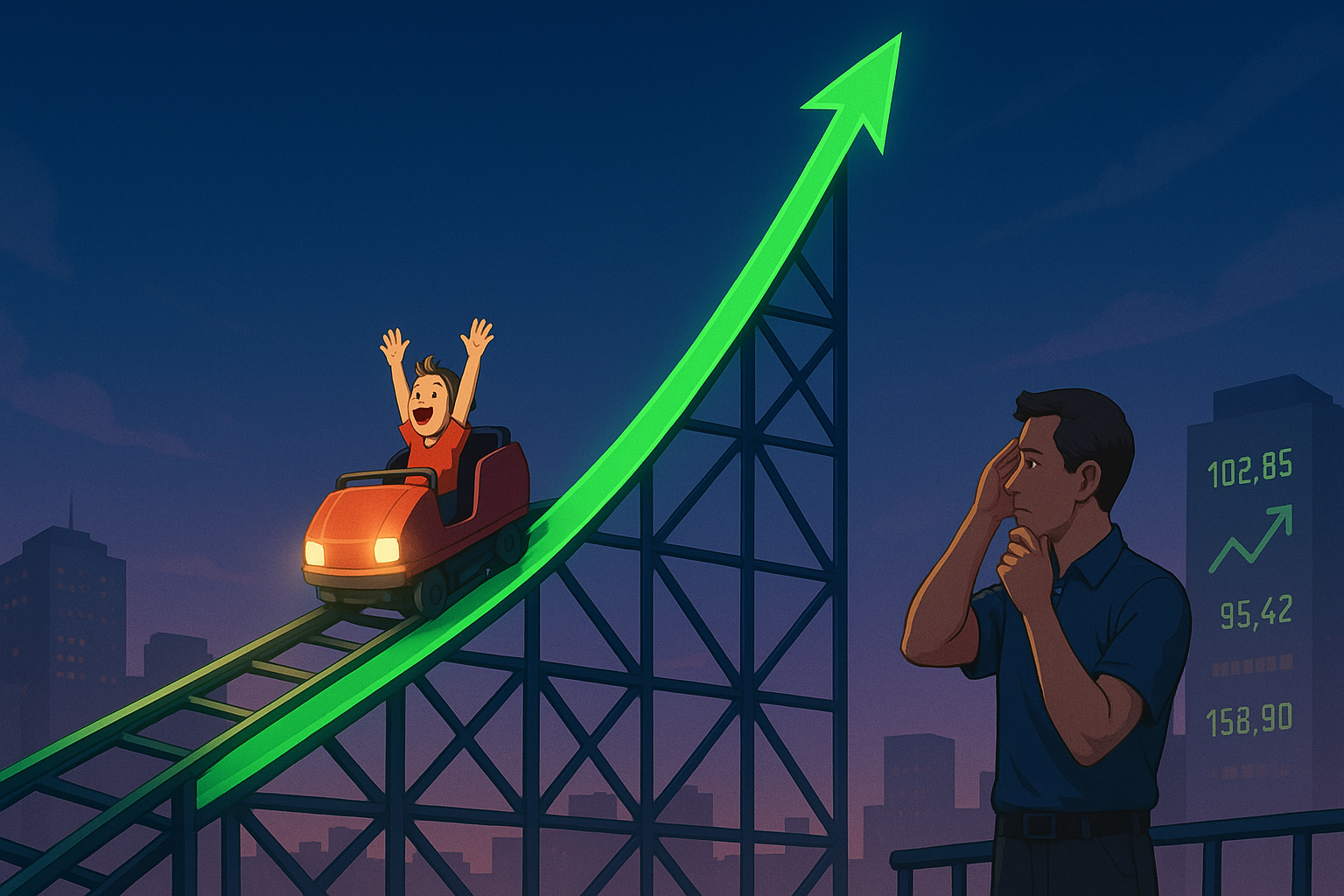
There's this mental model I've been considering during frothy markets like these. I call it the "Dad at the Roller Coaster" theory. Picture it: a father watching his kid ride their first serious coaster. Dad can see the big drop coming long before Junior does. The kid's enjoying the steady climb, completely oblivious to the stomach-churning plunge that's just around the bend.
Right now, the market is Junior—and many veteran investors are playing the role of Dad, watching with growing unease as we climb higher... and higher... and higher.
Irrational exuberance isn't just some quaint phrase Alan Greenspan tossed out to jazz up an otherwise dull dinner speech back in the '90s. It describes that peculiar market condition where asset prices completely detach from underlying value. The collective delusion becomes the fundamental driver. People buy things simply because others are buying things. Financial circular logic at its most dangerous.
I've been covering market cycles for years, and the warning signs are flashing like a Christmas tree in December: IPOs jumping 100% on their first trading day, companies adding "AI" to their name and watching their stock magically leap 40%, retail investors treating options like scratch-off lottery tickets, margin debt reaching for the stratosphere.
It all feels eerily familiar to anyone who lived through 1999 or 2007.
But here's the rub—calling market tops is a fool's errand. As Keynes (or maybe it wasn't him, attribution is tricky) famously observed, "The market can remain irrational longer than you can remain solvent." I've personally known brilliant investors who shorted too early and ended up dining on ramen in studio apartments while bulls bought vacation homes.
What makes today's exuberance particularly interesting (and confusing) is that it's not completely divorced from reality. AI does appear genuinely transformative. Interest rates, while higher than the zero-bound world we got accustomed to, aren't historically outrageous. Corporate earnings haven't collapsed.
The problem? Markets don't just price the present—they price expectations. And right now, expectations look like unicorns prancing through fields of money while dispensing perfect quarterly results. Everything's priced for perfection, which would be fine if humans had any track record of executing things flawlessly at scale.
(Narrator: They don't.)
Last week, I spoke with a hedge fund manager who told me his 17-year-old nephew had asked for advice on leveraged ETFs for his birthday money. When teenagers are dabbling in derivatives to juice returns, maybe—just maybe—we're approaching some kind of peak? This isn't scientific analysis, mind you. It's more like those nature documentaries where animals sense the earthquake before the seismographs do.
Look, these warning signs don't necessarily signal an imminent crash. They might just indicate we're entering a period of muted returns—where markets digest gains through time rather than price. Sideways markets can be just as psychologically painful for a generation raised on rocket ships as actual crashes.
So are we at peak exuberance? Hell if I know. Nobody does with certainty. But asking the question is probably healthier than ignoring it entirely. The time to think about risk isn't during the panic—it's when nobody else seems worried about it.
Keep an eye on your risk exposure. Enjoy the ride up, by all means. Just maybe don't bet the farm on the assumption that trees grow to the sky.
Because at some point, Junior's going to hit that big drop, and Dad's knowing look will suddenly make perfect sense.


