
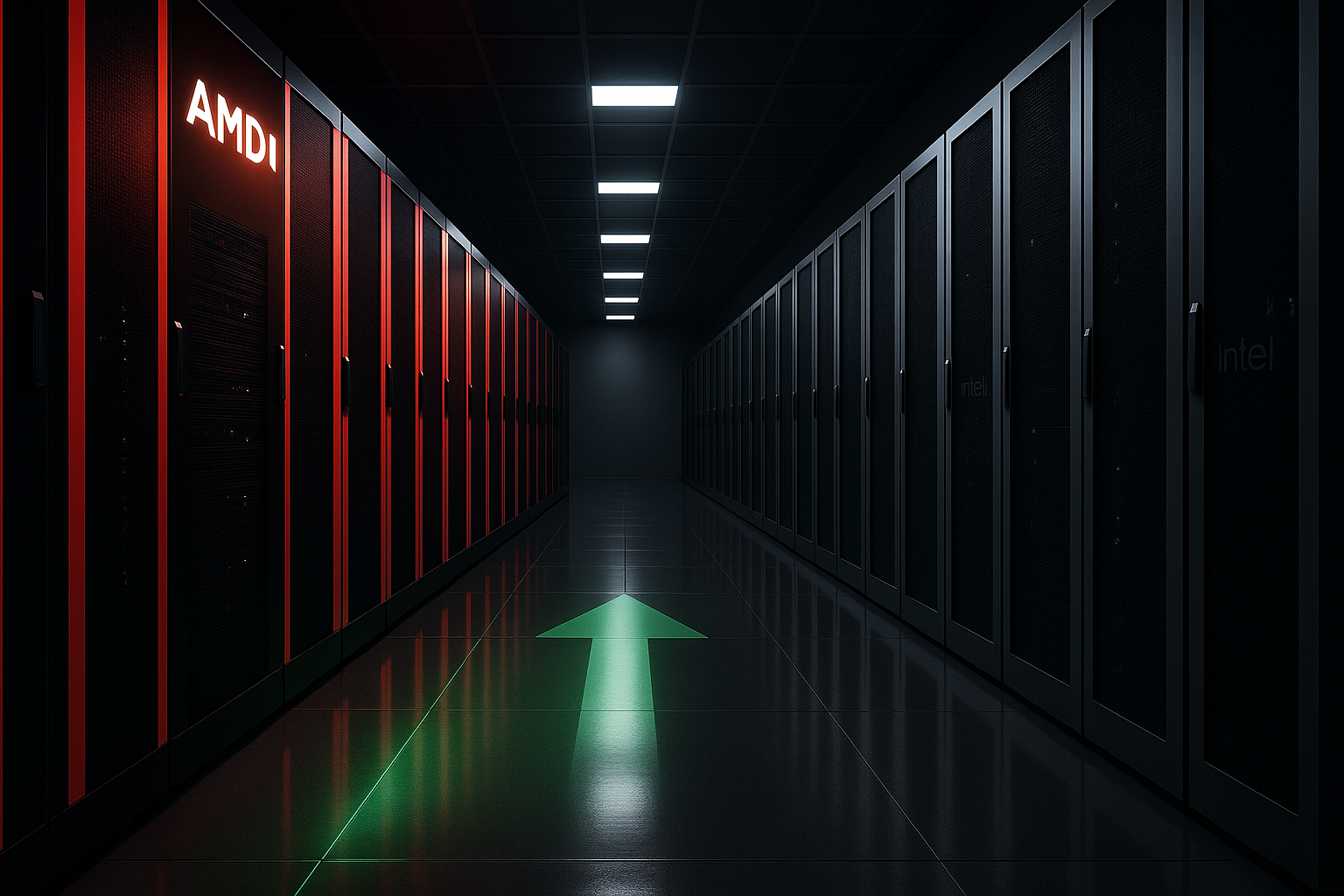
AMD just delivered a quarter that has Wall Street's attention—and likely has Intel executives breaking into cold sweats. The longtime semiconductor underdog didn't just beat expectations; it demolished them with a performance that speaks volumes about the shifting power dynamics in the chip industry.
Let's get the numbers out of the way first. AMD posted earnings of $1.20 per share on revenue of $9.25 billion, handily beating analyst expectations of $1.17 EPS and $8.74 billion in revenue. Not bad for a company many had written off as perpetually playing second fiddle just a decade ago.
But the real story? The data center business. Good lord.
AMD's data center segment raked in $4.3 billion against expectations of $4.1 billion—a 22.8% jump year-over-year. This isn't just growth; it's a declaration of war against Intel's most profitable stronghold. And AMD is winning.
I've been covering the semiconductor space since the days when AMD was primarily known for budget gaming chips, and what CEO Lisa Su has accomplished here borders on the miraculous. The transformation from value-oriented alternative to legitimate enterprise powerhouse happened so gradually and then all at once.
The thing about data center business—and trust me, I've spoken with countless IT directors about this—is that it's incredibly sticky. Once a company commits to a chip architecture, switching costs become astronomical. That's what makes AMD's encroachment so devastating for Intel. Every server rack that switches to EPYC processors represents years of future revenue Intel can kiss goodbye.
Client segment? Also crushed it. AMD pulled in $2.9 billion against expectations of $2.6 billion. Even the gaming division (which, let's face it, many analysts had mentally relegated to legacy status) surprised with $1.3 billion versus the anticipated $1.1 billion.
But here's where things get really interesting—the forward guidance. AMD expects Q4 revenue between $9.3 billion and $9.9 billion, blowing past Street expectations of $9.21 billion. That's not a company managing expectations. That's a company flexing.
(As an aside, I had to chuckle at how carefully AMD noted that guidance excludes MI308 shipments to China. Smart hedge given the regulatory minefield that is US-China tech relations these days.)
Look, there's been this persistent narrative that semiconductor success is zero-sum. If Nvidia's winning in AI, AMD must be losing. If AMD gains market share, Intel must be circling the drain. The reality is far more nuanced. The total addressable market for compute is expanding so rapidly that there's room for multiple winners—assuming they can execute.
And boy, is AMD executing.
What impresses me most about AMD's transformation isn't just the financial results, though a 229% year-over-year increase in net income speaks for itself. It's the completeness of the vision. This was once a company known primarily for being the cheaper alternative to Intel and Nvidia. Today? It's a comprehensive computing powerhouse with legitimate leadership positions across multiple segments.
The reported gross margin of 40% for the quarter might raise some eyebrows compared to Q2's 49%, but it reflects a company making strategic investments rather than maximizing short-term profits. The fact that they're projecting a non-GAAP gross margin of approximately 54% for Q3 FY2025 tells me these investments are already bearing fruit.
While Nvidia hogs the AI spotlight with its GPU dominance, AMD has been quietly building a more diversified portfolio. They're competitive in AI acceleration with their Instinct products, but they're not betting the entire company on a single technological trend. That's prudent leadership.
For investors who've been riding the AMD train since Su took the wheel in 2014, it's been one hell of a journey. The stock has appreciated... what, something like 5,000% since then? For those still watching from the sidelines, this quarter offers yet another reminder of what could have been in their portfolios.
The burning question isn't whether AMD can compete with the semiconductor giants anymore—that's been answered with an emphatic yes. The real question is how much daylight AMD can put between itself and Intel before the latter figures out how to right its listing ship.
Based on this quarter's results, that gap is only getting wider.


